The Mid-Point Theorem (Grade 10 NSC Matric Mathematics): Revision Notes
📚Revision Notes
The Mid-Point Theorem
What is the mid-point theorem?
The mid-point theorem is one of the most important theorems in Euclidean geometry. It describes a special relationship that exists when you connect the mid-points of two sides of any triangle.
Important
Definition: The mid-point theorem states that the line joining the mid-points of two sides of a triangle is parallel to the third side and equal to half the length of the third side.
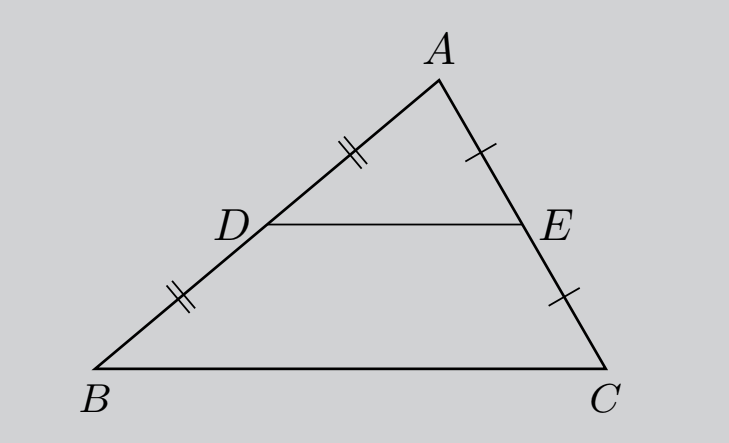
In mathematical terms, if D and E are the mid-points of sides AB and AC respectively in triangle ABC, then:
- (DE is parallel to BC)
Understanding the theorem statement
The mid-point theorem has two important parts that you must remember:
Note
The theorem consists of two critical relationships:
- Parallel relationship: The line segment connecting the two mid-points runs parallel to the third side of the triangle
- Length relationship: This connecting line is exactly half the length of the third side
This theorem works for any triangle, regardless of whether it is scalene, isosceles, or equilateral. The beauty of this theorem lies in its universal applicability - it establishes a consistent geometric relationship that holds true across all triangular shapes.
Proof of the mid-point theorem
Let's work through the complete proof step by step. This proof uses the properties of congruent triangles and parallelograms to establish both the parallel and length relationships.
Example
Worked Example: Proving the Mid-Point Theorem
Given: Triangle ABC where D is the mid-point of AB and E is the mid-point of AC
To prove: and
Step 1: Construct the proof setup
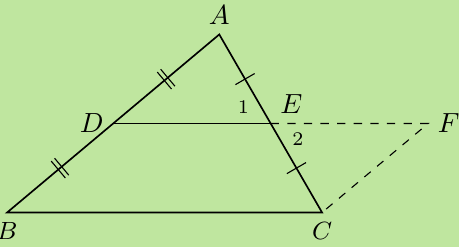
Extend line DE to point F so that . Then join points F and C to form line FC.
This construction creates a useful configuration that allows us to use the properties of congruent triangles.
Step 2: Prove that BCFD is a parallelogram
We need to show that triangles ADE and CFE are congruent:
In triangles ADE and CFE:
- (vertically opposite angles)
- (given - E is the mid-point of AC)
- (by construction)
Therefore, (by SAS - Side-Angle-Side)
Since the triangles are congruent, their corresponding sides are equal:
- (corresponding angles)
This means (because alternate interior angles are equal).
Since (D is the mid-point of AB), we have:
Therefore, BCFD is a parallelogram (one pair of opposite sides are equal and parallel).
Step 3: Use parallelogram properties
Since BCFD is a parallelogram, opposite sides are equal:
- But (by construction, since )
Therefore: , which means DE = ½BC
We have now proved both parts of the theorem:
- DE ∥ BC (from the parallelogram properties)
- DE = ½BC (from the equal opposite sides)
The converse of the mid-point theorem
The mathematical relationship works in both directions. Understanding the converse gives us additional tools for solving geometric problems.
Note
Converse of the Mid-Point Theorem:
If a line is drawn through the mid-point of one side of a triangle parallel to a second side, then it will bisect the third side.
This means that if you know a line passes through a mid-point and is parallel to another side, you can conclude that it must pass through the mid-point of the third side as well. This converse relationship is particularly useful in coordinate geometry and construction problems.
Key properties and applications
Understanding the mid-point theorem helps you solve many geometry problems across different contexts:
Finding unknown lengths: If you know the length of one side of a triangle, you can find the length of the mid-point line (half the side length)
Proving parallel lines: If you can show that two points are mid-points of triangle sides, then you know the connecting line is parallel to the third side
Working with similar triangles: The mid-point theorem creates smaller triangles that are similar to the original triangle with a ratio of 1:2
Solving coordinate geometry problems: The theorem is very useful when working with triangles on a coordinate plane
Note
Practical Applications:
The mid-point theorem appears frequently in:
- Construction and engineering for creating parallel supports
- Computer graphics for triangle subdivision
- Navigation systems for creating intermediate waypoints
- Architectural design for proportional spacing
Exam tips
When working with mid-point theorem problems, following a systematic approach will help you avoid common mistakes:
Note
Strategic Problem-Solving Approach:
- Always clearly identify which points are mid-points
- State both properties: parallel AND half the length
- In proofs, remember to use the converse when appropriate
- Look for parallelogram formations in your constructions
- Mark equal lengths and parallel lines clearly on your diagrams
- Double-check that your final answer addresses both parts of the theorem
Summary
Key Points to Remember:
- The mid-point theorem has two parts: the line joining mid-points is both parallel to the third side AND half its length
- The theorem works for any triangle: scalene, isosceles, or equilateral
- The converse is also true: a line through a mid-point parallel to another side will bisect the third side
- Key formula: If DE joins mid-points, then where BC is the third side
- Always mark your diagrams clearly to show which points are mid-points and which lines are parallel
- Use both the theorem and its converse to solve different types of problems effectively