Two-Dimensional Problems (Grade 10 NSC Matric Mathematics): Revision Notes
📚Revision Notes
Two-Dimensional Problems
Trigonometry helps us solve practical real-world problems involving heights, distances, and angles. We can use trigonometric ratios to solve problems in two dimensions that involve right-angled triangles, particularly when dealing with angles of elevation and angles of depression.
Understanding trigonometric ratios
Before tackling two-dimensional problems, let's recall the three fundamental trigonometric ratios for right-angled triangles:
Note
These ratios, combined with Pythagoras' theorem, form the foundation for solving two-dimensional problems. Remember the mnemonic SOH CAH TOA to help you recall which ratio to use!
Key concepts: angles of elevation and depression
In two-dimensional problems, we frequently work with two special types of angles that describe how we observe objects from different positions.
Angle of elevation
Important
Definition: The angle of elevation is the angle formed by the line of sight and the horizontal plane for an object above the horizontal plane.
When you look up at something (like the top of a building), the angle between your horizontal line of sight and the actual line to the object is the angle of elevation.
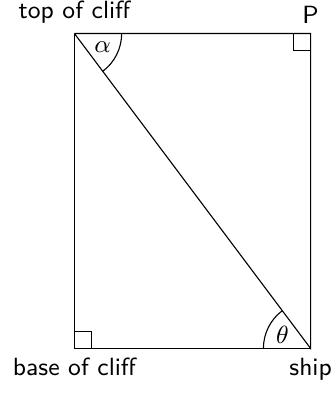
In this scenario, θ represents the angle of elevation from the ship looking up to the top of the cliff. The line of sight goes from the ship to the top of the cliff, and the horizontal plane runs from the ship to the base of the cliff.
Angle of depression
Important
Definition: The angle of depression is the angle formed by the line of sight and the horizontal plane for an object below the horizontal plane.
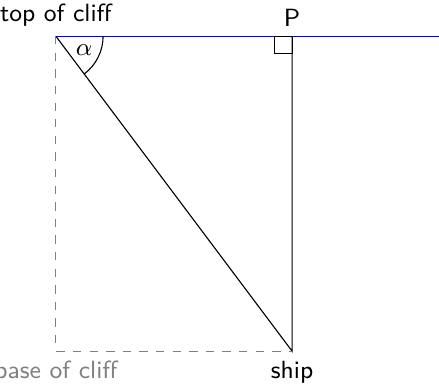
When you look down at something (like looking down from a cliff to a ship below), the angle between your horizontal line of sight and the actual line to the object is the angle of depression.
Here, α represents the angle of depression from the top of the cliff looking down to the ship. The horizontal plane runs through point P, and the line of sight goes down to the ship.
Important relationship
Note
Key Insight: The angle of elevation from one point equals the angle of depression from the other point when dealing with the same line of sight. In other words, α = θ in the diagrams above.
This relationship is crucial for solving many two-dimensional problems efficiently!
Measuring tools in practice
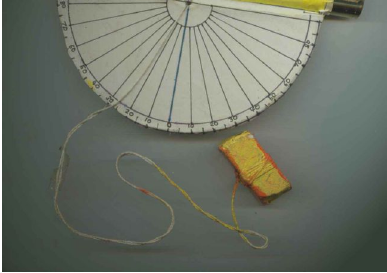
An inclinometer is a practical tool used to measure angles of inclination (which is the same as the angle of elevation in trigonometry). This tool helps surveyors, architects, and engineers determine heights of buildings or trees without having to measure them directly.
Worked examples
Example
Worked Example 1: Flying a kite
Problem: Mandla flies a kite on a 17 m string at an inclination of 63°. Find the height of the kite above the ground and the horizontal distance between Mandla and his friend Sipho who stands directly below the kite.
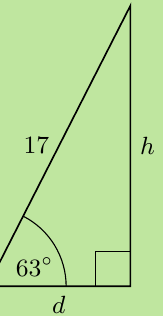
Solution: Step 1: Identify the triangle components
- Hypotenuse = 17 m (string length)
- Angle = 63°
- Height = h (opposite side)
- Distance = d (adjacent side)
Step 2: Calculate the height using sine ratio
Step 3: Calculate the distance using cosine ratio
Answer: The kite is 15.15 m above the ground, and Mandla and Sipho are 7.72 m apart.
Example
Worked Example 2: Calculating angles in a quadrilateral
Problem: ABCD is a trapezium with AB = 4 cm, CD = 6 cm, BC = 5 cm and AD = 5 cm. Point E on diagonal AC divides the diagonal such that AE = 3 cm and angle BEC = 90°. Find angle ABC.
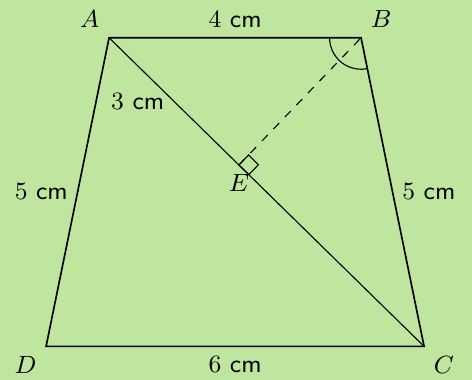
Solution: Step 1: Find angle ABE using triangle ABE
In triangle ABE:
Step 2: Use Pythagoras' theorem to find BE
In triangle ABE:
Step 3: Find angle CBE using triangle CBE
In triangle CBE:
Step 4: Calculate the total angle
Answer: Angle ABC = 106.7°
Example
Worked Example 3: Finding building height
Problem: From a point 100 m away from a building, the angle of elevation to the top is 38.7°. Calculate the height of the building.
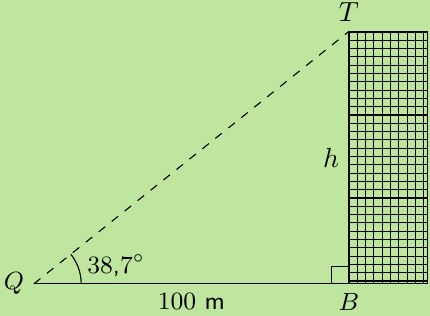
Solution: Step 1: Identify the components
- Adjacent side = 100 m
- Angle = 38.7°
- Opposite side = h (height)
Step 2: Use the tangent ratio
Step 3: Solve for h
Answer: The building is 80 m tall.
Example
Worked Example 4: Angles of elevation and depression
Problem: A cellphone tower is 200 m away from a block of flats. From point B, the angle of elevation to the top of the tower (E) is 34°, and the angle of depression to the bottom of the tower (C) is 62°. What is the height of the tower?
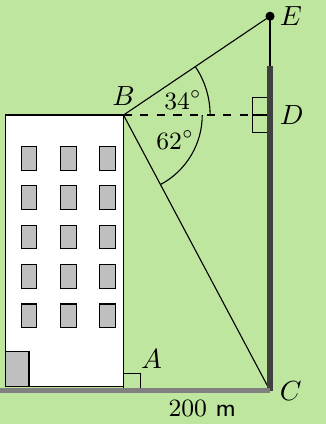
Solution:
Step 1: Calculate the height above point B (DE)
Using triangle BDE:
Step 2: Calculate the height below point B (CD)\
Using triangle BCD:
Step 3: Add both heights
Total height = DE + CD = 135 + 376 = 511 m
Answer: The cellphone tower is 511 m tall.
Example
Worked Example 5: Construction problem
Problem: Mr Nkosi has a 4 m high garage and wants to add a corrugated iron roof. The roof sheet is 5 m long with a 5° angle. How high must he build the wall?
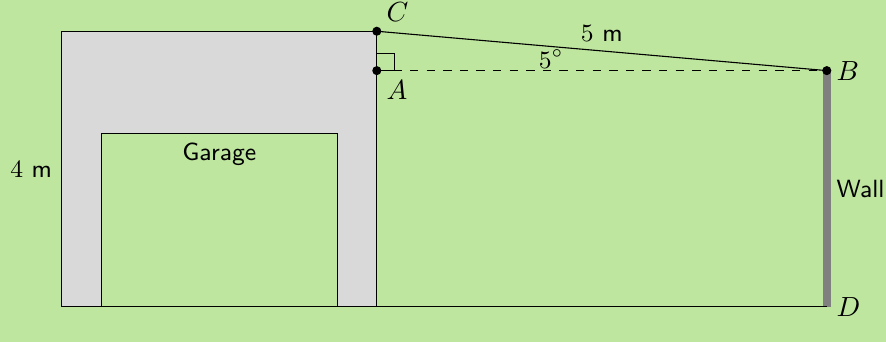
Solution: Step 1: Identify the triangle Triangle ABC is right-angled with:
- Hypotenuse BC = 5 m
- Angle = 5°
- Height AC = ? (what we need)
Step 2: Use sine ratio
Step 3: Calculate wall height
- Wall height BD = Garage height - AC = 4 - 0.4 = 3.6 m
Answer: Mr Nkosi must build his wall 3.6 m high.
Problem-solving strategy
When tackling two-dimensional trigonometry problems, follow this systematic approach:
Note
Step-by-Step Problem-Solving Method:
- Draw a clear diagram showing all given information
- Identify the right-angled triangle(s) you need to work with
- Label the sides as opposite, adjacent, and hypotenuse relative to the given angle
- Choose the appropriate trigonometric ratio (SOH CAH TOA)
- Substitute values and solve for the unknown
- Check your answer makes sense in the context
This methodical approach will help you tackle even complex problems with confidence!
Exam tips
Important
Essential Exam Strategies:
- Always draw a diagram - it helps you visualise the problem
- Remember that angle of elevation and angle of depression are equal for the same line of sight
- Be careful with units - ensure all measurements are in the same units
- Round answers appropriately (usually to 1 decimal place for practical problems)
- Use Pythagoras' theorem when you need the third side of a right triangle
Summary
Key Points to Remember:
- Angle of elevation is measured upward from the horizontal plane to an object above
- Angle of depression is measured downward from the horizontal plane to an object below
- The line of sight connects the observer directly to the object being viewed
- Use SOH CAH TOA to remember which trigonometric ratio to apply: Sin = Opposite/Hypotenuse, Cos = Adjacent/Hypotenuse, Tan = Opposite/Adjacent
- Two-dimensional problems often involve finding heights of buildings, distances between objects, or angles in real-world scenarios using right-angled triangles