Creation and Distribution of Wealth (Grade 11 NSC Matric Economics): Revision Notes
📚Revision Notes
Creation and Distribution of Wealth
What is wealth creation?
Understanding wealth
In economics, wealth refers to having an abundance of valuable material possessions or resources. Simply put, it means having riches or valuable things that can benefit you financially.
Wealth has three important characteristics that make it valuable:
- It can generate income - your wealth can earn money for you over time
- Its value can change - wealth can increase or decrease in value depending on market conditions
- Investments count as wealth - because they produce income through interest payments
Note
These three characteristics distinguish wealth from simple possessions. A car might be valuable, but if it's only depreciating and not generating income, it's not contributing to wealth creation in the economic sense.
How wealth is created
The most important way people create wealth is through savings. When you earn income but don't spend all of it, the money you save becomes part of your wealth. This relationship can be shown in a simple formula:
Where:
- Y = Income
- C = Consumption spending
- S = Savings
This means that from whatever money you earn, you either spend it on things you need (consumption) or you save it (which builds your wealth).
Other ways people can build wealth include:
- Luck - such as winning the lottery or finding valuable items
- Inheritance - receiving money or property from family members
- Business profits - earning money by running successful businesses
How do we measure wealth distribution?
The problem of uneven distribution
Around the world, including in South Africa, wealth is not shared equally among all people. There's a huge gap between the richest households and the poorest ones. To understand just how unequal this distribution is, economists use special tools to measure it.
There are two main methods used to measure wealth distribution: the Lorenz curve and the Gini coefficient.
The Lorenz curve
The Lorenz curve is a graph that shows how wealth is spread across a country's population. It was created in 1905 by an American economist named Max Lorenz.
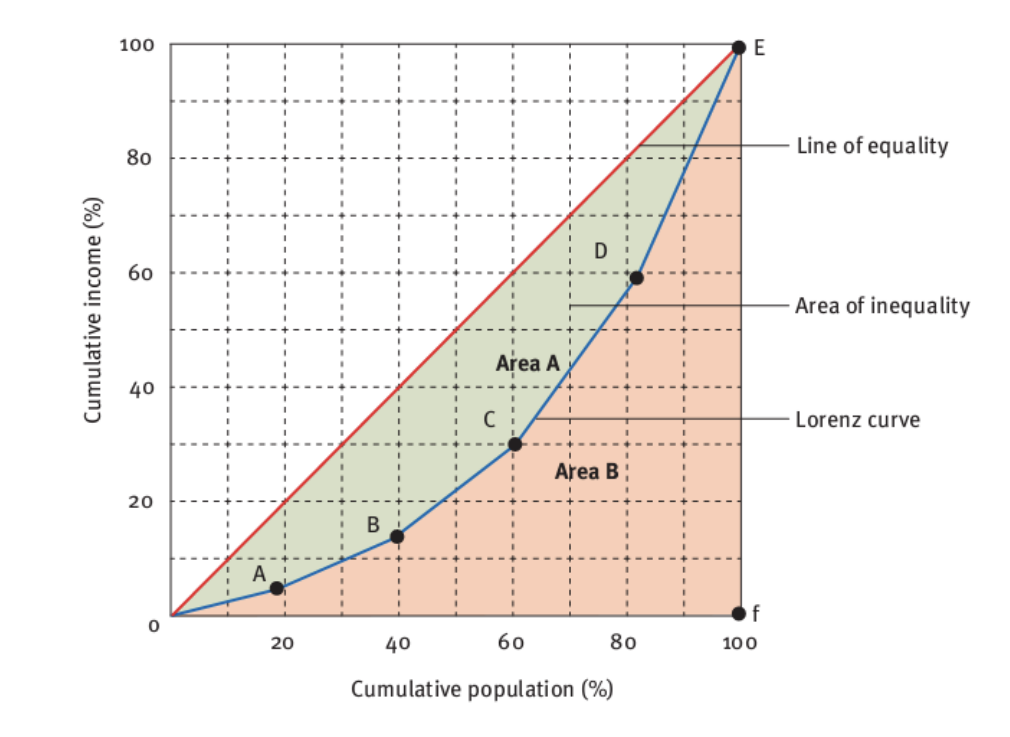
The graph works like this:
- The line of equality (the straight diagonal line) shows what perfect equality would look like - where everyone has exactly the same amount of wealth
- The Lorenz curve (the curved line) shows the actual distribution of wealth in reality
- The area between these two lines represents inequality - the bigger this area, the more unequal the wealth distribution
Important
The further the Lorenz curve bends away from the straight line, the more uneven the wealth distribution becomes. A perfectly equal society would have the Lorenz curve lying directly on top of the line of equality.
The Gini coefficient
The Gini coefficient is a number that economists calculate using the Lorenz curve. It gives us a single number to describe how equal or unequal wealth distribution is in a country.
The Gini coefficient ranges from 0 to 1 (sometimes shown as 0% to 100%):
- 0 (or 0%) = complete equality (everyone has exactly the same wealth)
- 1 (or 100%) = complete inequality (one person has everything, everyone else has nothing)
A lower Gini coefficient means wealth is more equally shared, while a higher coefficient means there's greater inequality.
Advantages of using the Gini coefficient
The Gini coefficient is popular among economists because it has several useful features:
- Anonymity - it doesn't matter who specifically are the rich or poor people; it just measures the overall pattern
- Scale independence - it works regardless of whether a country is rich or poor overall, or how its economy is measured
- Population independence - the size of a country's population doesn't affect the calculation
- Transfer principle - if wealth is moved from a rich person to a poor person, the Gini coefficient will show the distribution becoming more equal
Why is wealth unevenly distributed?
Several factors contribute to unequal wealth distribution:
- Inheritance - some people receive money or property from their families, giving them a head start
- Household size - larger families may find it harder to save money, as more people need to share the income
- Economic system advantages - certain economic structures may favour some groups over others
- Different skills and talents - people have varying abilities that may lead to different earning potential
- Discrimination - unfair treatment based on race, gender, or other factors can limit some people's opportunities
- Health problems - illness or disability can prevent people from earning income or require expensive medical care
Note
These factors often interact with each other. For example, discrimination can limit access to education, which then affects skills development and earning potential, creating a cycle that perpetuates wealth inequality across generations.
How can wealth be redistributed?
South African redistribution methods
The South African government uses several strategies to try to reduce wealth inequality and help poorer citizens:
- Social grants - direct cash payments to those in need, such as child support grants and old-age pensions
- Free benefits - providing essential services like healthcare and education at no cost
- Job creation programmes - government initiatives to create employment opportunities
- Minimum wages - setting the lowest legal amount employers can pay workers
- Anti-discrimination legislation - laws like the Employment Equity Act that promote fair treatment in the workplace
- Land restitution policy - returning land to communities that were unfairly dispossessed in the past
- Taxation - using progressive tax systems where wealthy people pay higher tax rates, then using this money to fund social programmes
These methods aim to transfer some wealth from richer people to poorer people, creating a more equal society.
Note
Progressive taxation means that as people earn more money, they pay a higher percentage in taxes. This system is designed so that those who can afford to contribute more to society do so, while protecting those with lower incomes.
Remember!
Summary
Key Points to Remember:
- Wealth means having valuable possessions or resources that can generate income
- Savings are the main source of wealth - the money you don't spend becomes part of your wealth
- The Lorenz curve shows wealth distribution graphically, with the line of equality representing perfect fairness
- The Gini coefficient gives a single number (0-1) to measure inequality, where lower numbers mean more equality
- South Africa uses multiple strategies like social grants, job creation, and progressive taxation to redistribute wealth and reduce inequality