Price Elasticity of Supply (Grade 11 NSC Matric Economics): Revision Notes
📚Revision Notes
Price Elasticity of Supply
Price elasticity of supply helps us understand how quickly and easily suppliers can respond to changes in the market price of their goods or services. This concept is crucial for understanding how markets work and why some products are easier to increase production for than others.
Note
Understanding supply elasticity is essential for businesses making production decisions and for governments when considering policies that might affect market prices. It helps predict how markets will respond to various economic changes.
What is price elasticity of supply?
Price elasticity of supply measures how responsive producers are when the price of their product changes. In simple terms, it tells us whether suppliers can quickly increase or decrease the amount they produce when prices go up or down.
Just like with demand elasticity, we measure supply elasticity using percentages. This allows us to compare different products fairly, regardless of their actual prices or quantities.
Note
Using percentages makes comparisons meaningful across different industries. For example, we can compare the supply responsiveness of both luxury cars (expensive items) and pencils (inexpensive items) on the same scale.
Calculating price elasticity of supply
The formula for working out price elasticity of supply is straightforward:
This calculation gives us a number that tells us how elastic (responsive) or inelastic (unresponsive) the supply is to price changes.
Example
Worked Example: Calculating Supply Elasticity
A local bakery increases bread production from 1000 loaves to 1200 loaves per day when the price rises from $2.00 to $2.40 per loaf.
Step 1: Calculate the percentage change in quantity supplied
Step 2: Calculate the percentage change in price
Step 3: Apply the formula
This means the bakery's supply is unit elastic - a 1% increase in price leads to a 1% increase in quantity supplied.
Types of supply elasticity
There are two main categories of price elasticity of supply:
- Price elastic supply: When suppliers can easily and quickly change their production levels in response to price changes
- Price inelastic supply: When suppliers find it difficult or impossible to quickly adjust their production levels when prices change
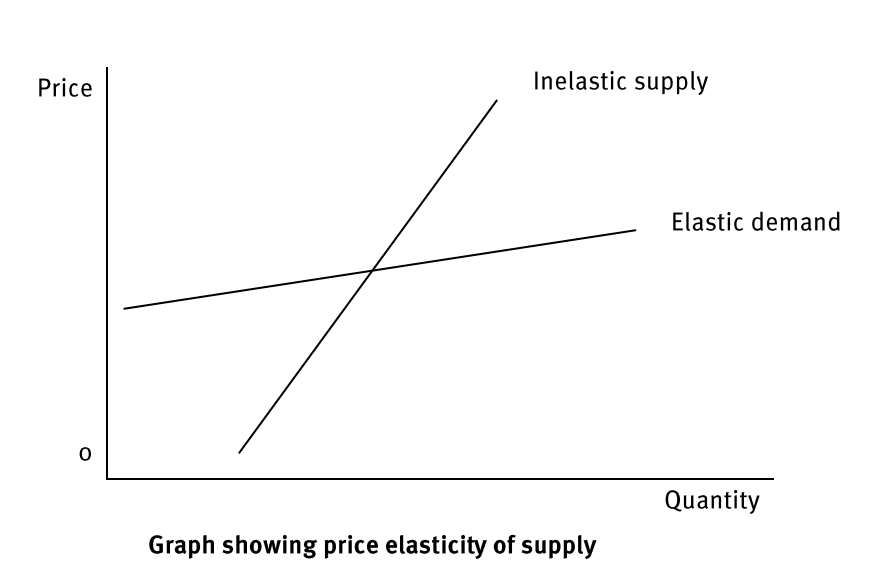
The graph above shows the difference between elastic and inelastic supply curves. Notice how the inelastic supply curve is steeper, showing that even large price changes result in small changes in quantity supplied. The elastic demand curve is also shown for comparison.
Important
Remember that steeper supply curves indicate more inelastic supply, while flatter supply curves show more elastic supply. This visual relationship helps you quickly identify supply responsiveness on graphs.
Factors that determine price elasticity of supply
Several key factors influence how easily suppliers can respond to price changes. Understanding these helps explain why some industries are more flexible than others.
Spare capacity
When a business has spare capacity, it means they have unused resources like empty factory space, idle machinery, or workers who could produce more. If a company can quickly increase production without major additional costs, their supply will be elastic. For example, a bakery with extra ovens and staff can easily bake more bread if prices rise.
Note
Businesses often maintain some spare capacity specifically to take advantage of unexpected increases in demand or price. However, maintaining unused capacity also involves costs, so there's a balance to be struck.
Stock levels
Businesses that keep high stock levels can respond quickly to increased demand without having to increase production immediately. This makes their supply more elastic. A clothing retailer with a large warehouse can quickly supply more items to shops when demand increases, even before increasing their manufacturing.
Ease of factor substitution
This refers to how easily a business can adapt their resources (capital and labour) to meet changing demand. If workers can be retrained quickly or machinery can be switched to different products easily, supply becomes more elastic. A printing company that can switch from printing books to magazines has more elastic supply than a specialist aircraft manufacturer.
Note
Flexibility in production is a major competitive advantage. Companies that can quickly adapt their operations to changing market conditions are better positioned to maximize profits and respond to opportunities.
Time period
The longer the time period, the more elastic supply becomes. In the short term, businesses may struggle to increase production significantly. However, given more time, they can build new facilities, hire and train more workers, or invest in better equipment. A farmer cannot quickly plant and harvest more crops, but over several seasons they can expand their farming operations.
Important
Time is perhaps the most critical factor affecting supply elasticity. Almost all supply becomes more elastic given sufficient time, as businesses can make fundamental changes to their production capacity and methods.
Summary
Key Points to Remember:
- Price elasticity of supply measures how responsive producers are to price changes
- The formula is:
- Elastic supply means producers can easily adjust production when prices change
- Four main factors affect supply elasticity: spare capacity, stock levels, ease of factor substitution, and time period
- Time matters - supply is generally more elastic in the long run than the short run