Demand and Supply Relationships (Grade 11 NSC Matric Economics): Revision Notes
📚Revision Notes
Demand and Supply Relationships
Understanding how demand and supply work together is fundamental to grasping how markets operate. These relationships help us predict what happens to prices and quantities when market conditions change.
Understanding demand relationships
Demand represents how much of a product consumers are willing and able to buy at different prices. Several important factors influence how demand behaves in the market.
Note
Demand is not just about wanting a product - consumers must be both willing AND able to purchase it at various price levels for it to count as economic demand.
Factors that influence demand
Multiple elements can cause demand to increase or decrease:
- Consumer expectations about future prices - If people think prices will rise later, they may buy more now
- Market size - More consumers in the market means higher overall demand
- Consumer tastes and preferences - Fashion trends and changing preferences affect what people want to buy
- Prices of related products - Both substitutes and complements impact demand
- Consumer income levels - Higher incomes generally allow people to buy more goods
- The current price of the product - This is the most direct factor affecting demand
The price-demand relationship
A key principle in economics is that demand and price have an inverse relationship. This means when the price of a product increases, the quantity demanded typically decreases. Conversely, when prices fall, people usually want to buy more of that product.
Important
The Law of Demand: As price increases, quantity demanded decreases (and vice versa). This inverse relationship is one of the most fundamental principles in economics and applies to virtually all normal goods.
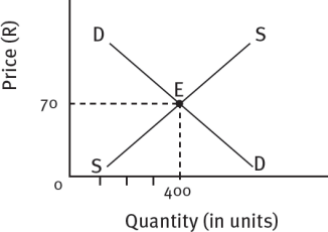
This graph shows how demand and supply interact to determine market equilibrium. The downward-sloping demand curve (D) demonstrates the inverse relationship between price and quantity demanded.
Substitutes in demand
Substitutes are products that can replace each other to satisfy similar consumer needs. When the price of one product rises, consumers often switch to cheaper alternatives, increasing demand for the substitute.
Example
Example: Substitute Goods in Action
If sunflower oil becomes more expensive, consumers might buy more canola oil instead. The two products serve the same cooking purpose, so they can easily substitute for one another. This creates a positive relationship between the price of one good and the demand for its substitute.
Complements in demand
Complements are products that consumers typically use together. These goods have a special relationship where changes in one product's price or demand directly affects the other.
When complementary products are involved, there's a negative relationship between the price of one product and the demand for its complement.
Example
Example: Complementary Goods
If mobile phone prices decrease, more people buy phones, which increases demand for hands-free devices. The products work better when used together, so their demands are linked.
Understanding supply relationships
Supply represents how much producers are willing and able to offer for sale at different price levels. Unlike demand, supply generally increases as prices rise.
The price-supply relationship
Supply demonstrates a positive relationship with price. As prices increase, producers find it more profitable to make and sell more units of the product. Higher prices provide greater incentives for production.
Important
The Law of Supply: As price increases, quantity supplied increases. This positive relationship occurs because higher prices make production more profitable, encouraging producers to supply more goods to the market.
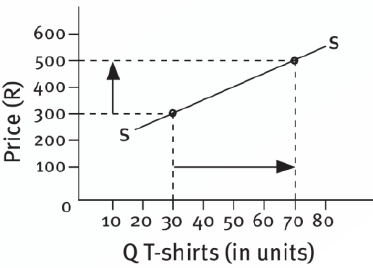
This supply curve for t-shirts illustrates the positive relationship between price and quantity supplied. As the price per t-shirt increases, manufacturers are willing to produce and supply more units to the market.
Factors that cause supply to change
Several factors can shift supply levels in the market:
- Price changes - The most direct factor affecting how much producers want to supply
- Industry size - More producers in the market increases total supply
- Production costs - Lower costs make it easier and more profitable to produce goods
- Technology improvements - Better technology can increase efficiency and supply capacity
- Weather and environmental conditions - Particularly important for agricultural products
Substitutes in supply
From the producer's perspective, substitute goods represent different products they could manufacture using similar resources. Producers will focus on making whichever product offers the highest profit potential.
Note
When producers can make different products using the same facilities and resources, an increase in production of one item typically leads to decreased production of alternatives. Manufacturers must choose how to allocate their limited resources most profitably.
Complements in supply
Some products are naturally produced together during the same production process. These complementary goods in supply mean that increasing production of one automatically increases production of the other.
Example
Example: Joint Production
When a company processes cattle, it simultaneously produces both beef and leather. An increase in beef production automatically results in more leather being available, since both come from the same source.
The connection between goods and factor markets
Markets don't operate in isolation - they're interconnected systems where changes in one area create ripple effects throughout the economy.
Goods markets (where final products are sold) and factor markets (where resources like labour, land, and capital are traded) have a close relationship. Changes in one market directly influence the other, creating a dynamic economic system.
Example
Example: Market Interconnection
If there's a shortage of skilled computer technicians in the factor market, fewer computers can be produced in the goods market. This reduces the supply of computers, potentially raising their prices. Conversely, when demand for a product increases in the goods market, producers need more resources, which increases demand in factor markets.
Note
This interconnection means that an increase in demand for any product sets off a chain reaction. Higher product demand encourages producers to increase supply, which requires more factors of production like labour, materials, and equipment. This increased factor demand can affect wages, resource prices, and employment levels throughout the economy.
Summary
Key Points to Remember:
- Demand and price have an inverse relationship - when prices go up, quantity demanded goes down
- Supply and price have a positive relationship - when prices increase, quantity supplied typically increases
- Substitute goods can replace each other, so price changes in one affect demand for the other
- Complementary goods are used together, creating linked demand patterns
- Factor markets and goods markets are interconnected - changes in one create effects in the other