Slope Elements (Grade 11 NSC Matric Geography): Revision Notes
📚Revision Notes
Slope Elements
What are slope elements?
Slope elements represent the different distinct parts or segments of a hillslope when viewed from the side (called a profile). These elements are essentially straight sections that make up the overall shape of any hill or mountain slope. When geographers study landforms, they typically identify four main slope elements that work together to create the complete slope profile.
Note
Each slope element has its own unique characteristics, formation processes, and role in shaping the landscape. Understanding these elements helps us analyze how slopes develop over time and how different geological processes affect landscape formation.
The four main slope elements
Every complete slope profile usually contains four distinct elements, arranged from highest to lowest elevation. These elements work together as a system, with processes in one element directly affecting the others.
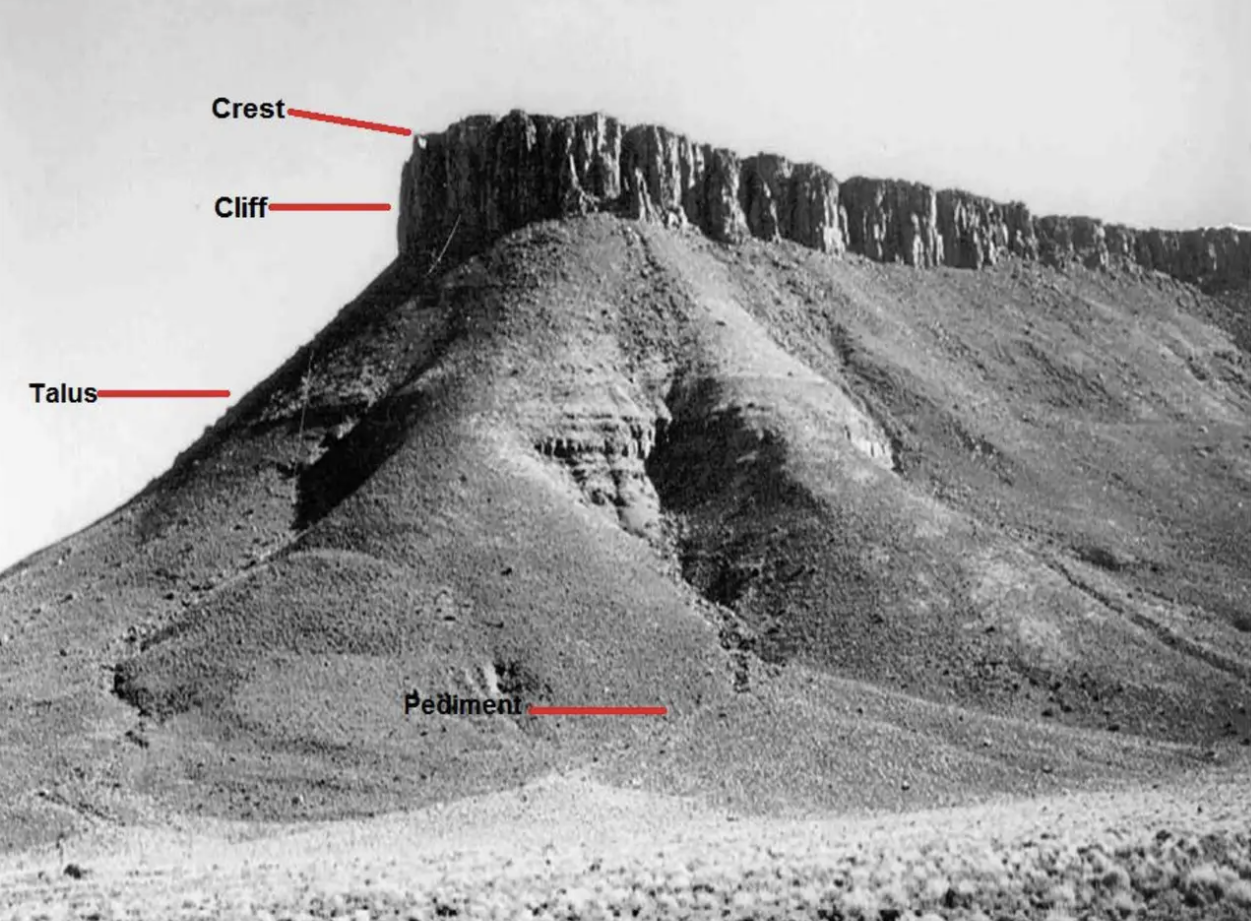
Important
The slope elements work as an integrated system where processes in one element directly influence what happens in adjacent elements. This interconnected nature is crucial for understanding landscape development.
Cliff (also called scarp or free face)
The cliff represents the steepest part of any slope and forms the most dramatic element of the landscape. This slope element develops when resistant rock layers are exposed and create near-vertical faces that resist weathering and erosion processes.
The height of a cliff depends entirely on how thick the resistant rock layer is at that location. When multiple layers of resistant rock exist, you might find several cliff sections at different heights on the same slope. The cliff face remains steep because the resistant rock doesn't break down easily through normal weathering processes.
Note
Rockfalls commonly occur on cliff faces because the slope angle is so extreme. These falling rocks contribute material to the slope element directly below the cliff, creating a continuous cycle of erosion and deposition.
Crest
The crest forms the highest point of the slope where the cliff face meets the plateau or flat area above. This element represents the transition zone between the horizontal plateau surface and the steep cliff face below.
The crest typically develops a convex (curved outward) shape due to two important processes working together. Sheetwash occurs when thin layers of water flow over the land surface after heavy rainfall, gradually wearing away the rock. Soil creep happens when soil particles slowly move down the slope due to gravity, representing the slowest form of mass movement.
Example
Typical Crest Dimensions
The crest usually measures no more than one meter in both height and width, making it a relatively narrow transition zone between the major slope elements.
Talus (also called debris slope or scree slope)
The talus slope lies directly below the cliff and consists entirely of broken rock material that has fallen from the cliff face above. This slope element forms through the accumulation of rock fragments of various sizes that have been loosened by weathering processes and gravity.
The angle of the talus slope is determined by the size of the rock fragments that compose it. Smaller particles create gentler angles as they can settle more compactly, while larger rocks maintain steeper angles. The talus acts as a temporary storage area for weathered material before it gets transported further down the slope.
Note
Surface runoff and earthflows commonly occur on talus slopes, helping to move smaller particles toward the bottom of the slope system. The talus may appear slightly concave (curved inward) as water and gravity continue to sort and move the accumulated material.
Pediment
The pediment represents the lowest and gentlest slope element, forming almost flat terrain at the base of the hillslope. This element creates the transition between the steeper upper slopes and the surrounding valley floor or river systems.
The pediment typically slopes very gently from the base of the talus toward any nearby river or drainage channel. The angle of this slope varies considerably, ranging from less than 7° near the talus to as gentle as 0.5° near the river valley, depending on local conditions.
Important
The boundary between the pediment and talus is called the knick line, marking the point where the slope angle changes significantly. This is a key identifying feature when analyzing slope profiles.
Soil creep and sheetwash processes are particularly active on pediments, gradually moving fine sediment toward river channels and completing the slope system's sediment transport cycle.
Understanding slope profiles
When studying any landscape, the profile view reveals how these slope elements combine to create the complete hillslope form. Karoo landscapes, which were discussed earlier in geography studies, typically display all four slope elements clearly, making them excellent examples for understanding these concepts.
Note
The slope elements work as an integrated system where processes in one element directly influence what happens in adjacent elements. Material weathered from the cliff accumulates on the talus, which then feeds sediment to the pediment, which finally delivers material to river systems for transport away from the area.
Identifying slope elements in real landscapes
Learning to recognize slope elements in actual landscapes requires practice in observing the different angles and materials that characterize each element. Resistant rock layers create the distinctive cliff faces, while the accumulation of weathered material below creates the characteristic talus slopes.
Important
The transition zones between elements often provide the clearest evidence for identifying where one element ends and another begins. The knick line between pediment and talus, and the sharp angle change between cliff and crest, serve as key identifying features.
Summary
Key Points to Remember:
- Slope elements are the four distinct straight segments that make up any complete hillslope profile
- The sequence from top to bottom is always: crest, cliff, talus, pediment
- Each element forms through different processes - cliffs resist weathering while pediments accumulate transported sediment
- The slope elements work together as a system, with material moving from higher to lower elements over time
- Understanding slope elements helps explain how landscapes develop and change through geological processes