The Role of Oceans in Climate Control (Grade 11 NSC Matric Geography): Revision Notes
📚Revision Notes
The Role of Oceans in Climate Control
Oceans play a crucial role in shaping Africa's climate patterns. They influence both temperature and rainfall across the continent through various mechanisms that create distinct climate zones and weather patterns.
Note
Understanding how oceans control climate is essential for explaining Africa's diverse climate patterns, from coastal areas with moderate temperatures to inland regions with extreme temperature variations.
How oceans moderate temperature
The ocean acts as a natural temperature regulator for coastal areas. During summer months, land areas experience much higher temperatures than ocean waters, while in winter, land becomes significantly colder than the sea. This happens because water takes longer to heat up and cool down compared to land surfaces.
Winds blowing from the sea help to moderate these temperature differences. In summer, ocean breezes cool down the land, while in winter, they warm it up. This natural air conditioning system reduces the difference between the highest and lowest temperatures that coastal areas experience throughout the year.
However, places located far inland don't benefit from this ocean influence. These areas experience what we call a continental climate.
Important
Continental climate - climate of places far from the coast in the interior of continents; these places are not affected by the moderating effect of the sea from the deep thermocline circulation.
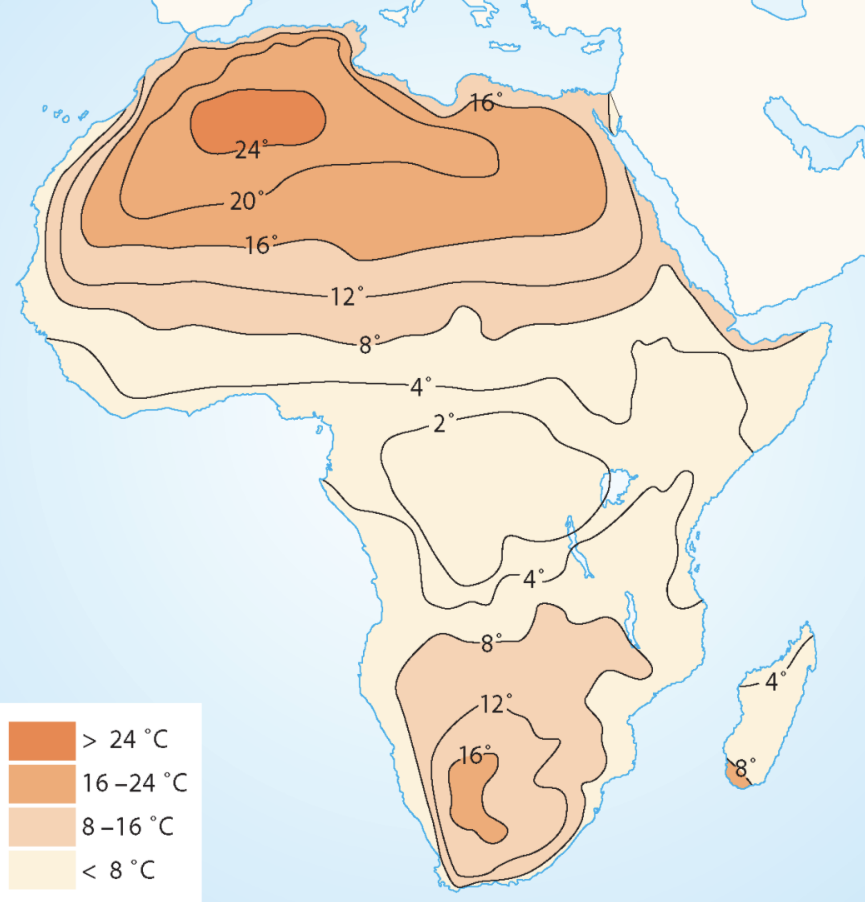
In Africa, this pattern is clearly visible when you look at temperature ranges across the continent. The hot, wet areas near the equator don't experience extreme temperature differences because they're influenced by ocean patterns. However, desert areas far from the sea have much larger temperature ranges, with very high daytime temperatures and much lower nighttime temperatures.
This pattern occurs because desert regions have clear skies that allow maximum solar radiation during the day, creating intense heat. At night, these same clear skies allow heat to escape rapidly back to space, causing temperatures to drop significantly.
Ocean currents and their climate effects
Temperature effects of ocean currents
Ocean currents are like massive rivers of water flowing through the seas, and they have a powerful impact on the climate of nearby coastal areas. Around Africa, there are three major current systems that significantly influence regional climates.
Warm surface currents flow along Africa's east coast, while cold currents flow along the west coast. The temperature of these currents directly affects the air above them, which in turn influences the climate of coastal regions.
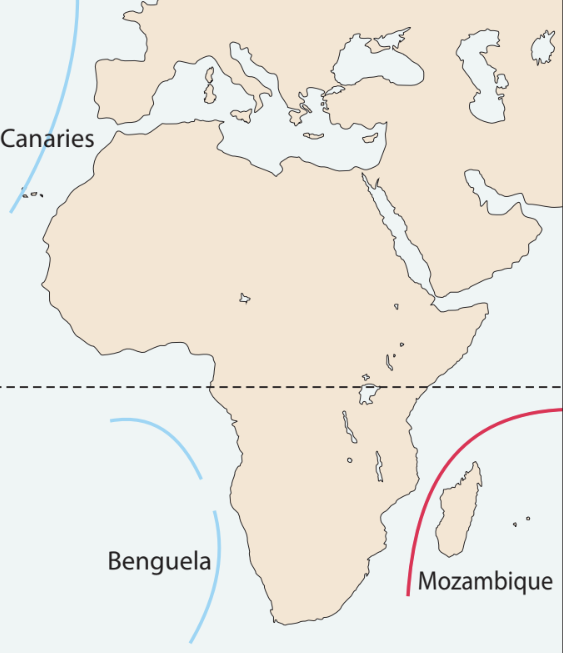
When a current flows along a coastline, it can make places several degrees warmer or cooler than similar locations at the same latitude that aren't affected by currents. This effect is usually quite localized and typically doesn't extend more than 100 kilometers inland.
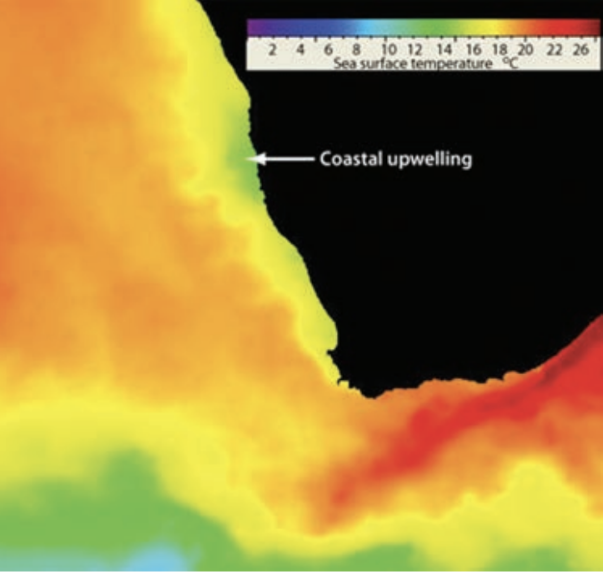
In some coastal areas, a special process called upwelling occurs.
Important
Upwelling - cold water rising to the surface from the deep thermocline circulation. This process brings nutrient-rich but very cold water up from deep ocean layers, strengthening the cooling effect of cold surface currents.
Rainfall effects of ocean currents
Ocean currents don't just affect temperature - they also play a major role in determining rainfall patterns. This happens because water evaporation rates depend heavily on temperature.
Water evaporates much more effectively when temperatures are high compared to when they're low. This means that air moving over a warm ocean current contains more moisture than air moving over a cold current. When this moist air reaches land, there's a greater chance of rainfall.
Note
The relationship between current temperature and rainfall is straightforward: warm currents = more evaporation = more moisture in air = higher rainfall potential.
This creates a noticeable difference between Africa's east and west coasts. The east coast, influenced by warm currents, tends to receive more rainfall than the west coast, which is affected by cold currents. These differences contribute to making South Africa's east coast generally wetter than its west coast.
Temperature patterns across Africa
Africa's climate shows clear patterns that reflect the influence of ocean proximity and current systems. Areas close to the coast experience smaller temperature ranges throughout the year due to the moderating effect of nearby ocean waters.
Inland areas, especially those in desert regions, experience much larger temperature swings. Some locations can have temperature differences of more than 20°C between their hottest and coolest periods. This is because they lack the stabilizing influence of ocean waters and often have clear skies that allow rapid heating during the day and cooling at night.
Example
Temperature Range Comparison:
Coastal areas: Experience moderate temperature variations due to ocean influence
- Summer: Ocean breezes provide cooling
- Winter: Ocean warmth moderates cold temperatures
Inland desert areas: Experience extreme temperature variations
- Daytime: Scorching temperatures due to clear skies and solar radiation
- Nighttime: Rapid cooling as heat escapes to space
- Result: Some of the largest daily temperature ranges on Earth
The most extreme temperature variations occur in desert areas far from any ocean influence. These regions can experience scorching daytime temperatures followed by surprisingly cool nights, creating some of the largest daily temperature ranges found anywhere on Earth.
Summary
Key Points to Remember:
- Oceans moderate coastal temperatures by keeping them cooler in summer and warmer in winter compared to inland areas
- Continental climate occurs in places far from the coast, characterized by large temperature ranges due to lack of ocean influence
- Three major ocean currents affect Africa: warm currents on the east coast and cold currents on the west coast
- Upwelling brings cold water to the surface, reinforcing the cooling effects of cold currents along the west coast
- Warm currents promote more rainfall than cold currents because they increase evaporation rates and moisture content in the air