Energy Balance and Energy Transfer (Grade 11 NSC Matric Geography): Revision Notes
📚Revision Notes
Energy Balance and Energy Transfer
Earth's energy balance
Earth maintains a delicate balance between the energy it receives and the energy it radiates back to space. Understanding this balance is crucial for comprehending how our planet's climate system works.
Incoming and outgoing radiation
Earth receives energy from the Sun in the form of shortwave solar radiation. This energy heats our planet's surface and atmosphere. In return, Earth radiates energy back to space as longwave terrestrial radiation. For the planet as a whole, the amount of incoming energy equals the amount of outgoing energy, creating what we call Earth's energy balance.
Important
Earth's energy balance is the balance between incoming solar radiation and outgoing radiation from Earth. This balance is essential for maintaining stable global temperatures.
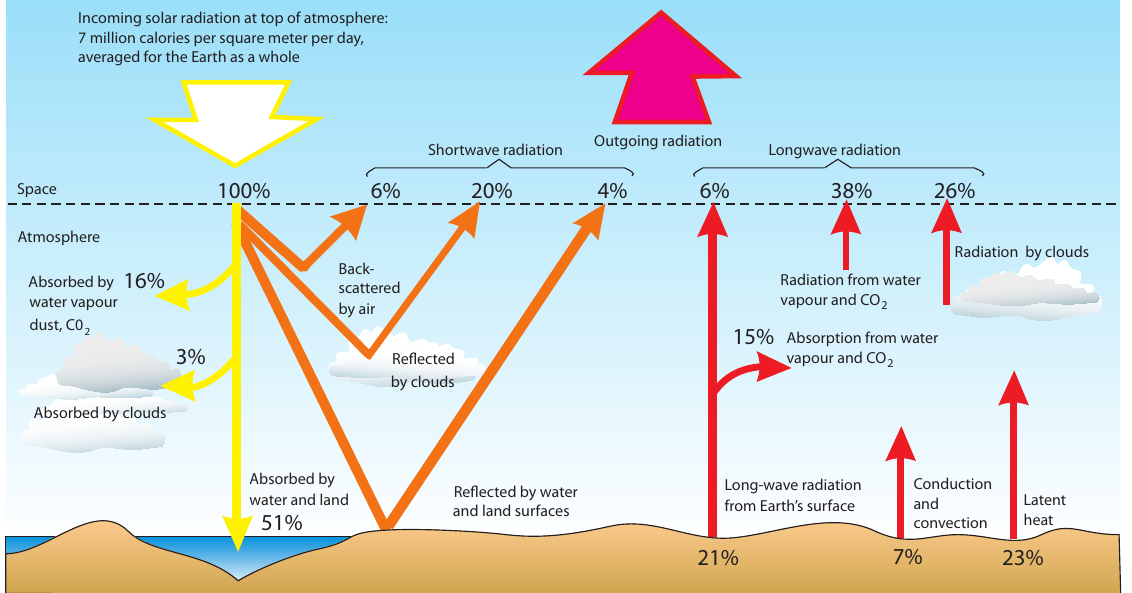
The energy balance diagram shows how solar radiation is distributed through Earth's atmosphere and surface. When sunlight reaches Earth:
- Some radiation is absorbed by the atmosphere (about 19 units out of 100)
- Some is reflected back to space by clouds and surfaces (about 30 units)
- The remaining energy reaches and warms Earth's surface (about 51 units)
Note
The energy that reaches Earth's surface doesn't stay there. It is transferred back to the atmosphere through several processes:
- Radiation - Earth's surface emits longwave radiation
- Conduction and convection - Direct heat transfer to the air
- Latent heat - Energy released when water vapour condenses
This creates a continuous cycle where energy flows in and out, maintaining balance.
Latitudinal imbalances in radiation
Although Earth maintains an overall energy balance, this balance doesn't exist everywhere on the planet. Different latitudes receive and lose different amounts of energy.
Radiation surplus and deficit
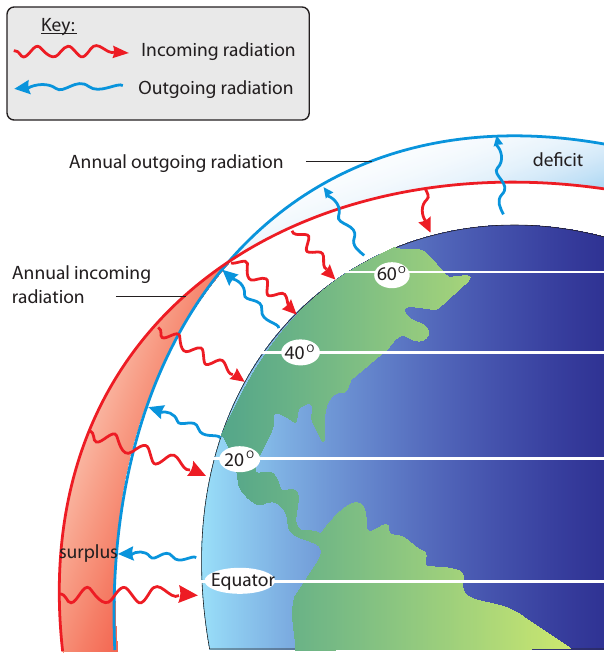
Near the equator, more solar radiation arrives than is lost to space. This creates a radiation surplus - areas where more energy flows in than leaves.
At higher latitudes near the poles, more radiation is lost to space than is received from the Sun. This creates a radiation deficit - areas where more energy flows out than is received.
Important
Key Definitions:
- Radiation surplus: where more radiation flows in than leaves
- Radiation deficit: where more radiation flows out than is received
Without energy transfer, equatorial regions would become increasingly hot whilst polar regions would become increasingly cold.
The diagram clearly shows this pattern:
- Low latitudes (near equator) - radiation surplus (red arrows longer than blue)
- High latitudes (near poles) - radiation deficit (blue arrows longer than red)
If this imbalance continued without any correction, equatorial regions would become increasingly hot whilst polar regions would become increasingly cold. However, this doesn't happen because energy is transferred between these regions.
Poleward energy transfer
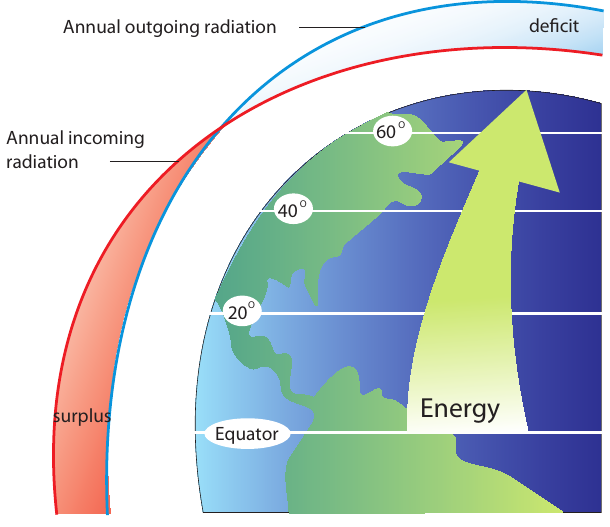
To maintain global energy balance, energy must move from areas of surplus to areas of deficit. This transfer of energy occurs poleward - from low latitudes toward the poles.
Note
The poleward energy transfer ensures that:
- Excess energy from tropical regions is moved toward the poles
- Polar regions receive additional energy to compensate for their deficit
- Global temperatures remain relatively stable over time
This energy transfer is achieved through two main mechanisms: ocean currents and winds.
Mechanisms responsible for energy transfer
The poleward transfer of energy occurs through two primary mechanisms that work together to redistribute heat around the globe.
Main energy transfer mechanisms:
- Winds - Warm moist air moves poleward from the tropics, carrying heat energy to higher latitudes
- Ocean currents - Moving streams of water transport warm water to colder places and cold water to warmer places
Important
These mechanisms are essential because:
- Without ocean currents, parts of the ocean around Europe would freeze, making shipping and fishing very difficult
- Without energy transfer by wind, world climates would be dramatically different
- These systems make many places more comfortable to live in
Energy transfer by oceans
Ocean currents play a vital role in transferring energy around the globe. There are two main types of ocean current systems that work at different depths.
Deep ocean circulation
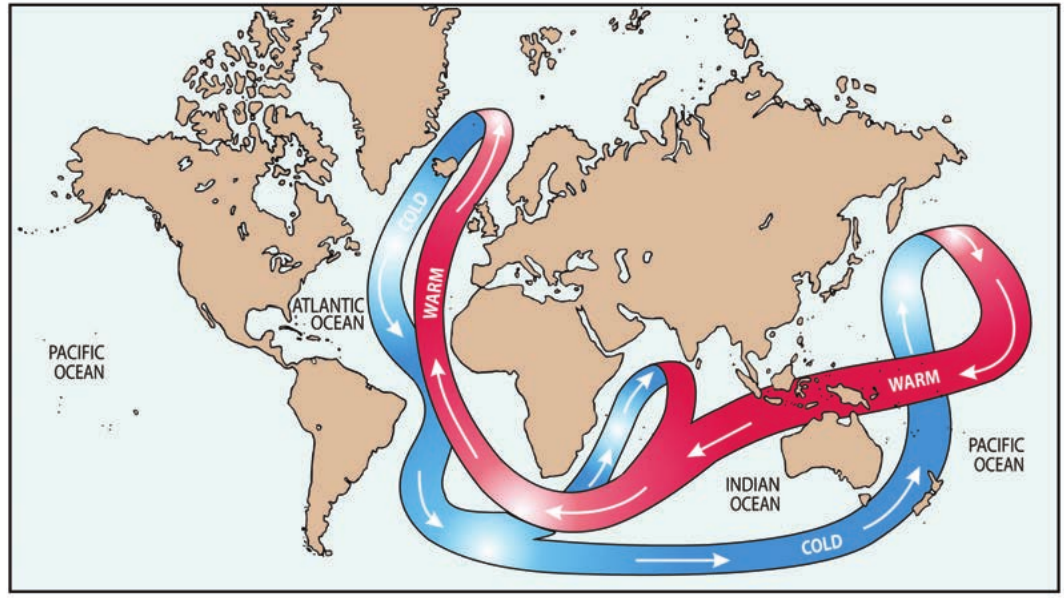
Deep ocean currents are driven by differences in water density. This system is called thermohaline circulation because water density depends on both temperature (thermo) and salinity (haline).
Note
How thermohaline circulation works:
- Colder water is more dense than warmer water
- Saltier water is more dense than less salty water
- Dense water sinks to the ocean floor
- Less dense water rises to replace it
- This creates a continuous circulation pattern
Example
Example: Thermohaline Circulation Process
Step 1: Near the poles, seawater begins to freeze
Step 2: Salt doesn't freeze with the water, making remaining water saltier and denser
Step 3: Dense, salty water sinks to the ocean floor
Step 4: Cold water flows slowly at deep levels toward the Southern Ocean
Step 5: Water eventually warms, becomes less dense, and rises
Step 6: Warmed water flows poleward again, completing the circulation
Surface currents
Surface currents flow in the upper 400 metres of water and move in circular patterns called gyres. These currents are driven by wind patterns and move much faster than deep currents.
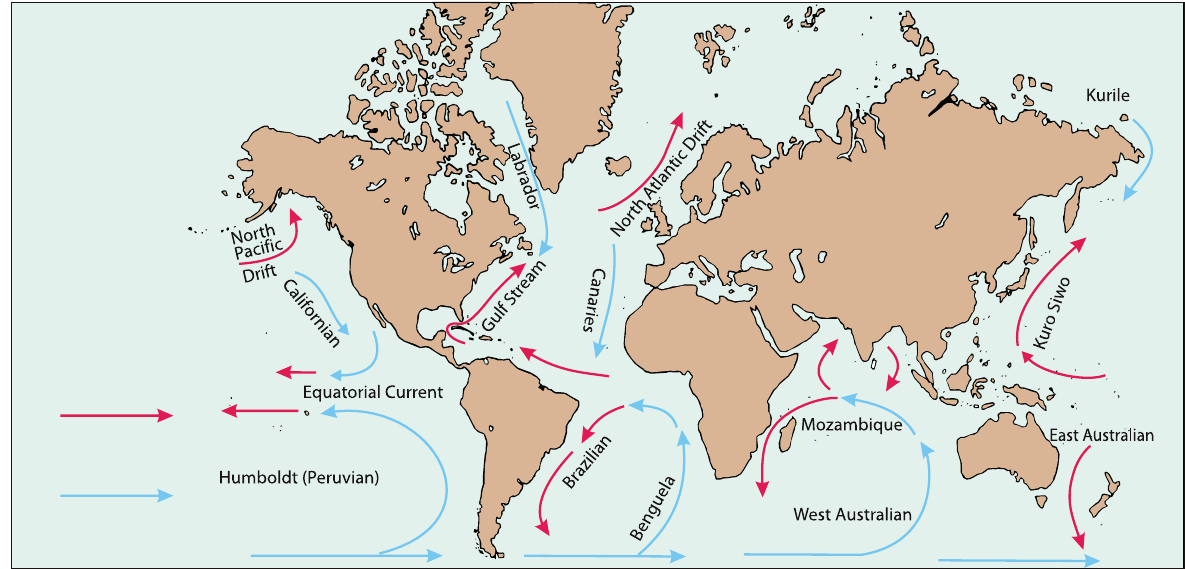
Surface current patterns:
- Move clockwise in the northern hemisphere
- Move anticlockwise in the southern hemisphere
- Carry warm water poleward on the western sides of oceans
- Carry cold water equatorward on the eastern sides of oceans
Example
Important Current Examples:
- Gulf Stream - carries warm water from the Caribbean toward Europe
- Kuroshio Current - brings warm water up the east coast of Asia
- Benguela Current - carries cold water along Africa's west coast
Energy transfer by wind
Wind is air that moves horizontally across Earth's surface. Winds play a crucial role in the global energy transfer system.
Note
How winds transfer energy:
- Some winds blow poleward from the tropics, carrying heat energy to higher latitudes
- Other winds blow from polar regions, moving cold air toward lower latitudes
- These wind patterns form part of the global atmospheric circulation
- The movement of heat in winds helps achieve global energy balance
Wind systems work together with ocean currents to redistribute energy around the planet, ensuring that temperature differences between equatorial and polar regions don't become extreme.
Summary
Key Points to Remember:
-
Earth maintains energy balance - the amount of incoming solar radiation equals the amount of outgoing terrestrial radiation for the planet as a whole
-
Latitudinal imbalances exist - equatorial regions have energy surplus whilst polar regions have energy deficit
-
Energy transfers poleward - heat moves from low latitudes to high latitudes to balance the global energy budget
-
Two main transfer mechanisms - ocean currents and winds redistribute energy around the globe
-
Ocean currents work at two levels - deep thermohaline circulation driven by density differences, and surface currents driven by winds forming circular gyres