Unequal Heating of the Atmosphere (Grade 11 NSC Matric Geography): Revision Notes
📚Revision Notes
Unequal Heating of the Atmosphere
What is unequal heating?
The atmosphere does not receive the same amount of heat everywhere on Earth. This unequal heating happens in two main ways:
- Latitudinal heating: Temperature changes as you move from the equator towards the poles
- Seasonal heating: Temperature changes throughout the year due to Earth's tilt and orbit around the sun
Note
This unequal distribution of heat energy is the driving force behind weather patterns, ocean currents, and climate systems around the world. Understanding these patterns helps explain why different regions experience different climates.
Key vocabulary
Important
Isotherm: A line on a map that connects places with the same temperature. These lines help us see temperature patterns across large areas.
Heat equator: A special isotherm that connects the places with the highest temperatures at any particular time. Unlike the geographical equator, the heat equator moves north and south during the year.
How temperature varies with latitude
Temperature patterns show clear relationships with latitude:
- Highest temperatures are found near the equator (0° latitude)
- Lowest temperatures occur near the North and South Poles (90° latitude)
- Temperature gradually decreases as you move away from the equator towards either pole
- This happens because the sun's rays strike the Earth most directly at the equator
Important
The angle at which sunlight hits Earth becomes less direct as you move towards the poles, spreading the same amount of energy over a larger area and creating cooler temperatures. This is the fundamental cause of latitudinal temperature differences.
How temperature varies with seasons
Seasonal temperature changes occur because Earth's axis is tilted as it orbits the sun:
- Summer months have higher temperatures
- Winter months have lower temperatures
- The seasons are opposite in the Northern and Southern Hemispheres
Note
When it's summer in the Northern Hemisphere (July), it's winter in the Southern Hemisphere. When it's winter in the Northern Hemisphere (January), it's summer in the Southern Hemisphere. This opposite seasonal pattern is crucial for understanding global temperature maps.
World temperature patterns
January temperature patterns
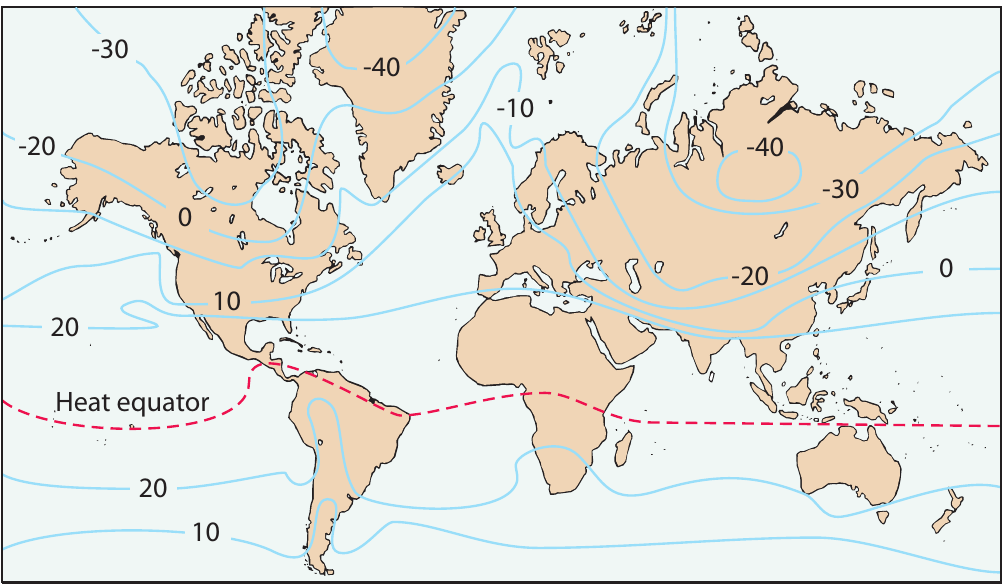
During January, the world temperature map shows:
- The Southern Hemisphere experiences summer with higher temperatures
- The Northern Hemisphere experiences winter with lower temperatures
- The heat equator is positioned south of the geographical equator
- Places within 20° north and south of the equator maintain high temperatures year-round
July temperature patterns
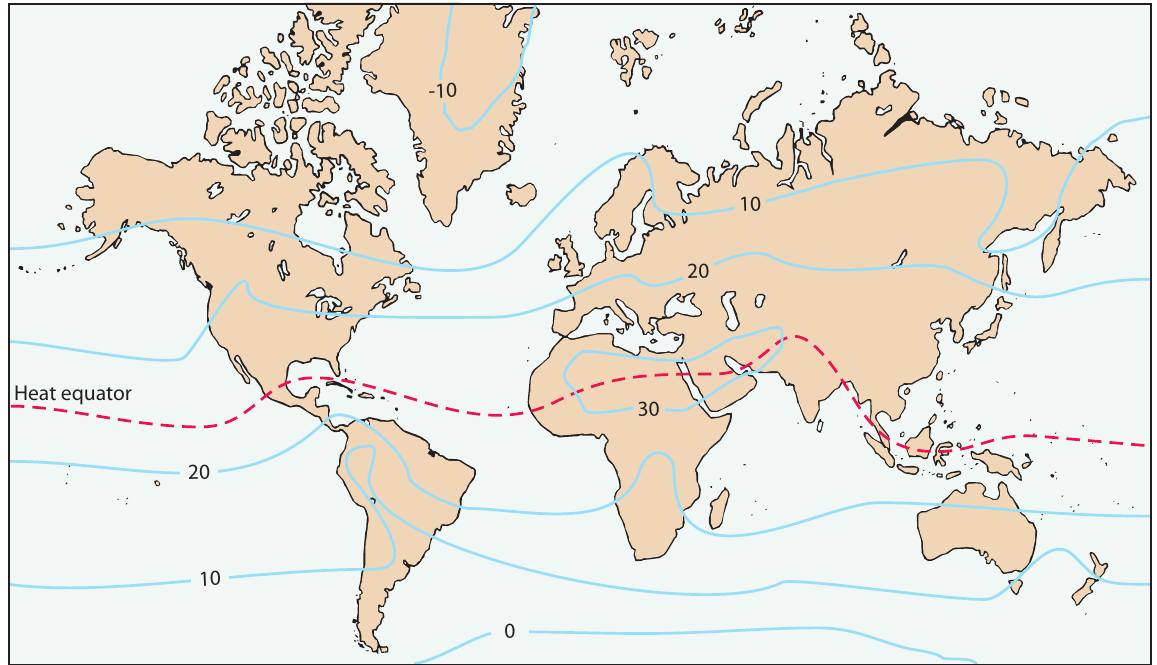
During July, the temperature patterns shift:
- The Northern Hemisphere experiences summer with higher temperatures
- The Southern Hemisphere experiences winter with lower temperatures
- The heat equator moves north of the geographical equator
- The position of all isotherms shifts north and south compared to January
Heat equator movement
The heat equator is not fixed in one position. It moves during the year:
- In January: positioned south of the geographical equator
- In July: positioned north of the geographical equator
- This movement follows the seasonal heating patterns of each hemisphere
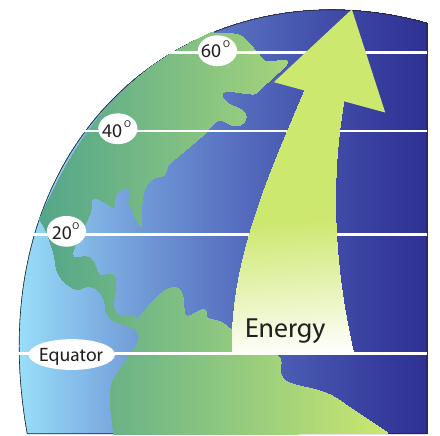
Energy transfer
Since the equatorial regions receive more heat than the polar regions, nature works to balance this unequal distribution:
- Excess heat energy from low latitudes (near the equator) is transferred towards higher latitudes (towards the poles)
- This energy transfer helps bring Earth's overall energy system into balance
- The transfer happens through atmospheric circulation (wind systems) and ocean currents
Note
This energy transfer system is crucial for maintaining Earth's climate and will be explored further in other units about Earth's energy balance. Without this transfer, equatorial regions would become unbearably hot while polar regions would become even colder.
Remember!
Summary
Key Points to Remember:
- Isotherms connect places with equal temperatures and help us visualise global temperature patterns
- Temperature decreases as you move from the equator towards the poles due to the angle of incoming solar radiation
- Seasons are opposite in the Northern and Southern Hemispheres - when one experiences summer, the other has winter
- The heat equator moves north in July and south in January, following seasonal temperature changes
- Energy transfers from hot equatorial regions to cooler polar regions, helping to balance Earth's energy system