Human Nutrition (Grade 11 NSC Matric Life Sciences): Revision Notes
📚Revision Notes
Human Nutrition
Understanding how your body processes food is essential for appreciating one of life's most fundamental processes. Human nutrition involves the complex journey that food takes through your digestive system, from the moment you take a bite until nutrients reach every cell in your body.
Key terminology
Before diving into the digestive process, let's explore the important terms you'll need to understand human nutrition. These words describe different stages and components of how your body handles food.
Note
Understanding these key terms will help you follow the digestive process more easily as we explore each stage in detail.
A bolus forms when you chew food and mix it with saliva - think of it as the first step in preparing food for your stomach. Bile is a special liquid your liver makes to help break down fats, while peristalsis describes the wave-like muscle movements that push food through your digestive tract, much like squeezing toothpaste from a tube.
The partially digested mixture in your stomach is called chyme, and the tiny finger-like projections in your small intestine are villi - these dramatically increase the surface area for absorbing nutrients.
The digestive system overview
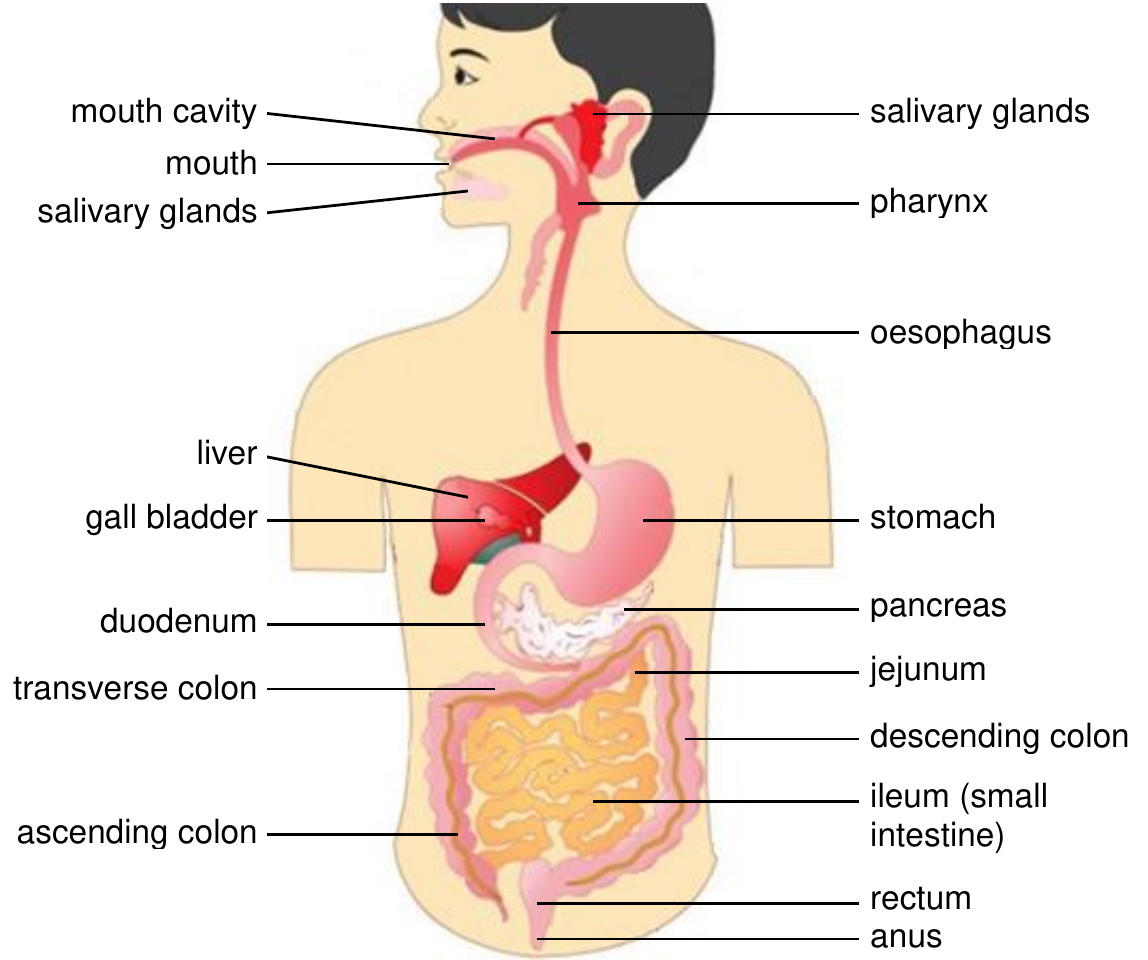
Your digestive system is like a sophisticated food processing plant that breaks down complex molecules into simple forms your body can use. The system consists of the alimentary canal (the main tube from mouth to anus) plus helper organs like the liver and pancreas.
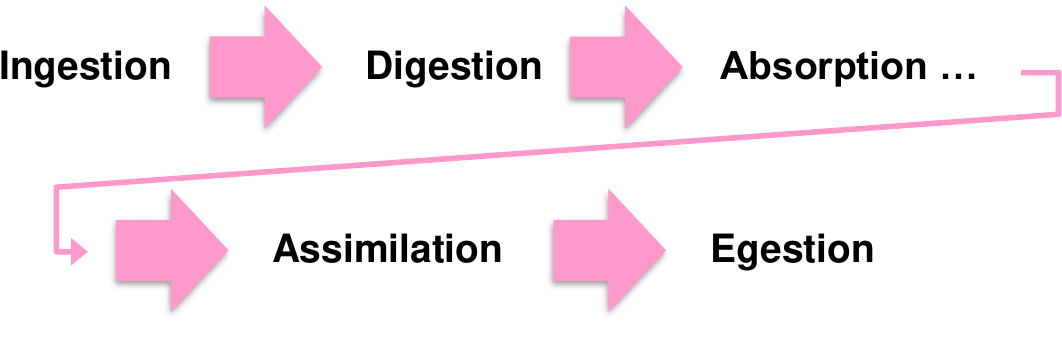
The digestive process follows five main stages, creating an efficient assembly line for processing nutrients:
Note
Think of your digestive system as an assembly line where each stage has a specific job, and all stages work together to transform food into usable nutrients for your body.
Structure and functions of digestive organs
Each part of your digestive system has specific roles that work together seamlessly. Let's examine how different organs contribute to breaking down and processing your food.
Your mouth cavity begins the process with teeth grinding food while salivary glands release enzymes to start breaking down carbohydrates. The pharynx and oesophagus transport food to your stomach using coordinated muscle contractions.
Your stomach acts like a muscular mixing bowl, churning food with strong acid and enzymes to create chyme. The liver and gall bladder work as a team - the liver produces bile which the gall bladder stores until needed for fat digestion.
The pancreas serves dual functions: it produces digestive juices as an exocrine gland and regulates blood sugar as an endocrine gland. Your small intestine handles most nutrient absorption through its specialised structure.
Mechanical digestion
Mechanical digestion involves physically breaking food into smaller pieces without changing its chemical structure. This increases the surface area available for chemical digestion to work effectively.
The process begins with mastication (chewing) in your mouth, where teeth grind food into smaller fragments. Your stomach continues mechanical digestion by churning and mixing food with gastric juices.
Peristalsis plays a crucial role throughout your digestive tract. These rhythmic muscle contractions create waves that push food in one direction, ensuring steady movement from mouth to anus. Remarkably, peristalsis is so effective that it can move food to your stomach even if you're standing on your head!
Note
Peristalsis is so powerful and well-coordinated that astronauts can still swallow and digest food normally even in zero gravity!
Another important mechanical process is emulsification, where bile breaks large fat globules into tiny droplets. This creates a much larger surface area for fat-digesting enzymes to work on, similar to how breaking a large ball into many small balls increases the total surface area.
Chemical digestion
Chemical digestion uses enzymes to break down large food molecules into smaller, absorbable units. This process is essential because most food particles are too large to enter your bloodstream directly.
Enzymes are biological catalysts that speed up chemical reactions. They're highly specific and sensitive to temperature and pH changes, working best under optimal conditions.
Important
Enzymes are extremely specific - each enzyme can only break down one type of food molecule. This is why your body needs many different enzymes working together to digest a complete meal.
There are three main groups of digestive enzymes:
- Carbohydrases break down carbohydrates (like starch) into simple sugars (glucose)
- Proteases break down proteins into amino acids
- Lipases break down lipids (fats) into glycerol and fatty acids
Each enzyme group works in different locations throughout your digestive system and prefers specific pH conditions. For example, stomach acid creates the acidic environment needed for protein-digesting enzymes, while the small intestine provides the slightly alkaline conditions preferred by carbohydrases and lipases.
Example
Worked Example: Enzyme Action
When you eat a piece of bread:
- In your mouth: Amylase (a carbohydrase) begins breaking starch into simpler sugars
- In your stomach: Pepsin (a protease) starts breaking down any proteins present
- In your small intestine: Pancreatic amylase continues starch digestion while lipases break down any fats from butter
Each enzyme works in its optimal pH environment to ensure efficient digestion.
Absorption
Most nutrient absorption occurs in your small intestine, where the digestive process has broken food into its smallest components. The small intestine's structure is perfectly designed for this crucial function.
Your small intestine is approximately 6 metres long and contains several features that maximise absorption:
- Transverse folds in the intestinal walls
- Millions of villi (finger-like projections)
- Microvilli on each villus cell
Note
The combination of folds, villi, and microvilli creates a surface area roughly equivalent to a tennis court - all packed into your abdomen! This massive surface area is essential for efficient nutrient absorption.
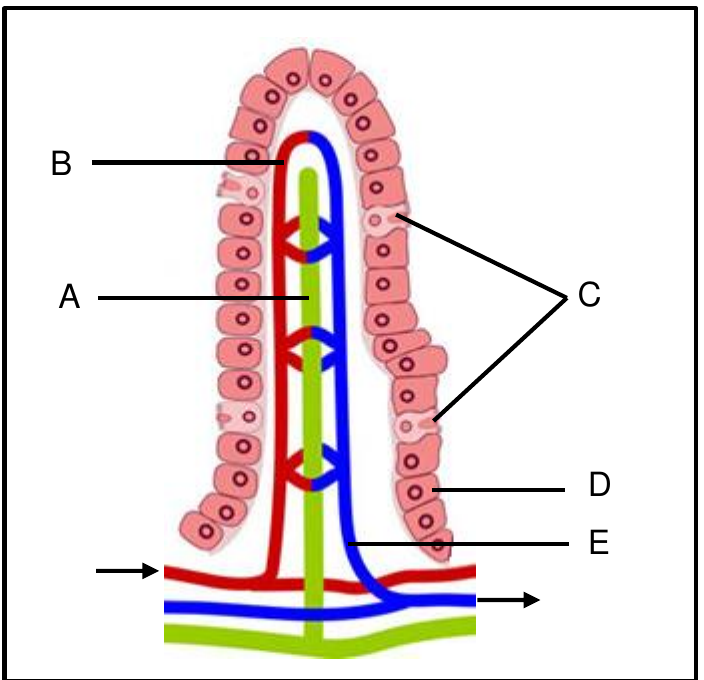
The villi are specially adapted for absorption with several key features:
- A single-layer epithelium allows nutrients to pass through quickly
- Goblet cells produce mucus to keep the surface moist
- Rich blood capillary networks transport absorbed nutrients
- Mitochondria provide energy for active transport
- Lacteals (lymph vessels) absorb fats
Different nutrients use different absorption methods. Active transport requires energy to move substances against concentration gradients, while passive diffusion and osmosis rely on natural concentration differences.
Transport of nutrients
Once absorbed, glucose and amino acids follow a specific pathway through your circulatory system:
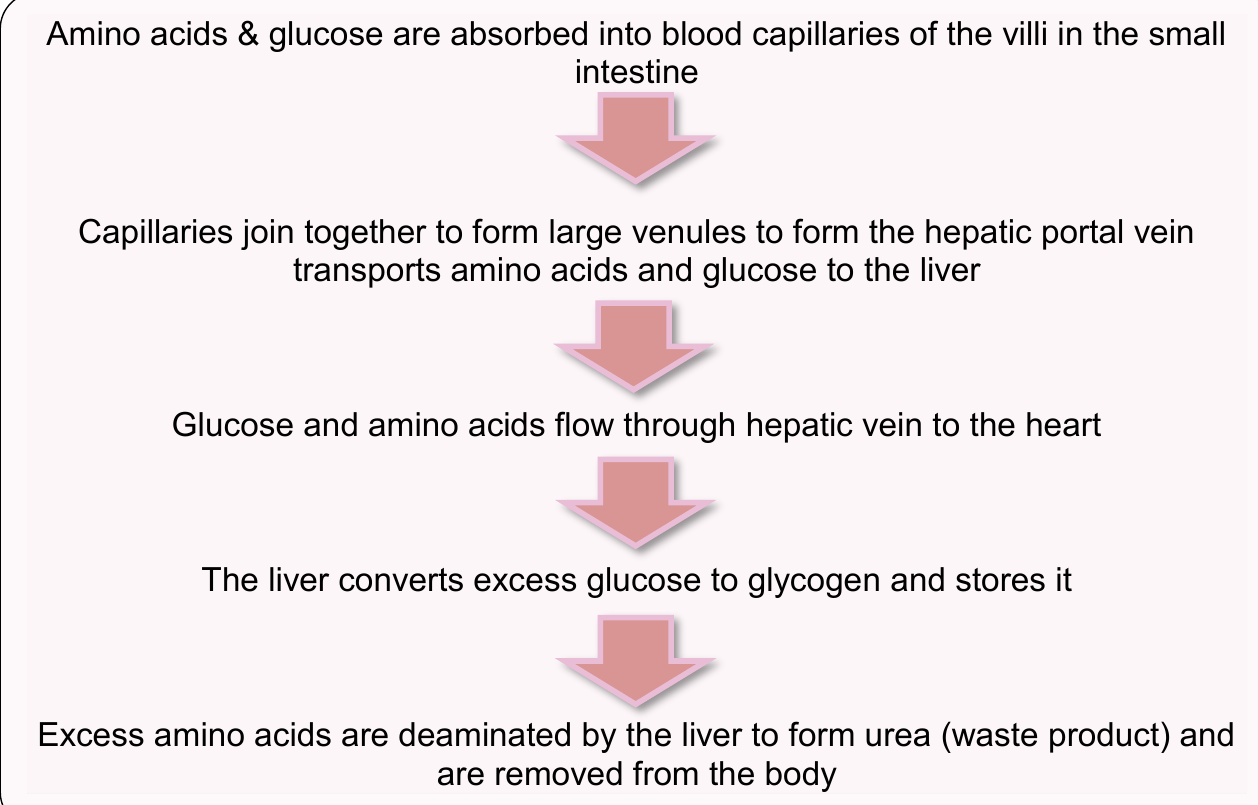
The absorbed nutrients travel from the small intestine villi into blood capillaries, which merge to form the hepatic portal vein. This vein transports nutrients directly to your liver for processing before they circulate throughout your body.
Important
The hepatic portal vein is crucial because it ensures all absorbed nutrients pass through your liver first. This allows your liver to regulate nutrient levels and remove any potentially harmful substances before they reach the rest of your body.
Your liver performs several vital functions:
- Converts excess glucose into glycogen for storage
- Processes amino acids through deamination, removing waste products
- Regulates blood glucose levels
- Metabolises various substances including alcohol and drugs
Assimilation
Assimilation represents the final stage where your body cells actually use the absorbed nutrients. Different cell types absorb specific nutrients according to their needs.
For example, muscle cells absorb amino acids to build and repair proteins, while all cells can absorb glucose for energy production. Your liver plays a central role in assimilation by:
- Managing glucose metabolism
- Processing amino acids through deamination
- Breaking down toxins and waste products
- Producing essential proteins
Egestion
The final stage involves removing undigested materials from your body. Waste products travel through the colon (large intestine), where most remaining water and mineral salts are absorbed.
The colon consists of three regions: ascending, transverse, and descending colon. Undigested material is temporarily stored in the rectum before being eliminated through the anus as faeces.
Summary
Key Points to Remember:
-
The five digestive stages work together: Ingestion → Digestion → Absorption → Assimilation → Egestion create an efficient system for processing nutrients
-
Mechanical and chemical digestion complement each other: Physical breakdown increases surface area for enzyme action, while chemical breakdown creates absorbable molecules
-
The small intestine is perfectly designed for absorption: Its length, folds, villi, and microvilli create an enormous surface area for nutrient uptake
-
Your liver is a metabolic powerhouse: It processes nutrients, stores energy, removes toxins, and helps maintain blood glucose homeostasis