Homeostatic Regulation by the Kidneys (Grade 11 NSC Matric Life Sciences): Revision Notes
📚Revision Notes
Homeostatic Regulation by the Kidneys
Introduction to homeostasis
The human body has an amazing ability to keep its internal environment stable - this process is called homeostasis. Think of it like a thermostat that keeps your house at the perfect temperature. For your body to work properly, several things need to stay within narrow ranges:
- Body temperature around 37°C
- Blood pH levels must be carefully controlled
- The composition of body fluids needs to stay balanced
Note
Just like a thermostat automatically adjusts heating and cooling to maintain your desired room temperature, your body has sophisticated mechanisms that automatically detect changes and make corrections to keep your internal environment stable.
Your kidneys play a crucial role in maintaining homeostasis by controlling three important mechanisms:
- pH regulation of the blood
- Water level regulation (called osmoregulation)
- Salt level regulation in the blood
Osmoregulation
Osmoregulation is the process by which your body controls water and salt levels in your blood and tissue fluids. This is essential because too much or too little water can seriously affect how your cells function.
The main hormone involved in water regulation is ADH (Antidiuretic Hormone). This hormone is produced by the hypothalamus in your brain and released from the pituitary gland. ADH works by controlling how much water your kidneys reabsorb back into your bloodstream.
When water levels are unbalanced
Your body can face two main water-related challenges:
Note
Understanding Dehydration vs Overhydration
Dehydration occurs when you don't have enough water in your blood and tissue fluids. This can happen when you:
- Exercise heavily and sweat a lot
- Are exposed to hot temperatures
- Don't drink enough water
- Lose water through illness
Overhydration happens when there's too much water in your blood and tissue fluids. This can occur when you:
- Are in cooler temperatures with little sweating
- Drink excessive amounts of water
- Don't exercise much
When your hypothalamus detects low water levels, it triggers the pituitary gland to release more ADH. Conversely, when water levels are too high, your hypothalamus detects this and the pituitary gland releases less ADH.
How ADH controls water reabsorption
Important
Critical ADH Mechanism
ADH works by affecting the permeability (how easily water can pass through) of specific parts of your kidney tubules:
When ADH levels are high:
- The collecting ducts and distal convoluted tubules become more permeable to water
- More water is reabsorbed back into your blood
- Less water is lost in urine (concentrated urine is produced)
- Your blood becomes more dilute
When ADH levels are low:
- The kidney tubules become less permeable to water
- Less water is reabsorbed into your blood
- More water is lost in urine (dilute urine is produced)
- More water leaves your body
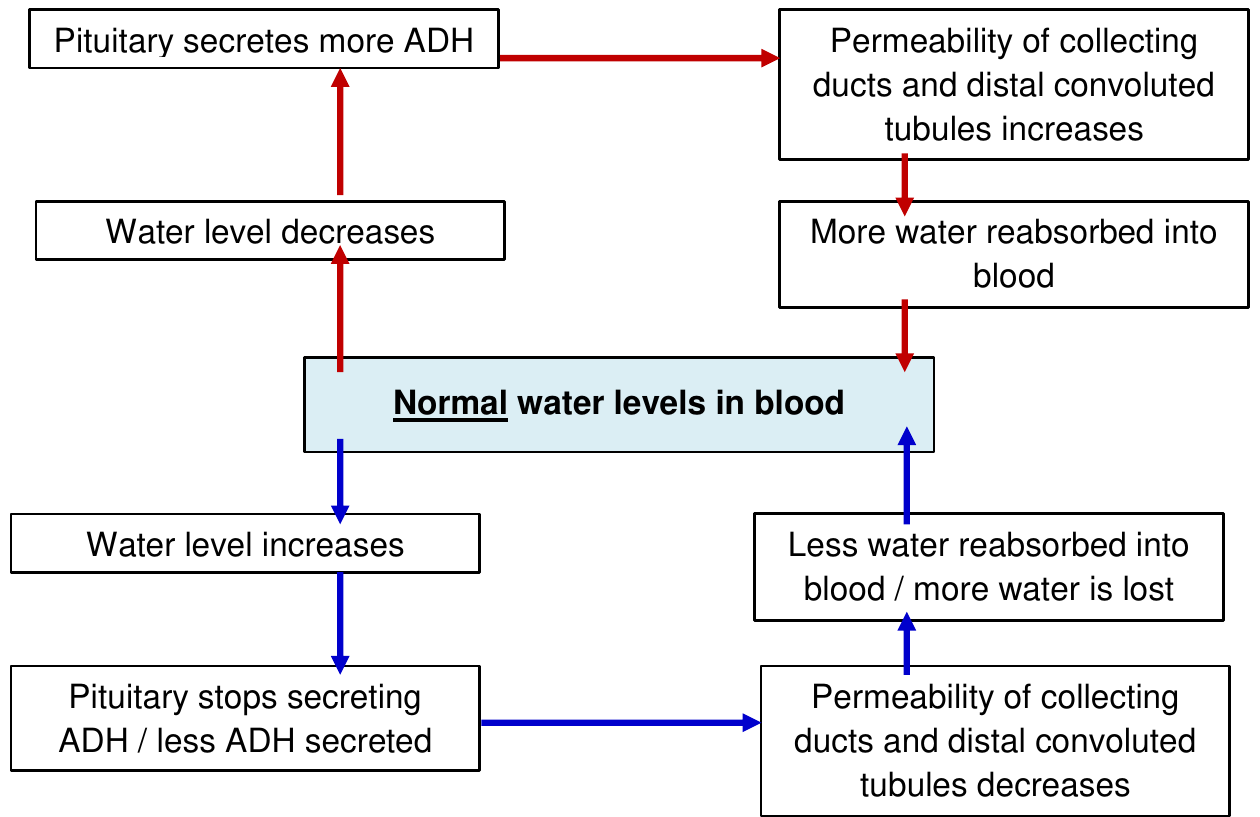
The water regulation feedback loop
Example
Worked Example: The Water Regulation Process
This process works as a negative feedback loop - when water levels move away from normal, your body responds to bring them back to balance:
Step 1: Normal water levels are maintained in your blood
Step 2a: If water levels decrease:
- Pituitary secretes more ADH
- Kidney tubules become more permeable
- More water reabsorbed
- Water levels return to normal
Step 2b: If water levels increase:
- Pituitary stops or reduces ADH secretion
- Kidney tubules become less permeable
- Less water reabsorbed
- Water levels return to normal
Effects of certain drinks
Note
Alcoholic drinks and caffeine-containing beverages (like coffee and tea) act as diuretics. This means they cause you to lose water by making you urinate more frequently. ADH works in the opposite way - it helps your body retain water by reducing water loss.
Regulation of salt levels in the blood
Salt regulation is just as important as water regulation for maintaining healthy body fluids. Sodium and potassium are the main salts found in your body fluids, with sodium being particularly important for proper nerve and muscle function.
How salt levels affect body fluids
Your body needs to maintain constant salt levels because they affect the concentration of your body fluids. The key hormone responsible for this regulation is aldosterone, which is produced by the adrenal glands.
Important
Salt Level Detection and Response
Low salt levels (hypotonic conditions):
- Receptor cells in the kidney's blood vessels detect decreased sodium levels
- The adrenal glands are stimulated to secrete more aldosterone hormone
- Aldosterone increases sodium reabsorption in the kidneys
- Less sodium is lost in urine
- Salt levels return to normal
High salt levels (hypertonic conditions):
- Receptor cells detect increased sodium levels
- The adrenal glands stop releasing aldosterone
- Sodium reabsorption decreases
- More sodium is excreted in urine
- Salt levels return to normal
The aldosterone mechanism

The relationship between aldosterone and sodium regulation is straightforward: when the adrenal gland secretes more aldosterone, reabsorption of sodium ions increases in the kidneys. This helps restore normal salt levels in your blood.
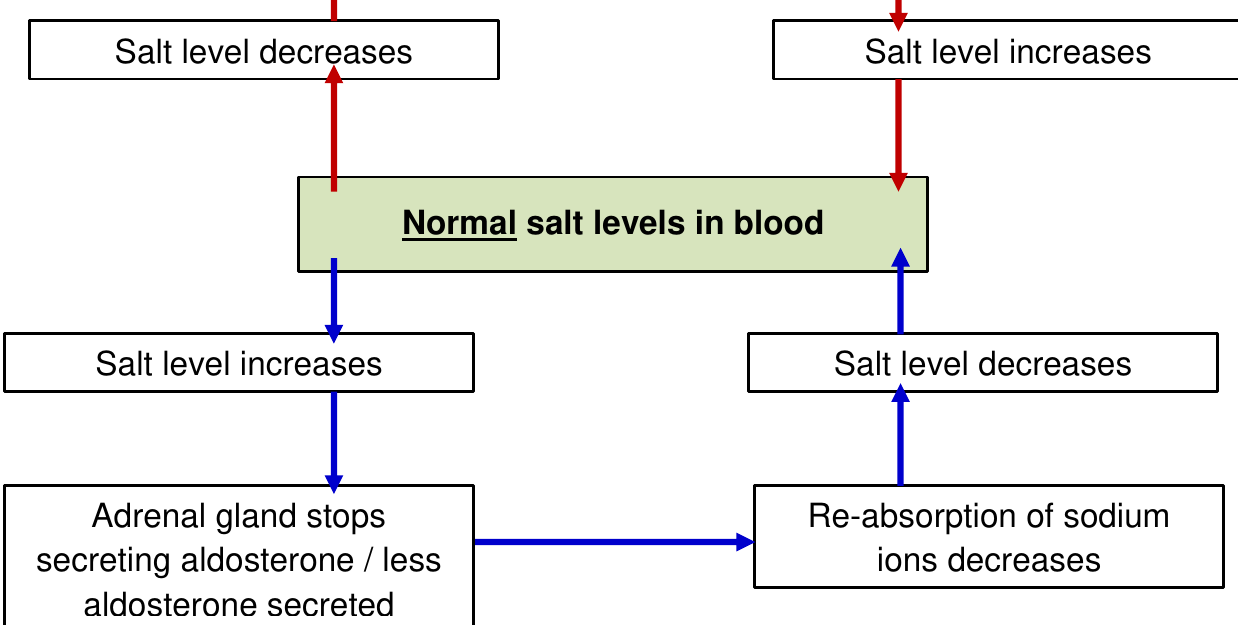
The salt regulation feedback loop
Example
Worked Example: The Salt Regulation Process
Like water regulation, salt control also works through negative feedback:
Step 1: Normal salt levels are maintained in your blood
Step 2a: If salt levels decrease:
- Adrenal gland secretes more aldosterone
- Increased sodium reabsorption occurs
- Salt levels increase back to normal
Step 2b: If salt levels increase:
- Adrenal gland stops secreting aldosterone
- Decreased sodium reabsorption occurs
- More salt lost in urine
- Salt levels decrease back to normal
This system ensures that homeostasis is maintained and your body fluids stay within the optimal range for cellular function.
Summary
Key Points to Remember:
- Homeostasis is your body's ability to maintain a stable internal environment, with kidneys playing a key role in regulating water and salt levels
- ADH (from the pituitary gland) controls water reabsorption - more ADH means more water retained, less ADH means more water lost
- Aldosterone (from the adrenal glands) controls sodium reabsorption - more aldosterone means more sodium retained in the body
- Both water and salt regulation work through negative feedback loops that automatically correct imbalances and return levels to normal
- Diuretics like alcohol and caffeine work opposite to ADH by increasing water loss through urination