Some Basics of Photosynthesis (Grade 11 NSC Matric Life Sciences): Revision Notes
📚Revision Notes
Some Basics of Photosynthesis
What is photosynthesis?
Photosynthesis is one of the most important biological processes on Earth. It's the way plants make their own food using sunlight. Think of it as nature's way of capturing energy from the sun and turning it into usable energy for living things.
Simply put, photosynthesis is a chemical process where plants convert carbon dioxide and water into glucose (sugar) using light energy from the sun. This process also releases oxygen as a waste product, which is lucky for us because we need oxygen to breathe!
The word "photosynthesis" comes from two parts: "photo" meaning light, and "synthesis" meaning to make or build. So photosynthesis literally means "making things with light."
Key terminology you need to know
Before diving deeper into photosynthesis, let's understand some important terms that will help you grasp the concepts better.
Important
Understanding these biological terms is essential for mastering photosynthesis concepts. Take time to learn these definitions as they form the foundation for everything that follows.
- Autotrophic organisms (like green plants) can make their own food through photosynthesis
- Heterotrophic organisms (like animals and humans) must eat other organisms to get energy
- Metabolism includes both building up reactions (anabolism) and breaking down reactions (catabolism)
- Radiant energy – energy from the sun that travels as light and heat, used by plants in photosynthesis.
- Chloroplast – the green part of a plant cell where photosynthesis takes place.
- Chlorophyll – the green pigment in chloroplasts that absorbs sunlight for photosynthesis.
- Thylakoids – tiny, flat discs inside chloroplasts that contain chlorophyll and carry out the light reactions of photosynthesis.
- Grana– stacks of thylakoids inside a chloroplast that increase the surface area for light absorption.
- Stroma – the fluid-filled space around the grana in a chloroplast where the second stage of photosynthesis (the Calvin cycle) happens.
The big picture of photosynthesis
Let's look at how photosynthesis works in a living plant. The process requires specific inputs and produces specific outputs.
Note
Think of photosynthesis as a recipe that plants follow every day. Just like baking a cake requires specific ingredients in the right proportions, photosynthesis needs exact inputs to produce its products.
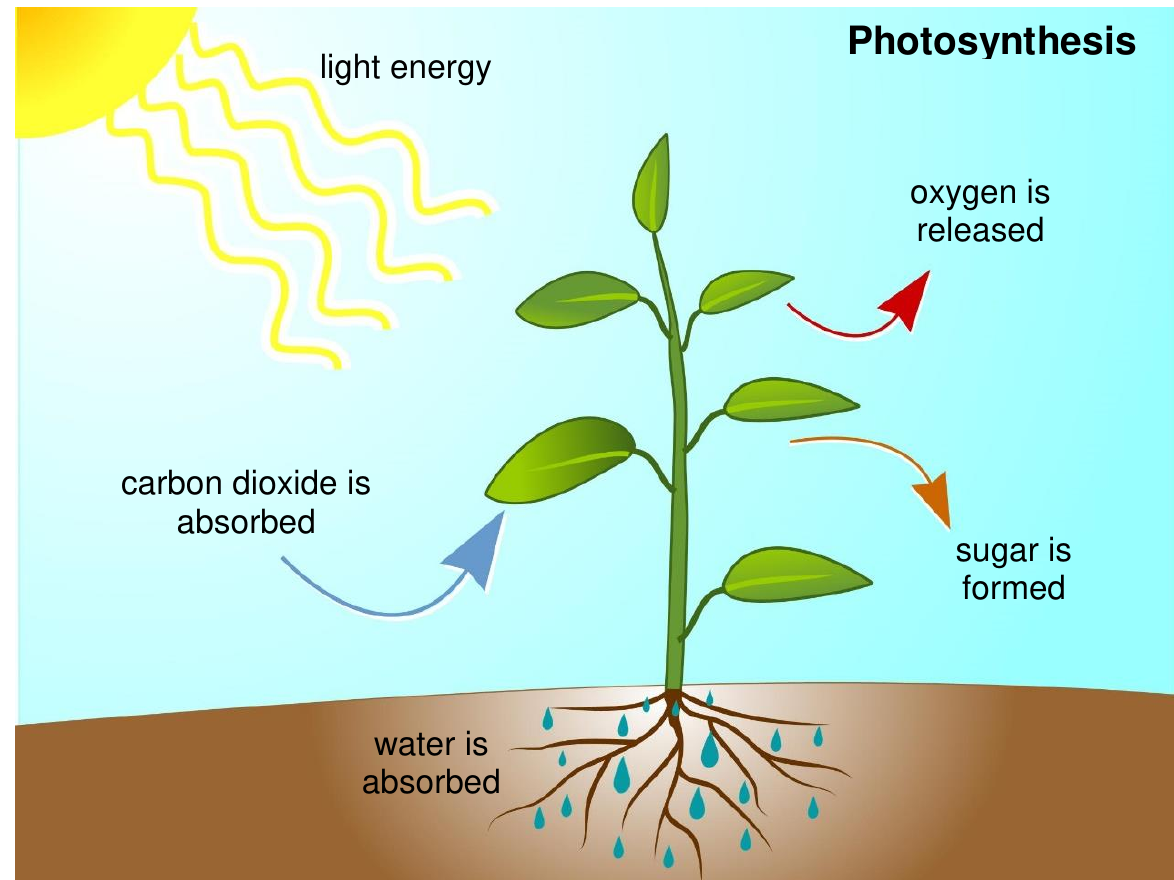
This diagram shows us that photosynthesis is like a recipe. Plants take in carbon dioxide from the air through their leaves, absorb water through their roots, and capture light energy from the sun. They then use these ingredients to make glucose (sugar) and release oxygen back into the atmosphere.
Requirements for photosynthesis
For photosynthesis to occur, plants need five essential things:
- Carbon dioxide: Plants absorb this gas from the atmosphere through tiny pores in their leaves called stomata
- Water: Absorbed from the soil through the plant's root system and transported to the leaves
- Radiant energy: Light energy from the sun is captured by the plant's leaves
- Chlorophyll: This green pigment is essential for capturing light energy
- Enzymes: Special proteins that speed up the chemical reactions involved in photosynthesis
Products of photosynthesis
When photosynthesis occurs, two main products are formed:
- Glucose: A simple sugar that serves as food for the plant. Plants can convert glucose into starch for storage or use it immediately for energy
- Oxygen: Released as a waste product into the atmosphere through the plant's leaves
Photosynthesis equations
Scientists represent the photosynthesis process using both word equations and chemical equations.

The word equation shows us the process in simple terms that are easy to understand.

Example
Understanding the Chemical Equation:
The chemical equation uses scientific symbols to show exactly what happens:
Where:
- represents carbon dioxide
- represents water
- represents glucose
Both equations show that chlorophyll and enzymes are needed to make the reaction happen, but they're not used up in the process - they act as catalysts.
Where does photosynthesis happen?
Photosynthesis occurs in special structures within plant cells called chloroplasts. These are tiny green organelles found mainly in the leaves of plants. The green colour comes from chlorophyll, the pigment that captures light energy.
Understanding chloroplast structure
To understand how photosynthesis works, we need to know about the different parts of a chloroplast and what they do.
The chloroplast has several important components:
- Thylakoids: Disc-shaped structures containing chlorophyll where light reactions occur
- Grana: Stacks of thylakoids that maximise the surface area for capturing light
- Stroma: The liquid-filled space around the grana where sugar production occurs
- Double membrane: Protects the chloroplast and controls what enters and leaves
- Starch granules: Store the glucose that's been converted to starch
- Chloroplast DNA: Contains genetic information needed for chloroplast function
The process of photosynthesis
Photosynthesis happens in two main phases, each occurring in different parts of the chloroplast:
- Light dependent phase: Occurs in the grana (stacks of thylakoids) and requires direct sunlight
- Light independent phase: Occurs in the stroma and doesn't need direct light
Important
These two phases work together but happen in different locations within the chloroplast. Understanding where each phase occurs helps explain why chloroplast structure is so important for the overall process.
During these phases, several important processes occur:
- Photolysis: Water molecules are split using light energy to produce oxygen
- Phosphorylation: Energy is stored in molecules called ATP (adenosine triphosphate)
- Calvin cycle: The process where carbon dioxide is converted into glucose
Remember!
Summary
Key Points to Remember:
-
Photosynthesis converts light energy into chemical energy - it's how plants make food from sunlight, carbon dioxide, and water
-
The equation is simple: Carbon dioxide + Water + Light energy → Glucose + Oxygen (with chlorophyll and enzymes helping)
-
Chloroplasts are the powerhouses - these green organelles in plant cells contain all the machinery needed for photosynthesis
-
Two main phases occur: Light dependent reactions (in grana) and light independent reactions (in stroma)
-
Photosynthesis benefits all life - plants make their own food and release oxygen that other organisms need to survive