The Process of Photosynthesis (Grade 11 NSC Matric Life Sciences): Revision Notes
📚Revision Notes
The Process of Photosynthesis
Photosynthesis is one of the most important biological processes on Earth. It allows plants to convert light energy from the sun into chemical energy in the form of glucose. This process happens inside specialised structures called chloroplasts, which are found in plant cells.
Note
Photosynthesis is essentially how plants make their own food using sunlight, water, and carbon dioxide. It's also the process that produces most of the oxygen we breathe!
The chloroplast structure
Before understanding how photosynthesis works, you need to know about the different parts of a chloroplast and what each part does. Think of a chloroplast like a specialised factory where different departments have specific jobs.
Important
Understanding chloroplast structure is crucial because each part has a specific role in photosynthesis. The location of each process matters!
The chloroplast has several important parts:
- Thylakoids are disc-shaped membranes that contain the green pigment chlorophyll. This is where light energy is captured.
- Grana (singular: granum) are stacks of thylakoids, like piles of coins. This is where the light-dependent reactions happen.
- Lamella are the membranes that make up the thylakoids, providing the surface area needed for chemical reactions.
- Stroma is the liquid-filled space inside the chloroplast, surrounding the grana. This is where glucose is made.
- Starch granules are structures where excess glucose gets stored as starch for later use.
- Chloroplast DNA contains genetic information that helps the chloroplast function independently.
- Double membrane acts like a protective barrier that controls what substances can enter and leave the chloroplast.
Key terminology
Understanding photosynthesis requires knowing some important scientific terms. These words might seem complex at first, but they describe simple concepts.
Note
Don't worry if these terms seem overwhelming at first. Each one describes a simple concept, and understanding them will make photosynthesis much clearer!
Here are the essential terms you need to know:
- Photolysis means splitting water molecules using light energy. The word breaks down into "photo" (light) and "lysis" (split).
- Phosphorylation is the process of making ATP, which are energy-carrying molecules that cells use for power.
- ATP stands for adenosine triphosphate. Think of these as tiny batteries that store and transport energy around cells.
- Calvin cycle is a series of chemical reactions that happen during the light-independent phase to make glucose.
- Glucose is the sugar molecule that plants make during photosynthesis. It's their main food source.
- Starch is how plants store excess glucose, like how we might store food in a pantry.
- Glycogen is how animals store glucose, similar to starch but with a different structure.
Overview of photosynthesis
Photosynthesis happens in two main stages that work together like a relay race. Each phase has a specific job and takes place in a different part of the chloroplast.
The two phases are:
- Light dependent phase: Requires light energy and happens in the grana
- Light independent phase: Does not need light directly and happens in the stroma
Note
These phases are connected because the products made in the first phase are used as raw materials in the second phase. Think of it as a production line where one department's output becomes the next department's input.
The light dependent phase
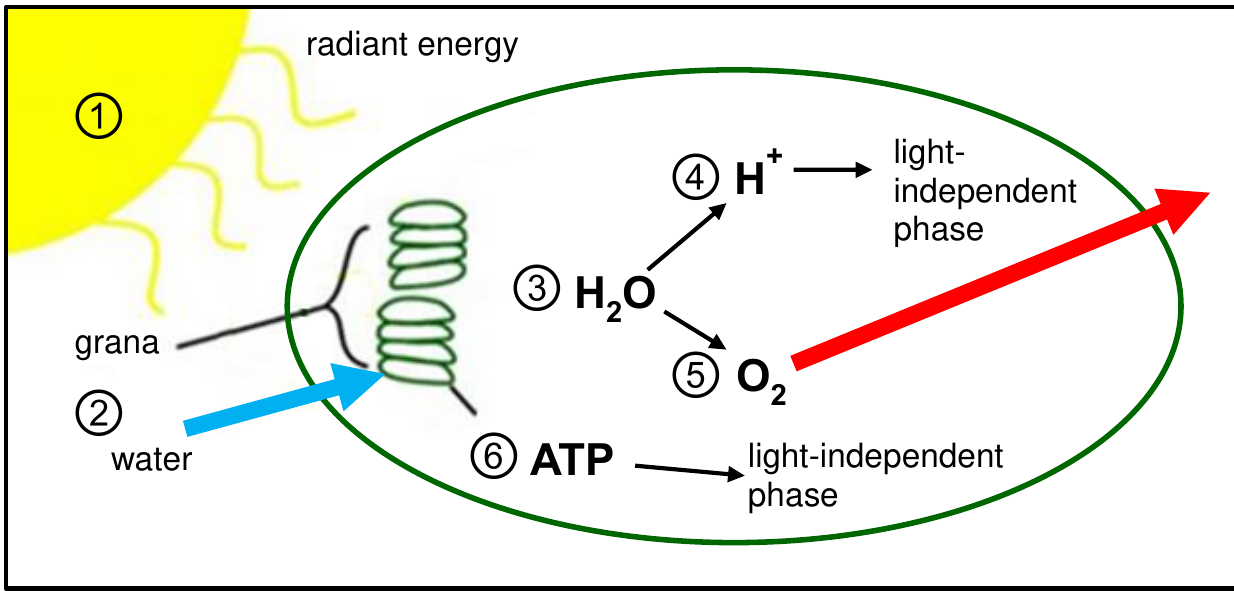
This first phase of photosynthesis captures light energy and uses it to split water molecules. It happens in the grana of chloroplasts and requires direct sunlight to work.
Example
Worked Example: The Light Dependent Phase Process
Here's how the light dependent phase works step by step:
Step 1: Light energy absorption
Chlorophyll in the grana captures radiant energy from the sun. This energy powers all the reactions that follow.
Step 2: Water uptake
Water molecules () are absorbed into the grana of the chloroplast from the surrounding plant tissue.
Step 3: Photolysis occurs
The captured light energy causes water molecules to split apart. This process is called photolysis because light ("photo") splits ("lysis") the water.
Step 4: Hydrogen ions released
When water splits, it produces energy-rich hydrogen ions (). These hydrogen ions will be used in the next phase of photosynthesis.
Step 5: Oxygen released
The other product of water splitting is oxygen gas (). Plants release this oxygen into the atmosphere as a waste product, which is lucky for us because we need it to breathe!
Step 6: ATP formation
The light energy also causes phosphorylation to happen, which means ATP energy carriers are made. These ATP molecules will power the reactions in the light independent phase.
The key point to remember is that this phase converts light energy into chemical energy (ATP) and provides the hydrogen ions needed for making glucose.
The light independent phase
The second phase of photosynthesis uses the products from the first phase to make glucose. It happens in the stroma of chloroplasts and can continue even when there's no light, as long as ATP and hydrogen ions are available.
This phase is also called the Calvin cycle because it involves a series of reactions that repeat in a cycle.
Example
Worked Example: The Light Independent Phase Process
Step 1: Carbon dioxide absorption
Carbon dioxide gas () enters the plant through tiny pores called stomata and travels to the chloroplast stroma.
Step 2: Glucose production
The carbon dioxide combines with the hydrogen ions () from the light dependent phase. This reaction is powered by the ATP that was also made in the first phase. The result is glucose formation.
Step 3: Starch storage
Any excess glucose that the plant doesn't need immediately gets converted into starch and stored in starch granules within the chloroplast.
Important
This phase can happen in light or darkness because it doesn't directly need light energy. However, it does need the ATP and hydrogen ions that were made using light energy in the first phase.
Comparison between the phases
Understanding the differences between these two phases helps you see how photosynthesis works as a complete process.
| Feature | Light Dependent Phase | Light Independent Phase |
|---|---|---|
| Location | Occurs in the grana | Occurs in the stroma |
| Light requirement | Light is required | Light is not required |
| Main process | Radiant energy is absorbed and used for photolysis and phosphorylation | Carbon dioxide is absorbed from the atmosphere |
| Key reactions | Photolysis occurs - hydrogen is released and oxygen returns to the atmosphere | Hydrogen and carbon dioxide combine using ATP to form glucose |
| Products | ATP is produced | Excess glucose is stored as starch |
Note
This comparison shows how the two phases complement each other. The first phase captures and converts energy, while the second phase uses that energy to build glucose molecules.
Process overview
Looking at photosynthesis as a whole process helps you understand how all the parts work together.
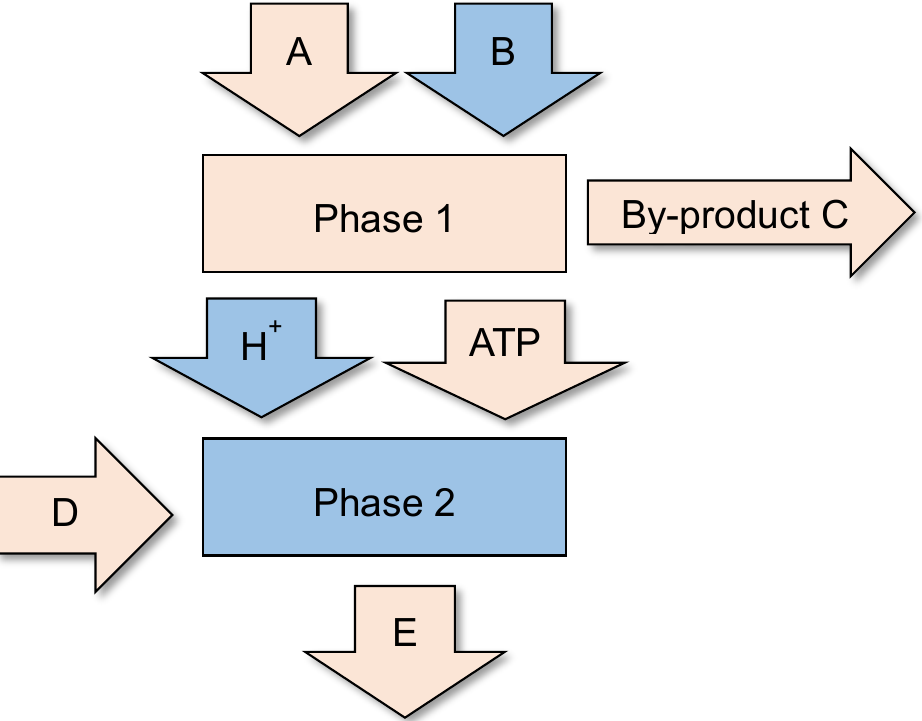
The overall process can be summarised as:
- Phase 1 (Light dependent): Takes in light energy and water, produces ATP, hydrogen ions, and oxygen
- Phase 2 (Light independent): Takes in carbon dioxide and uses ATP and hydrogen ions to produce glucose
Important
The connection between phases is crucial - Phase 1 creates the "fuel" (ATP) and "building blocks" (hydrogen ions) that Phase 2 needs to make glucose.
The importance of photosynthesis
Photosynthesis is essential for life on Earth for several important reasons:
Atmospheric balance: Photosynthesis helps maintain the right levels of carbon dioxide and oxygen in our atmosphere. Plants take in carbon dioxide (which can be harmful in large amounts) and release oxygen (which we need to breathe).
Energy conversion: The process converts light energy from the sun into chemical energy stored in glucose. This is the foundation of almost all food chains on Earth.
Food production: Glucose serves as food for the plants themselves and for other organisms that eat plants. Without photosynthesis, there would be no food for any living thing.
Additional compounds: Plants use the stored starch to make other important biological molecules like proteins and lipids, which are essential for growth and development.
Summary
Key Points to Remember:
- Photosynthesis happens in two connected phases: light dependent (in grana) and light independent (in stroma)
- The light dependent phase splits water using light energy, producing ATP, hydrogen ions, and oxygen
- The light independent phase combines carbon dioxide with hydrogen ions (using ATP for energy) to make glucose
- Photosynthesis is vital for life because it balances atmospheric gases, converts solar energy to chemical energy, and provides the foundation for all food chains
- Excess glucose is stored as starch in plants, which can be converted into other essential biological molecules when needed