Quadratic Inequalities (Grade 11 NSC Matric Mathematics): Revision Notes
📚Revision Notes
Quadratic Inequalities
What are quadratic inequalities?
A quadratic inequality is an inequality that involves a quadratic expression. Unlike quadratic equations where we find exact values, quadratic inequalities ask us to find ranges of values that satisfy the given condition.
Quadratic inequalities can take four main forms:
- (greater than zero)
- (greater than or equal to zero)
- (less than zero)
- (less than or equal to zero)
Note
The key difference between quadratic equations and inequalities is that equations give us specific x-values as solutions, while inequalities give us ranges or intervals of x-values that make the inequality true.
How to solve quadratic inequalities
To solve a quadratic inequality, we need to determine which parts of the graph of the quadratic function lie above or below the x-axis. The most reliable approach uses a systematic method with a table of signs.
Note
Why use a table of signs?
A table of signs helps us organize our work systematically and ensures we don't miss any intervals or make sign errors. This method works consistently for all types of quadratic inequalities.
Step-by-step method:
Step 1: Factorise the quadratic expression
- Write the quadratic in factorised form if possible
- If factorisation is difficult, use the quadratic formula to find the roots first
Step 2: Find the critical values
- Critical values are the x-values where the expression equals zero
- These are the roots of the quadratic equation
- Set each factor equal to zero to find these values
Step 3: Create a table of signs
- Use the critical values to divide the number line into intervals
- Test the sign of each factor in each interval
- Multiply the signs to find where the whole expression is positive or negative
Step 4: Sketch a rough graph (optional)
- This helps visualise the solution
- Remember: if , the parabola opens upward (U-shape)
- If , the parabola opens downward (∩-shape)
Step 5: Write the final answer
- Express your solution in interval notation or inequality form
- Represent the solution on a number line
Worked examples
Example
Worked Example 1: Standard quadratic inequality
Question: Solve
Solution:
Step 1: Factorise the quadratic
So we need to solve:
Step 2: Find critical values Setting each factor to zero: and
Step 3: Complete the table of signs
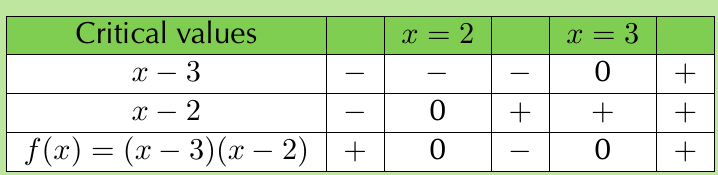
From this table, we can see that when or .
Step 4: Sketch the graph
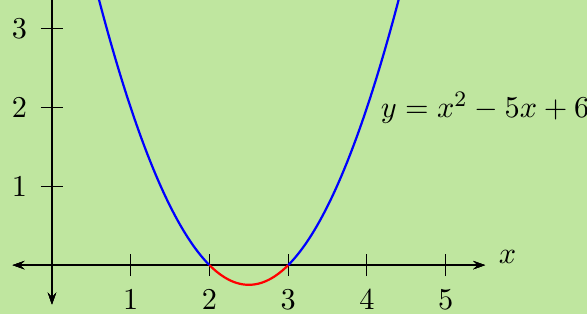
The graph shows that the parabola is above or on the x-axis for or .
Step 5: Final answer
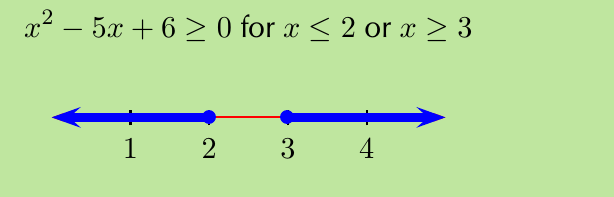
for or
Example
Worked Example 2: Perfect square case
Question: Solve
Solution:
Step 1: Factorise the quadratic
So we need:
Step 2: Find critical values
Setting gives us , so
Since is always positive or zero (being a perfect square), it can only equal zero at .
Step 3: Analysis Since a square of any real number is never negative, has no solution. only when .
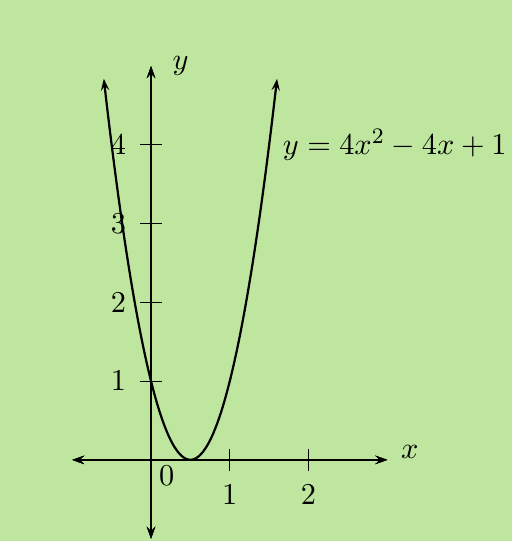
Final answer:
Example
Worked Example 3: Using the quadratic formula
Question: Solve
Solution:
Step 1: Check if factorisation is possible
The expression cannot be easily factorised, so we use the quadratic formula.
Step 2: Find the roots using the quadratic formula
For :
and
Step 3: Create the table of signs

Step 4: Analyse the graph
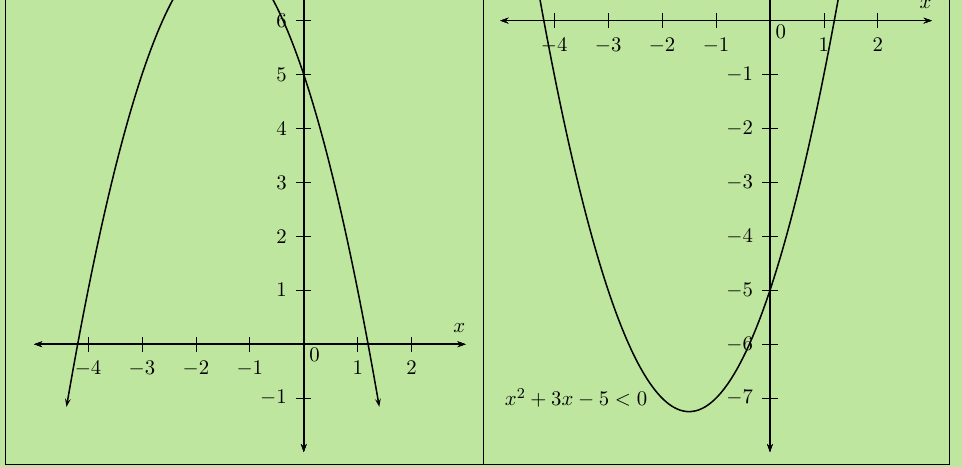
Since , the parabola opens upward. The quadratic is negative between the two roots.
Step 5: Final answer
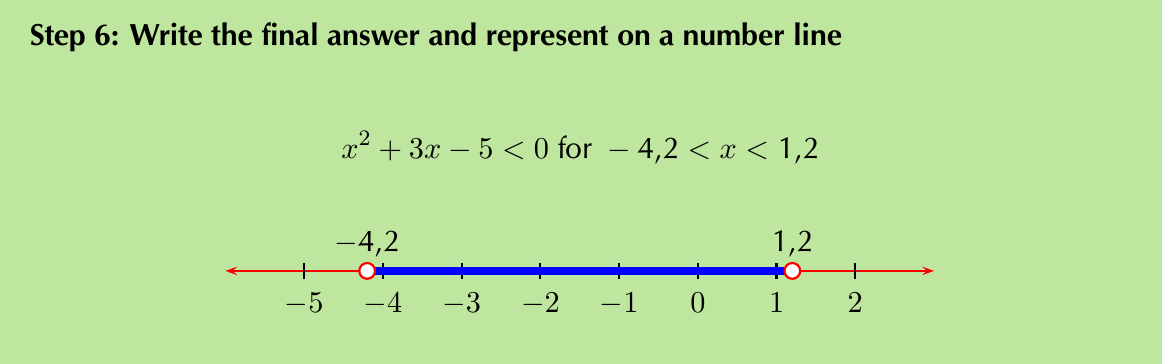
for (approximately)
Example
Worked Example 4: Quadratic inequalities with fractions
Question: Solve where
Solution:
Step 1: Rearrange the inequality
Step 2: Find a common denominator
Step 3: Find critical values
The critical values are: , , and
Note: and make the denominator zero, so they're restrictions, not part of the solution.
Step 4: Complete the table of signs
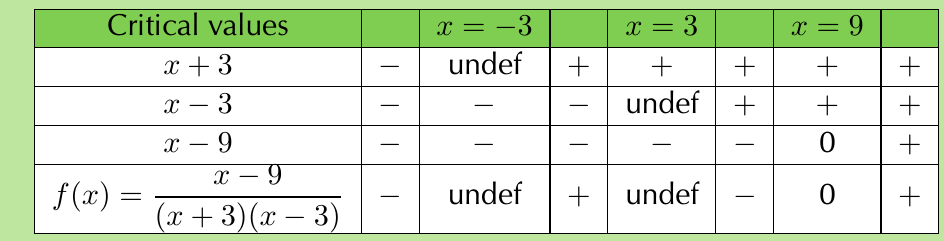
Step 5: Final answer
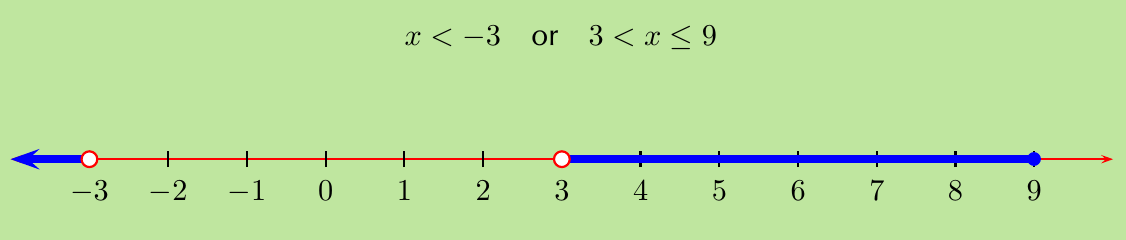
The solution is: or
Important exam tips
Important
Common Pitfalls to Avoid:
- Sign changes: When multiplying or dividing an inequality by a negative number, remember to flip the inequality sign.
- Perfect squares: Remember that always, and only when the expression equals zero.
- Restrictions: When dealing with fractions, always identify values that make denominators zero - these cannot be part of your solution.
- Boundary values: Pay attention to whether boundary points are included (≤, ≥) or excluded (<, >) in your final answer.
Summary
Key Points to Remember:
- Quadratic inequalities involve finding ranges of x-values rather than specific solutions
- Use a table of signs to systematically determine where the expression is positive or negative
- Critical values are where the expression equals zero - these divide your number line into intervals
- Always check restrictions when fractions are involved in the inequality
- Perfect squares are never negative - they can only be positive or zero