Summary (Grade 11 NSC Matric Mathematics): Revision Notes
📚Revision Notes
Summary
Key formulas for interest and depreciation
Financial mathematics involves calculating how money grows through interest or decreases through depreciation over time. There are two main approaches for each scenario: simple and compound calculations.
Important
Critical Distinction:
- Simple calculations use linear formulas with
- Compound calculations use exponential formulas with
Understanding this fundamental difference is essential for choosing the correct approach in exam problems.
Simple interest and depreciation
Simple interest means that interest is calculated only on the original principal amount throughout the entire investment period. The interest earned each year remains constant.
Formula:
Where:
- = final accumulated amount
- = principal (initial amount)
- = interest rate per period (as a decimal)
- = number of time periods
Note
In simple interest calculations, the interest amount stays the same each year because it's always calculated on the original principal only, never on previously earned interest.
Simple depreciation works similarly but represents a decrease in value. The depreciation amount remains constant each year.
Formula:
The key difference is the minus sign, showing that value decreases rather than increases.
Compound interest and depreciation
Compound interest means that interest is calculated on both the principal amount and any previously earned interest. This creates exponential growth because you earn "interest on interest."
Formula:
Compound depreciation follows the same exponential pattern but shows decreasing value over time.
Formula:
Important
Key Recognition: Notice that compound formulas use exponential notation instead of the linear used in simple calculations. This exponential component creates the powerful effect of compounding.
Nominal and effective annual interest rates
When interest is compounded more frequently than annually (such as monthly or quarterly), there's an important distinction between the nominal rate and the effective rate.
Note
Understanding the Difference:
- Nominal interest rate is the stated annual interest rate without considering the effect of compounding frequency
- Effective annual interest rate is the actual annual rate you earn when compounding occurs more frequently than once per year
Formula:
Where:
- = effective annual interest rate
- = nominal annual interest rate
- = number of compounding periods per year
Important
Critical Rule: The effective rate is always higher than the nominal rate when compounding occurs more than once per year. More frequent compounding always increases the effective annual interest rate.
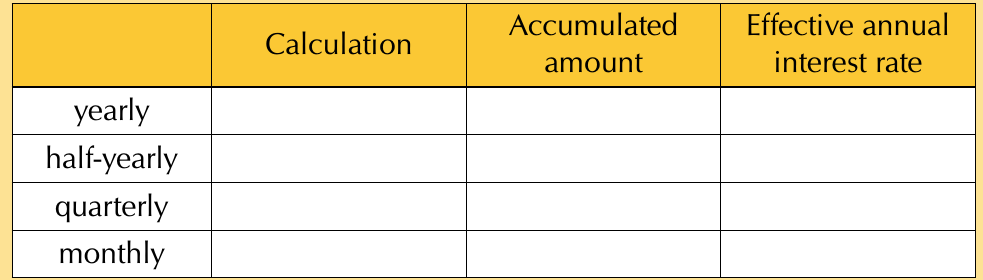
This table structure helps you compare how different compounding frequencies affect your final accumulated amount and effective annual interest rate.
Worked examples
Example
Worked Example 1: Simple vs Compound Interest
Problem: Calculate the accumulated amount after 3 years if R5000 is invested at 8% per annum using both simple and compound interest.
Simple interest solution:
Compound interest solution:
Result: The compound interest generates R58.56 more due to earning interest on previously earned interest.
Example
Worked Example 2: Effective Annual Interest Rate
Problem: Calculate the effective annual interest rate equivalent to a nominal interest rate of 8.75% per annum compounded monthly.
Solution:
Result: The effective annual rate (9.12%) is higher than the nominal rate (8.75%) because of monthly compounding.
Example
Worked Example 3: Comparing Investment Options
Problem: Determine which option provides better returns for paying back a student loan:
- Option A: 9.1% per annum compounded quarterly
- Option B: 9% per annum compounded monthly
- Option C: 9.3% per annum compounded half-yearly
Solution: Calculate the effective annual rate for each option:
Option A:
- Effective rate = 9.40%
Option B:
- Effective rate = 9.38%
Option C:
- Effective rate = 9.53%
Answer: Option B (9% compounded monthly) is the best choice as it has the lowest effective annual interest rate.
Note
Exam Strategy Tips:
- Always identify whether the problem involves simple or compound calculations
- When comparing different investment or loan options, convert to effective annual rates for fair comparison
- Remember that more frequent compounding generally results in higher effective rates
- Check your calculator is in the correct mode and round final answers appropriately
- For depreciation problems, ensure you use the minus sign in your formulas
Summary
Key Points to Remember:
- Simple interest/depreciation: Linear growth/decline using
- Compound interest/depreciation: Exponential growth/decline using
- Effective rates are always higher than nominal rates when compounding occurs more than annually
- Frequent compounding increases the effective annual interest rate
- Always convert to effective rates when comparing different financial options