Analytical Geometry (Grade 11 NSC Matric Mathematics): Revision Notes
📚Revision Notes
Inclination of a Line
What is the angle of inclination?
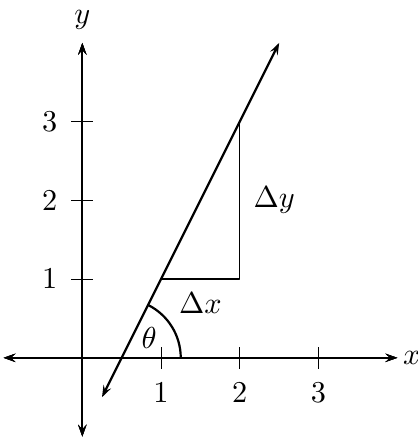
The angle of inclination of a straight line is the angle that the line makes with the positive x-axis. This angle is always measured from the positive x-axis in an anticlockwise direction.
Note
The angle of inclination is represented by the Greek letter θ (theta) and can range from 0° to 180°. Understanding this concept is crucial because it directly connects the geometric appearance of a line with its algebraic properties.
The relationship between gradient and angle of inclination
There is a fundamental relationship between the gradient of a line and its angle of inclination. From the coordinate geometry basics, we know that gradient is calculated as:
From trigonometry, we also know that the tangent ratio is:
Looking at the right triangle formed by the line, we can see that:
Important
The Key Relationship:
This means that the gradient of any straight line equals the tangent of its angle of inclination.
Special cases you need to know
Vertical lines
For vertical lines:
- The angle of inclination θ = 90°
- The gradient is undefined because there is no change in x-values (Δx = 0)
- Therefore, tan θ is also undefined (since tan 90° is undefined)
Horizontal lines
For horizontal lines:
- The angle of inclination θ = 0°
- The gradient equals 0 because there is no change in y-values (Δy = 0)
- Therefore, tan θ = tan 0° = 0
Lines with negative gradients
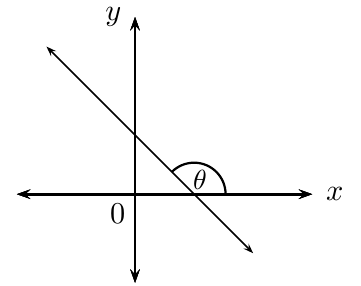
When a straight line has a negative gradient, the angle formed between the line and the positive x-axis appears obtuse (greater than 90°).
Important
Process for Handling Negative Gradients:
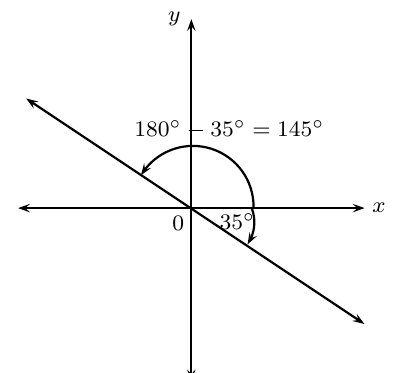
- Calculate the gradient as normal:
- This gives a negative angle in the fourth quadrant
- Add 180° to convert this to the obtuse angle in the second quadrant
- The final angle of inclination will be between 90° and 180°
Worked examples
Example
Worked Example 1: Finding the angle of inclination from two points
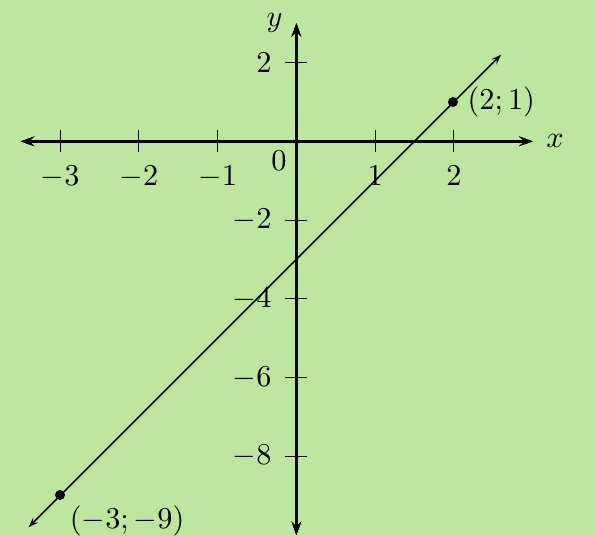
Question: Determine the angle of inclination of the straight line passing through the points (2; 1) and (-3; -9).
Solution:
Step 1: Draw a sketch to visualise the problem.
Step 2: Assign variables to the coordinates.
- Point 1:
- Point 2:
Step 3: Calculate the gradient.
Step 4: Use the gradient to find the angle of inclination.
Important: Make sure your calculator is in DEG (degrees) mode.
Answer: The angle of inclination is 63.4°.
Example
Worked Example 2: Finding the equation from angle of inclination
Question: Determine the equation of the straight line passing through the point (3; 1) with an angle of inclination of 135°.
Solution:
Step 1: Use the angle of inclination to find the gradient.
Step 2: Write the gradient-point form of the line equation.
Step 3: Substitute the known values.
Answer: The equation of the straight line is y = -x + 4.
Example
Worked Example 3: Finding the acute angle between two lines
Question: Determine the acute angle between the line passing through points M(-1; 7/4) and N(4; 3), and the straight line y = -3/2x + 4.
Solution:
Step 1: Draw a sketch to visualise the problem.
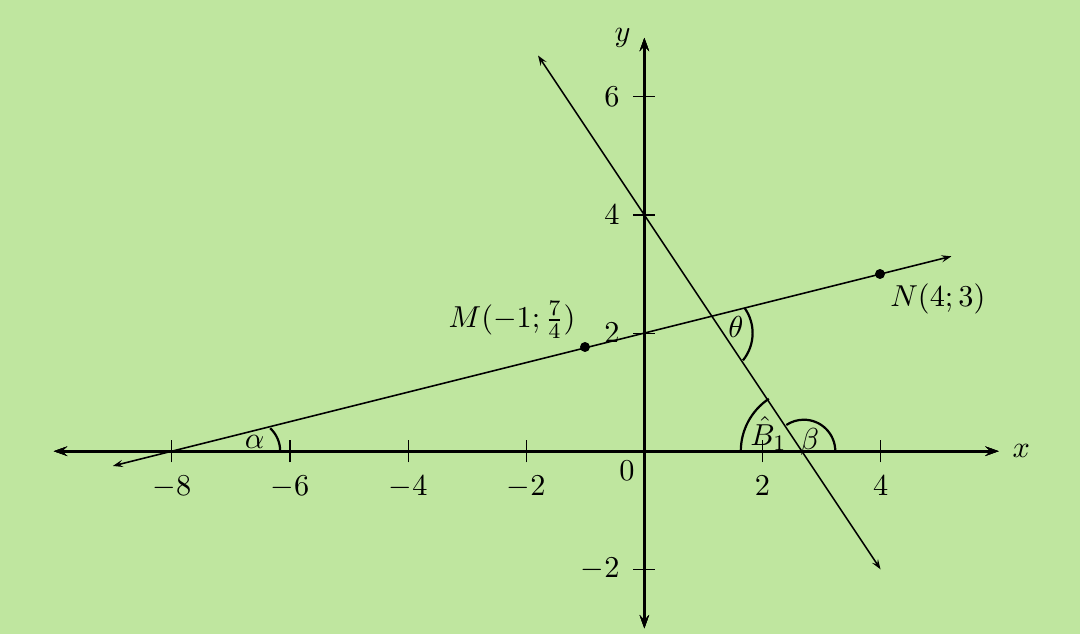
Step 2: Find the gradient of the first line (through M and N).
Step 3: Find the angle of inclination of the first line.
Step 4: Find the angle of inclination of the second line.
- From y = -3/2x + 4, the gradient is -3/2.
Since this is negative, we add 180°:
Step 5: Calculate the acute angle between the lines.
Answer: The acute angle between the two straight lines is 70.3°.
Key formulas and exam tips
Important
Essential Formulas:
- Gradient:
- Angle of inclination: for
- For negative gradients: Add 180° to the reference angle
Note
Exam Tips:
- Always ensure your calculator is in degrees mode (DEG)
- For negative gradients, remember to add 180° to get the obtuse angle
- Draw a sketch when possible - it helps prevent errors
- Double-check your answer by substituting back into
Important
Common Exam Traps:
- Forgetting to convert negative angles to obtuse angles
- Calculator set to radians instead of degrees
- Mixing up the order of coordinates when calculating gradient
- Not recognising when to find acute vs obtuse angles between lines
Summary
Key Points to Remember:
- The angle of inclination is the angle between a line and the positive x-axis, measured anticlockwise
- The key relationship is , connecting gradient and angle of inclination
- Vertical lines have θ = 90° and undefined gradient
- Horizontal lines have θ = 0° and gradient = 0
- For negative gradients, add 180° to the reference angle to get the correct obtuse angle of inclination