Parallel Lines (Grade 11 NSC Matric Mathematics): Revision Notes
📚Revision Notes
Parallel Lines
Definition and key concept
Parallel lines are straight lines that never intersect, no matter how far they are extended. In coordinate geometry, parallel lines have a special relationship with their gradients.
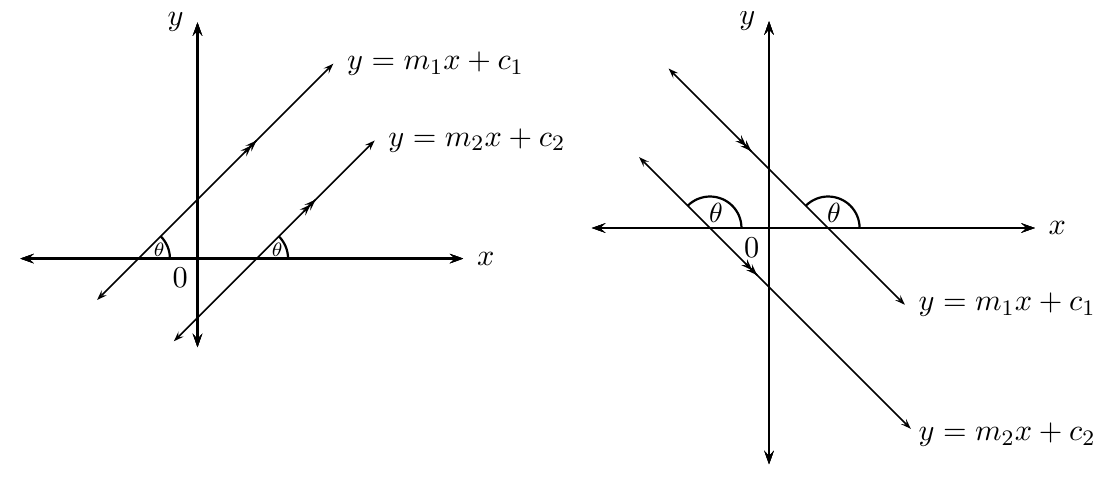
The most important property of parallel lines is that they have equal gradients. If two lines are parallel, their gradients (slopes) are exactly the same.
Note
Key rule: If line 1 has gradient and line 2 has gradient , and the lines are parallel, then:
Understanding gradients in parallel lines
When we have two lines with equations in the form :
- Line 1:
- Line 2:
For these lines to be parallel, we need m₁ = m₂. The values (y-intercepts) can be different - this is what makes the lines parallel rather than identical.
Example
Practical Example: Parallel Lines with Different Y-Intercepts
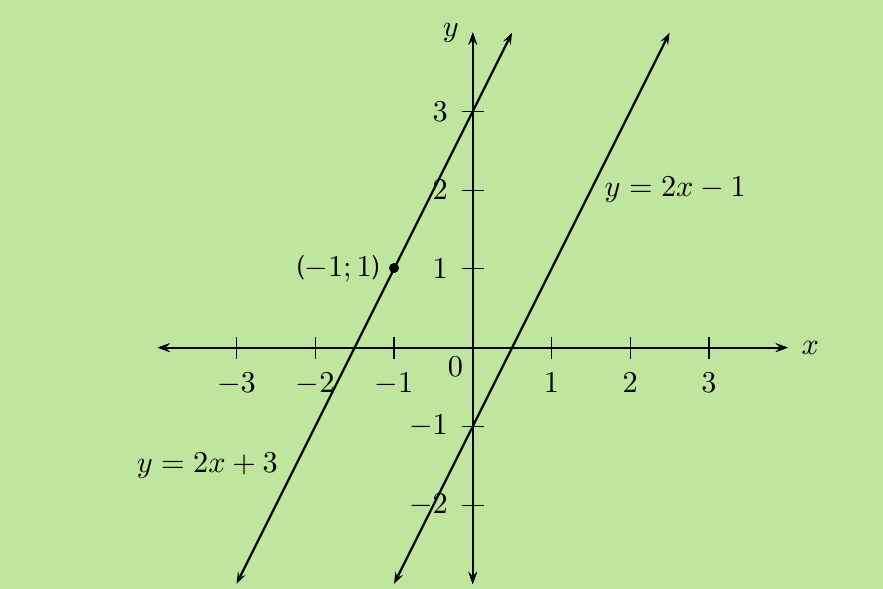
The diagram shows two parallel lines: and .
Notice both have:
- Gradient = 2 (same slope)
- Different y-intercepts (3 and -1)
This is what makes them parallel - same direction, different positions.
Method for finding equation of parallel line
To find the equation of a line that is parallel to a given line and passes through a specific point, follow these steps:
Note
Step-by-Step Method:
Step 1: Write the given equation in gradient-intercept form
Convert the equation to format to identify the gradient.
Step 2: Use the gradient-point form
Since parallel lines have equal gradients, use the same gradient in the gradient-point form:
where is the given point.
Step 3: Simplify to get the final equation
Expand and rearrange to get the equation in form.
Worked example 1: Finding parallel line equation
Example
Worked Example: Finding Parallel Line Through Given Point
Question: Determine the equation of the line that passes through the point and is parallel to the line .
Solution:
Step 1: Write the equation in gradient-intercept form
The gradient is m = 2.
Step 2: Apply the parallel line rule
Since the lines are parallel: m₁ = m₂ = 2
Step 3: Use gradient-point form
Substitute and point :
Answer: The equation is y = 2x + 3
Worked example 2: Using angle of inclination
Example
Worked Example: Parallel Line Using Angle of Inclination
Question: Line passes through point and has an angle of inclination of . Determine the equation of line which passes through point and is parallel to .
Solution:
Step 1: Find the gradient using angle of inclination
Step 2: Apply parallel lines rule
Since :
Step 3: Use gradient-point form
Substitute and point :
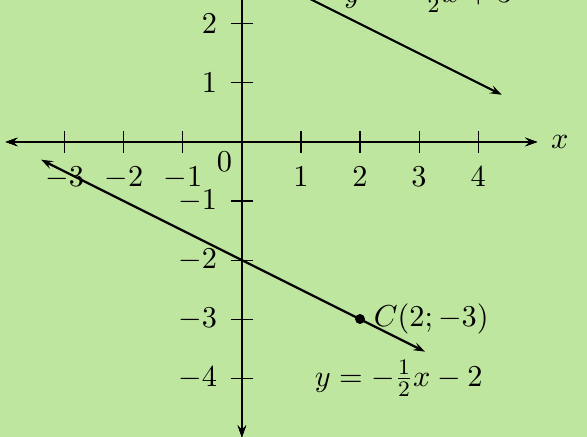
Answer: The equation is y = -½x - 2
Important exam tips
Important
Critical Exam Success Tips:
-
Always convert to gradient-intercept form first - Make sure the given equation is in form before identifying the gradient.
-
Check your gradient signs - Pay careful attention to positive and negative gradients, especially when working with angles of inclination greater than 90°.
-
Use sketches to verify - Drawing a quick sketch can help you check if your parallel lines look correct and don't intersect.
-
Remember the gradient-point formula: is your key tool for finding equations when given a point and gradient.
Key formulas to memorise
Note
Essential Formulas for Parallel Lines:
- Gradient-intercept form:
- Gradient-point form:
- Parallel lines condition:
- Gradient from angle:
Remember!
Summary
Key Points to Remember:
- Parallel lines always have equal gradients - this is the fundamental rule for identifying and creating parallel lines
- Different y-intercepts make lines parallel rather than identical - same gradient, different starting points
- Convert equations to standard form before comparing gradients to avoid mistakes
- Use gradient-point form when you know a point and need to find a parallel line equation
- Sketch your answer when possible to verify that your lines appear parallel and make sense