Perpendicular Lines (Grade 11 NSC Matric Mathematics): Revision Notes
📚Revision Notes
Perpendicular Lines
What are perpendicular lines?
Perpendicular lines are straight lines that intersect each other at exactly 90 degrees (a right angle). When two lines are perpendicular, there is a special mathematical relationship between their gradients that helps us identify and work with them.
Important
The most important property of perpendicular lines is that the product of their gradients equals -1. This means if one line has gradient and another line has gradient , and these lines are perpendicular, then:
We can also express this relationship by saying that the gradients are negative reciprocals of each other:
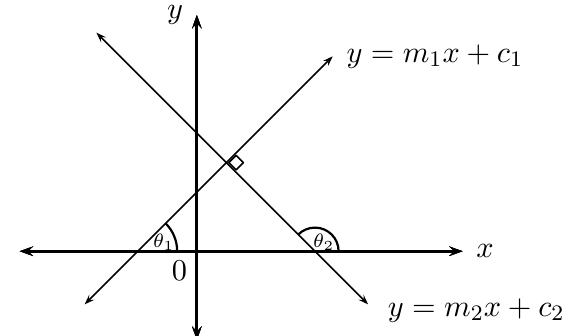
Deriving the formula m₁ × m₂ = -1
To understand why perpendicular lines have gradients whose product is -1, let's examine the mathematical proof using coordinate geometry.
Note
Mathematical Proof Using Coordinate Geometry
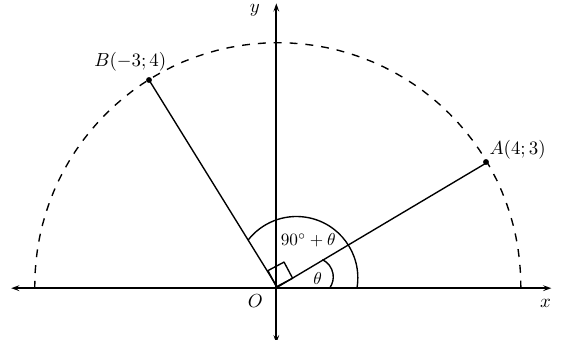
Consider a point on the Cartesian plane with an angle of inclination from the positive x-axis. If we rotate this point through 90° and place point at , the angle of inclination becomes .
Let's calculate the gradient of line :
Now let's calculate the gradient of line :
By rotating through 90°, we know that . Let's check the product of their gradients:
This proves our formula! For any general point with angle of inclination , if we create a perpendicular line through point with angle of inclination , we get:
Finding equations of perpendicular lines
When we need to find the equation of a line that is perpendicular to a given line and passes through a specific point, we follow a systematic approach.
Method for finding perpendicular line equations
Note
Step-by-Step Method
Step 1: Write the given line equation in standard form to identify the gradient .
Step 2: Use the perpendicular relationship to find the gradient of the unknown line:
Step 3: Use the gradient-point form with the given point - :
Step 4: Simplify to get the final equation in standard form.
Important
This rule does not apply to vertical or horizontal lines, as their gradients are undefined or zero respectively.
Worked examples
Example
Worked Example 1: Finding a perpendicular line to a given equation
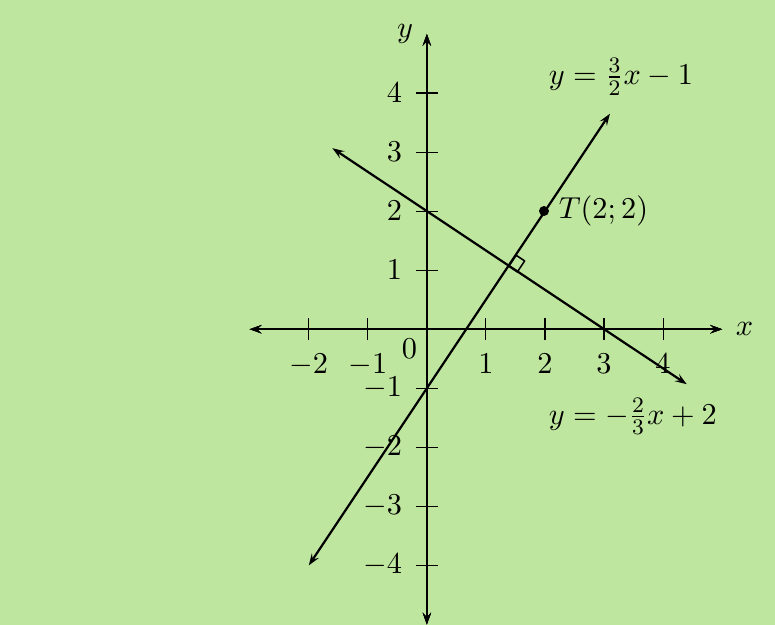
Question: Determine the equation of the straight line passing through the point and perpendicular to the line .
Solution:
Step 1: Write the equation in standard form
Starting with :
Therefore,
Step 2: Find the gradient of the perpendicular line
Since the lines are perpendicular:
Step 3: Use gradient-point form
Example
Worked Example 2: Using angle of inclination
Question: Determine the equation of the straight line passing through the point and perpendicular to the line with an angle of inclination of 71.57°.
Solution:
Step 1: Find the gradient from the angle of inclination
Step 2: Find the gradient of the perpendicular line
Since the lines are perpendicular:
Step 3: Use gradient-point form
Summary
Key Points to Remember:
- Perpendicular lines intersect at 90 degrees and their gradients multiply to give -1
- The formula is m₁ × m₂ = -1 - this is the key relationship to remember
- Gradients are negative reciprocals - flip the fraction and change the sign
- Always convert to standard form first when finding gradients from equations
- Use gradient-point form to find the equation once you know the perpendicular gradient