Euclidean Geometry (Grade 11 NSC Matric Mathematics): Revision Notes
📚Revision Notes
Circle Geometry
Circle geometry is a key part of Grade 11 Euclidean geometry and is revisited in Grade 12. It examines the relationships between angles, chords, and other elements within circles. Mastering the circle geometry theorems is essential for success in solving geometric problems and exam questions.
Key definitions and concepts
Understanding the basic terminology is fundamental before exploring the theorems. Each term describes a specific part or line related to a circle.
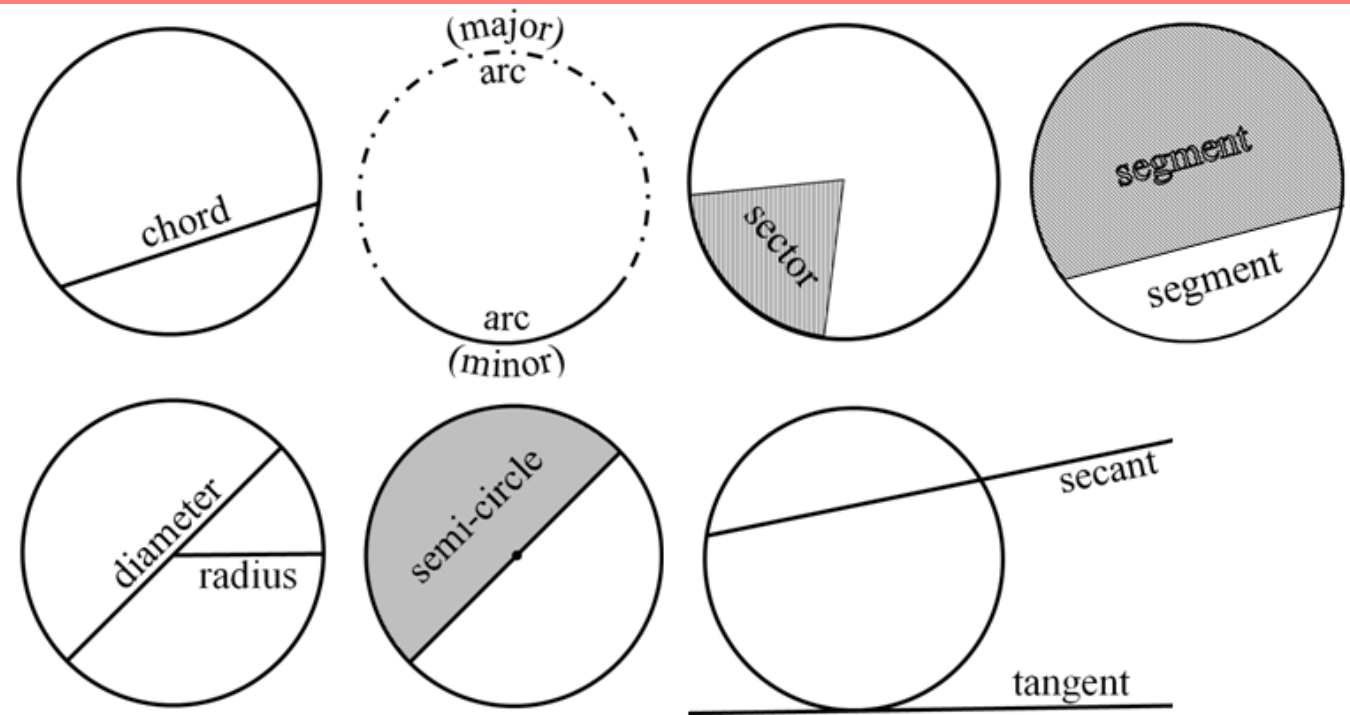
Chord: A straight line segment that connects two points on the circumference of a circle.
Arc: A portion of the circumference. The major arc is the longer portion, while the minor arc is the shorter portion between two points.
Sector: A pie-slice shaped region bounded by two radii and an arc.
Segment: The region between a chord and the arc it cuts off from the circle.
Diameter: The longest possible chord that passes through the centre of the circle.
Radius: A line segment from the centre of the circle to any point on the circumference.
Semicircle: Exactly half of a circle, formed when a diameter divides the circle.
Secant: A straight line that intersects the circle at two distinct points.
Tangent: A straight line that touches the circle at exactly one point.
Theorem 1: Perpendicular from centre bisects chord
When a line from the centre of a circle is drawn perpendicular to a chord, it divides that chord into two equal parts.
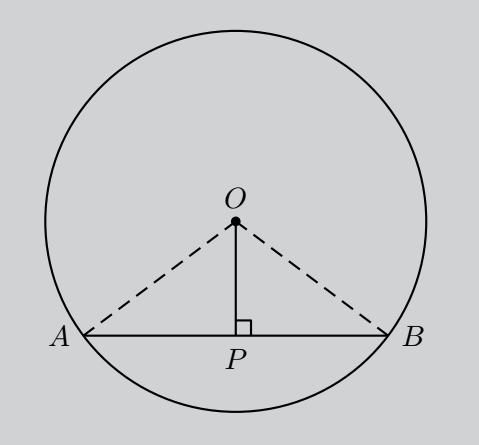
Given: Circle with centre O and chord AB, where OM ⊥ AB
To prove: AM = MB
Method: Draw radii OA and OB to form triangles △OAM and △OBM.
Proof steps:
- OA = OB (both radii)
- OM = OM (common side)
- ∠OMA = ∠OMB = 90° (given perpendicular)
- Therefore △OAM ≡ △OBM (RHS congruency)
- Hence AM = MB (corresponding sides of congruent triangles)
Important note: The converse is also true — a line from the centre to the midpoint of any chord is perpendicular to that chord.
Worked example 1
Example
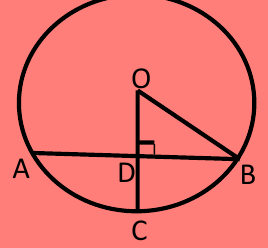
Given: Circle with centre O and chord AB. OD ⊥ AB at D. C is a point on the circumference. OB = 13 units and AB = 24 units.
Find: The length of CD
Solution:
Since OD ⊥ AB, we know AD = DB (perpendicular from centre bisects chord)
Therefore DB = AB ÷ 2 = 24 ÷ 2 = 12 units
In right triangle △ODB:
Using Pythagoras:
- units
Since OB = OC = 13 units (both radii):
- units
Theorem 2: Angle at centre is double angle at circumference
The angle subtended by an arc at the centre of a circle is exactly double the angle subtended by the same arc at any point on the circumference (on the same side of the chord).
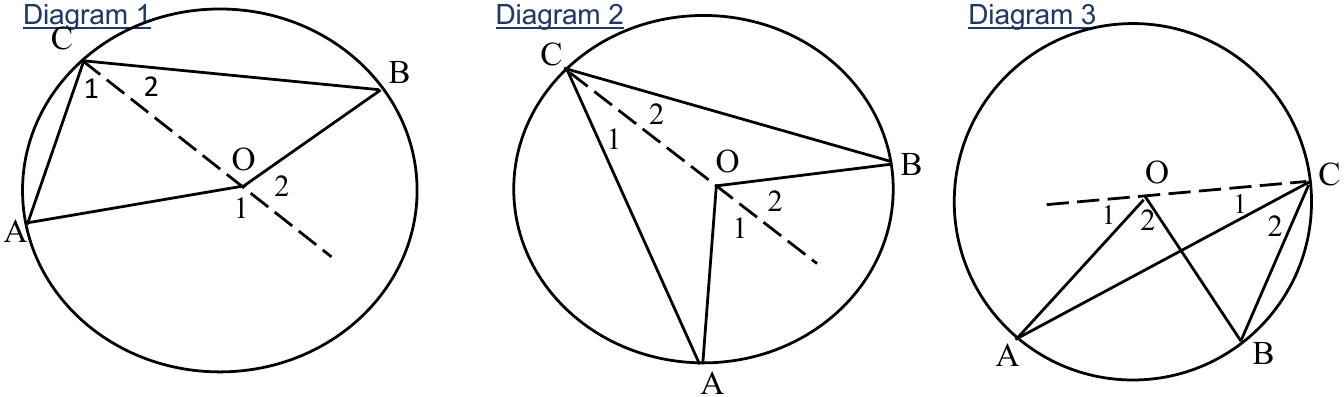
Given: Circle with centre O and arc AB subtending ∠AOB at the centre and ∠ACB at the circumference
To prove: ∠AOB = 2 × ∠ACB
Method: Draw radius CO and use the properties of isosceles triangles.
Key insight: Since OA = OC = OB (all radii), triangles △OAC and △OBC are isosceles. The base angles in each triangle are equal, allowing the angles at the circumference to be expressed in terms of central angles. This leads to the relationship ∠AOB = 2 × ∠ACB.
Theorem 3: Angle in a semicircle is 90°
Any angle inscribed in a semicircle (subtended by a diameter) is always a right angle.
Definition: An inscribed angle is an angle formed by two chords that meet at a point on the circumference.
Given: Circle with diameter PT and point M on the circumference
To prove: ∠PMT = 90°
Solution approach:
Since PT is a diameter, ∠POT = 180° (straight line)
Using Theorem 2: ∠PMT = ½ × ∠POT = ½ × 180° = 90°
Key exam tip: Whenever a triangle is inscribed in a circle and one side is a diameter, the opposite angle is automatically 90°.
Worked example 2
Example
Given: Circle with centre M. PR and PQ are equal chords. MS ⊥ PR at S, and PS = x units.
Find: Express QS in terms of x.
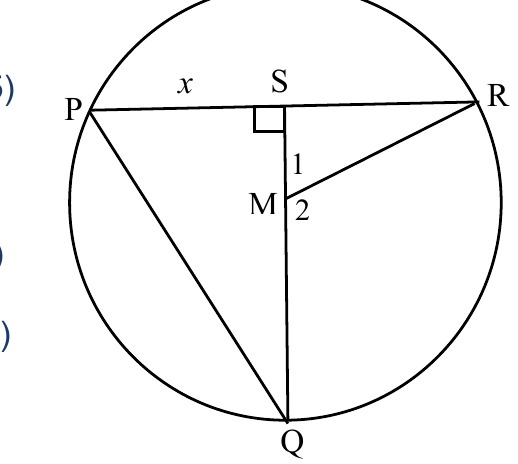
Solution:
Since MS ⊥ PR, S is the midpoint of PR:
- PS = SR = x
- Therefore PR = 2x
Since PR = PQ (equal chords), we have PQ = 2x
In right triangle △PQS:
- (Pythagoras)
- units
Theorem 4: Opposite angles of cyclic quadrilateral are supplementary
In a cyclic quadrilateral (a four-sided figure with all vertices on a circle), opposite angles sum to 180°.
Definition: A cyclic quadrilateral is a quadrilateral where all four vertices lie on the circumference of the same circle.
Given: Cyclic quadrilateral ABCD with centre O
To prove: ∠A + ∠C = 180° and ∠B + ∠D = 180°
Method: Use the relationship between angles at the centre and circumference.
Proof outline:
- ∠A is subtended by arc BCD at the circumference
- ∠C is subtended by arc BAD at the circumference
- The sum of these arcs is the complete circle (360°)
- Using Theorem 2: ∠A + ∠C = ½(360°) = 180°
Worked example 3
Example
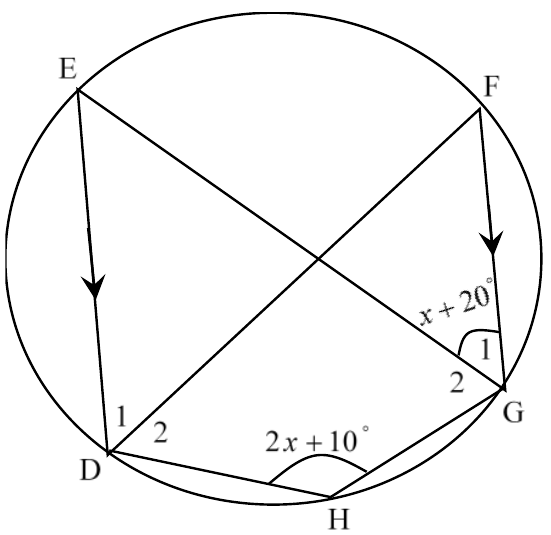
Given: Cyclic quadrilateral DEFG with ∠G = x + 20° and ∠E = 2x + 10°, where DE ∥ FG
Find: The value of x and hence ∠E
Solution:
Since DEFG is cyclic: ∠E + ∠G = 180° (opposite angles)
Hence:
Theorem 5: Tangent-chord angle equals alternate segment angle
The angle between a tangent to a circle and a chord drawn from the point of contact equals the angle in the alternate segment.
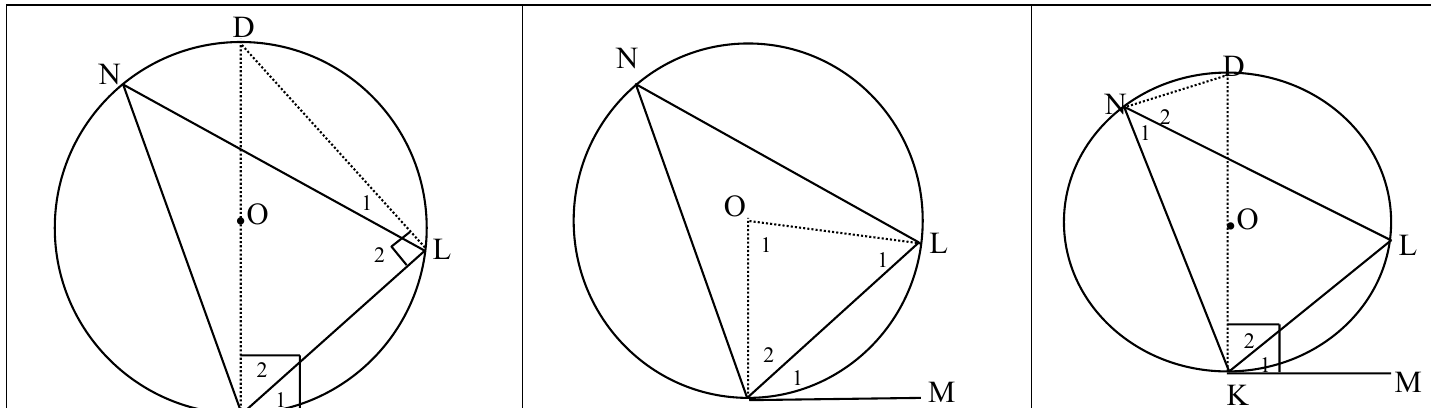
Definition: The alternate segment refers to the region of the circle on the opposite side of the chord, where the equal angle is formed.
Given: Circle with chord KL and tangent MK at point K
To prove: ∠MKL = ∠N (where N is a point on the alternate segment)
Key insight: This theorem connects angles formed outside the circle (tangent-chord angle) with angles inside the circle (inscribed angles).
Proof method: The proof typically involves:
- Drawing a diameter through the point of contact
- Using the fact that the tangent is perpendicular to the radius at the point of contact
- Applying the angle in a semicircle theorem
- Using the relationship between angles subtended by the same arc
Exam tip: Look for problems involving tangents and chords meeting at the same point — this theorem often provides the key relationship needed.
Summary
Remember!
• Perpendicular from centre bisects chord — use this when finding chord lengths or when chords are cut by lines from the centre
• Centre angle is double circumference angle — essential for most angle calculations in circles; remember both angles must be on the same side of the chord
• Angle in a semicircle equals 90° — whenever a triangle is inscribed in a circle with one side as a diameter, the opposite angle is automatically 90°
• Opposite angles in cyclic quadrilateral sum to 180° — if all four vertices of a quadrilateral lie on a circle, opposite angles are supplementary
• Tangent-chord angle equals alternate segment angle — this connects angles outside the circle with angles inside the circle, often used in more complex problems