Revision (Grade 11 NSC Matric Mathematics): Revision Notes
📚Revision Notes
Revision
This revision covers key concepts in Euclidean geometry including parallelograms and the mid-point theorem. Understanding these fundamental concepts will help you solve geometric problems and prove relationships between shapes.
Parallelogram
Note
Definition: A parallelogram is a four-sided shape (quadrilateral) where both pairs of opposite sides are parallel to each other.
Properties of a parallelogram
A parallelogram has several important properties that you need to remember:
- Both pairs of opposite sides are parallel - This is what defines a parallelogram
- Both pairs of opposite sides are equal in length - Opposite sides have the same measurement
- Both pairs of opposite angles are equal - Angles directly across from each other are the same size
- Both diagonals bisect each other - The diagonals cut each other exactly in half
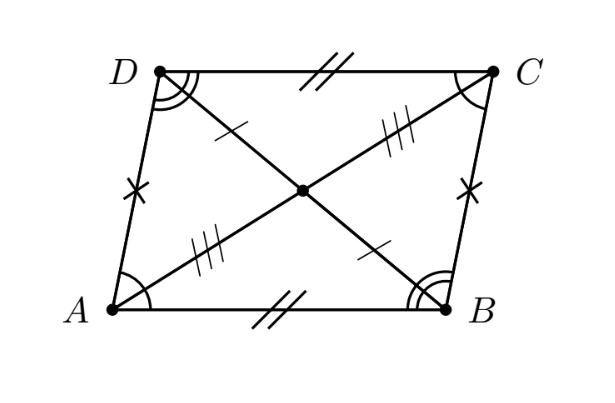
These properties work together and are very useful for solving geometry problems. If you know a shape is a parallelogram, you can use any of these properties in your calculations and proofs.
Important
Exam tip: Remember that if you can prove any one of these properties for a quadrilateral, combined with the definition, you can often prove it's a parallelogram.
The mid-point theorem
Note
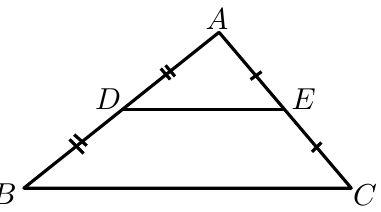
Definition: The mid-point theorem states that the line joining the mid-points of two sides of a triangle is parallel to the third side and equal to half the length of the third side.
Understanding the mid-point theorem
This theorem is extremely useful when working with triangles. Here's what it means in practical terms:
- Take any triangle and find the mid-points of two sides
- Draw a line connecting these mid-points
- This connecting line will always be parallel to the third side
- The length of this connecting line will always be exactly half the length of the third side
Mathematical representation
If we have triangle ABC with:
- D is the mid-point of side AB (so AD = DB)
- E is the mid-point of side AC (so AE = EC)
Then we can conclude:
- DE is parallel to BC (written as DE || BC)
- DE = BC (the length of DE equals half the length of BC)
Important
Exam tip: This theorem is often used in coordinate geometry problems and when proving properties of similar triangles.
Example
Worked Example: Finding Mid-point Segment Length
Question: In triangle PQR, M is the mid-point of PQ and N is the mid-point of PR. If QR = 12 cm, find the length of MN.
Solution: Step 1: Identify what we know
- M is the mid-point of PQ
- N is the mid-point of PR
- QR = 12 cm
Step 2: Apply the mid-point theorem
By the mid-point theorem, MN is parallel to QR and MN = QR
Step 3: Calculate
MN = QR = cm
Answer: MN = 6 cm
Summary
Key Points to Remember:
- A parallelogram is defined by having both pairs of opposite sides parallel
- Parallelograms have four key properties: parallel opposite sides, equal opposite sides, equal opposite angles, and diagonals that bisect each other
- The mid-point theorem connects mid-points of triangle sides to create a line parallel to the third side
- The mid-point connecting line is always half the length of the third side
- These concepts are frequently tested in NSC Mathematics Paper 2, so practise identifying when to use them