Summary (Grade 11 NSC Matric Mathematics): Revision Notes
📚Revision Notes
Summary
This summary covers the essential concepts and theorems in Euclidean geometry relating to circles, cyclic quadrilaterals, and tangent properties that you need to master for your NSC Mathematics exam.
Note
This document focuses specifically on the circle geometry topics that frequently appear in NSC Mathematics Paper 2. Master these concepts and you'll be well-prepared for the geometry section of your exam.
Basic circle terminology
Understanding the fundamental parts of a circle is crucial for solving geometry problems. Each term has a specific meaning that you must remember accurately.
Arc - An arc represents a portion of the circumference of a circle. Think of it as a curved section between two points on the circle's edge.
Chord - A chord is a straight line that joins the endpoints of an arc. It's any line segment that connects two points on the circumference.
Circumference - This is the perimeter or boundary line of a circle. It's the complete distance around the outside of the circle.
Radius - A radius is any straight line drawn from the centre of the circle to a point on the circumference. All radii of the same circle are equal in length.
Diameter - A diameter is a special type of chord that passes through the centre of the circle. It represents the longest possible chord and equals twice the radius length.
Segment - A segment is the part of a circle that gets cut off by a chord. When you draw a chord, it divides the circle into two segments.
Tangent - A tangent is a straight line that makes contact with a circle at exactly one point on the circumference. This single point of contact is crucial to remember.
Note
Memory Tip: Remember that a diameter is the longest chord possible, and it always equals . This relationship appears frequently in calculations.
Important circle properties
Perpendicular bisector properties
When dealing with points and their relationships to chords, these properties become essential for proofs and problem-solving.
If O is the centre of a circle and OM is perpendicular to chord AB, then AM equals MB. This means the perpendicular from the centre to a chord bisects that chord.
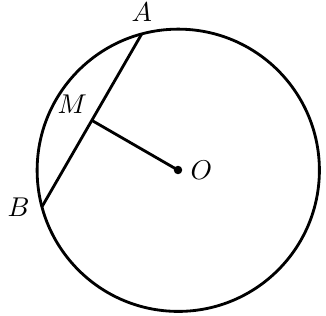
Conversely, if O is the centre and AM equals MB, then .
Additionally, if AM equals MB and OM is perpendicular to AB, then the line MO passes through the centre O.
Important
Critical Property: The perpendicular from the centre of a circle to any chord always bisects that chord. This is one of the most useful properties for solving circle geometry problems.
Central and inscribed angle relationships
This is one of the most important theorems in circle geometry and appears frequently in exam questions.
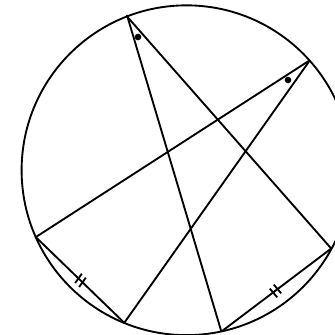
When an arc subtends an angle at both the centre of a circle and at the circumference, the angle at the centre is always twice the size of the angle at the circumference. This relationship holds true regardless of which point on the circumference you choose.
Example
Worked Example: Central and Inscribed Angles
If arc AB subtends an angle of at point P on the circumference, what is the angle subtended at the centre O?
Solution:
- Angle at circumference =
- Angle at centre =
Answer: The central angle is
Equal chords and equal angles
Angles at the circumference that are subtended by the same arc (or by arcs of equal length) are always equal. This property is particularly useful when proving that angles are equal in circle geometry problems.
Cyclic quadrilaterals
A cyclic quadrilateral is a four-sided polygon where all four vertices lie on the circumference of a circle. Understanding their properties is essential for many geometry proofs.
Key properties of cyclic quadrilaterals
The most important property to remember is that opposite angles of a cyclic quadrilateral are supplementary - they add up to .
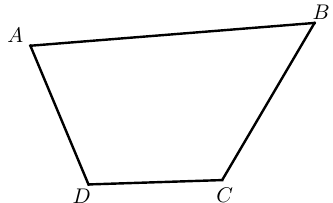
For a cyclic quadrilateral ABCD:
- (opposite angles supplementary)
- (opposite angles supplementary)
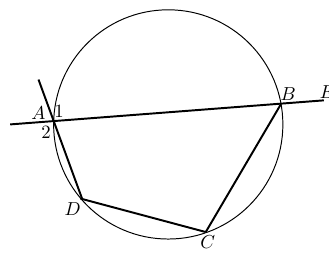
Additionally, an exterior angle of a cyclic quadrilateral equals the interior opposite angle. So (exterior angle equals interior opposite angle).
Important
Remember: Opposite angles are supplementary (sum to ), NOT equal! This is a common mistake in exams.
Tests for cyclic quadrilaterals
To prove that a quadrilateral is cyclic, you can use several tests:
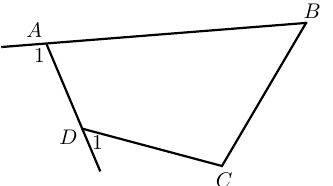
Test 1: Opposite angles sum to 180° If or , then ABCD is a cyclic quadrilateral.
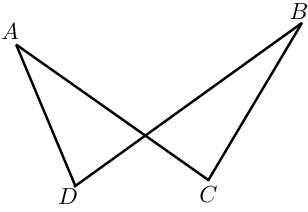
Test 2: Equal angles in the same segment If or , then ABCD is a cyclic quadrilateral.
Test 3: Equal opposite angles If or , then ABCD is a cyclic quadrilateral.
Example
Worked Example: Testing for Cyclic Quadrilaterals
In quadrilateral PQRS, , , , and . Is PQRS a cyclic quadrilateral?
Solution: Check if opposite angles are supplementary:
- ✓
- ✓
Answer: Yes, PQRS is a cyclic quadrilateral because opposite angles sum to .
Tangent properties
Tangents have special properties that make them useful in geometric proofs and calculations.
Basic tangent properties
The most fundamental property is that a tangent line is always perpendicular to the radius drawn at the point of contact with the circle.
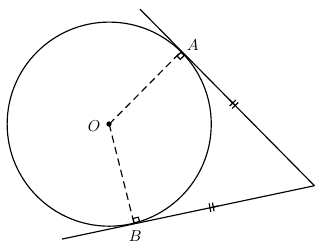
If AT and BT are tangents to circle O, then:
- (tangent perpendicular to radius)
- (tangent perpendicular to radius)
- (tangents from the same external point are equal)
Note
Key Insight: Tangents drawn from the same external point to a circle are always equal in length. This property is extremely useful for solving problems involving tangent lengths.
Tangent-chord relationships
When you have a tangent and a chord meeting at a point on the circle, special angle relationships emerge.
If DC is a tangent to the circle, then:
- (tangent-chord angle equals angle in alternate segment)
- (tangent-chord angle equals angle in alternate segment)
Conversely, if or , then DC is a tangent touching the circle at point T.
Important
Alternate Segment Theorem: The angle between a tangent and a chord drawn from the point of contact equals the angle in the alternate segment. This theorem is fundamental for tangent-chord proofs.
Exam tips and common mistakes
Understanding where students commonly make errors can help you avoid these pitfalls and improve your exam performance.
Important
Common Exam Traps:
- Remember that cyclic quadrilateral opposite angles are supplementary (add to ), not equal
- Tangent is perpendicular to radius at the point of contact, not at any other point
- Central angle is twice the inscribed angle, not equal to it
- Don't confuse supplementary () with complementary ()
Note
Problem-solving Approach:
- Identify what type of theorem applies (cyclic quad, tangent, angle relationships)
- State the theorem clearly in your proof
- Show your working step by step
- Check that opposite angles actually sum to for cyclic quads
Summary
Key Points to Remember:
- Opposite angles in a cyclic quadrilateral always sum to
- A tangent is always perpendicular to the radius at the point of contact
- Central angles are twice the size of inscribed angles subtending the same arc
- Equal chords subtend equal angles at the circumference
- Tangents drawn from the same external point to a circle are equal in length