Introduction (Grade 11 NSC Matric Mathematics): Revision Notes
📚Revision Notes
Introduction
What is linear programming?
Linear programming is a mathematical method used to find the best solution to problems where you want to maximize or minimize something (like profit or cost) while working within certain limitations.
Optimization means finding the combination of factors that gives you the best possible result. In everyday life, people constantly face optimization problems:
- A farmer wants to know how many hectares to plant to maximize yield
- A stockbroker wants to know how much to invest to maximize profit
- An entrepreneur wants to know how many people to employ to minimize costs
To solve these problems mathematically, we assign variables to represent the different factors that can change in the situation. We then find the combination of these variables that gives us the best result.
Note
Linear programming is particularly useful in business and economics where you need to make optimal decisions under constraints like limited resources, time, or budget.
Method 1: Using tables
For smaller problems, we can use a systematic table approach to find the optimal solution. This method involves listing all possible combinations that satisfy the constraints and then calculating which gives the best result.
Example
Worked Example: Bicycle Manufacturing
Problem: Mr. Hunter manufactures two types of bicycles - Mountees and Roadees. He can produce a maximum of 5 Mountees per day and 3 Roadees per day. Each Mountee needs 1 technician and each Roadee needs 2 technicians to assemble. He has 8 technicians total. The profit on a Mountee is R800 and on a Roadee is R2400. Find the number of each bicycle to manufacture for maximum profit.
Solution:
Step 1: Assign variables
- Let = number of Mountees produced per day
- Let = number of Roadees produced per day
Step 2: Organize the information
- Maximum Mountees:
- Maximum Roadees:
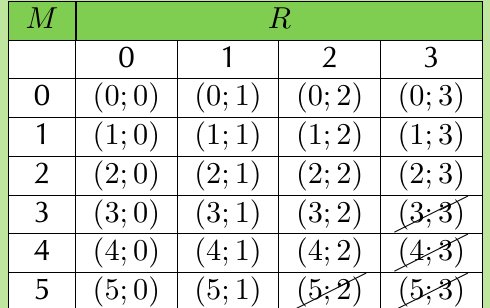
- Technician constraint:
- Profit per Mountee: R800
- Profit per Roadee: R2400
Step 3: Create a table of all possible combinations
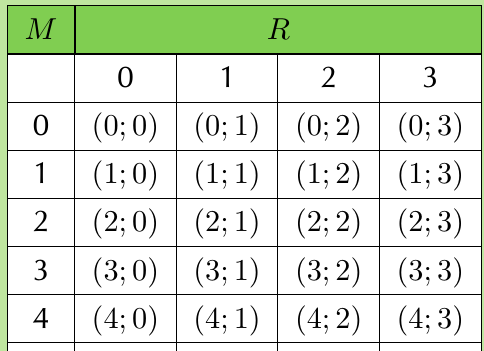
Step 4: Apply the technician constraint We eliminate combinations where :
Step 5: Calculate profits The profit equation is:
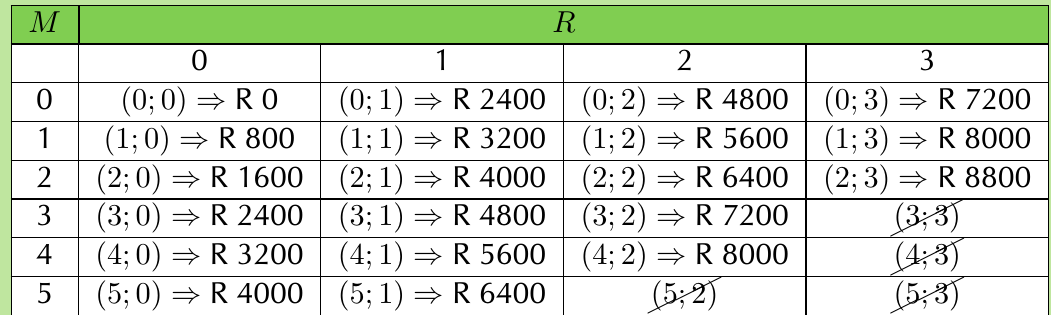
Step 6: Find the maximum The maximum profit of R8800 occurs when and .
Important
The table method works well for problems with a small number of variables and constraints, but becomes impractical for larger, more complex optimization problems.
Method 2: Using graphs (linear programming)
A more efficient method for solving optimization problems uses graphs with constraints written as inequalities. This graphical approach allows us to visualize the problem and find solutions more efficiently.
Key concepts
Constraints are the limitations in the problem, written as inequalities that must all be satisfied.
Objective function is the equation you want to maximize or minimize (sometimes called the search line).
Feasible region is the area on the graph where all constraints are satisfied.
Note
The graphical method is particularly powerful because it provides a visual representation of the problem, making it easier to understand the relationship between constraints and the optimal solution.
Example
Worked Example: Bicycle Problem Using Graphs
Using the same bicycle manufacturing problem:
Step 1: Write constraints as inequalities
- (maximum Mountees)
- (maximum Roadees)
- (technician constraint)
- (cannot produce negative bicycles)
Step 2: Write the objective function (to be maximized)
Step 3: Draw the constraints on a graph
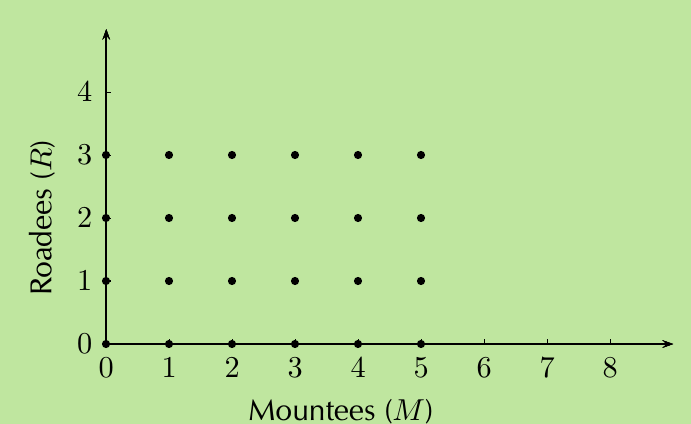
Step 4: Show the technician constraint From , we get
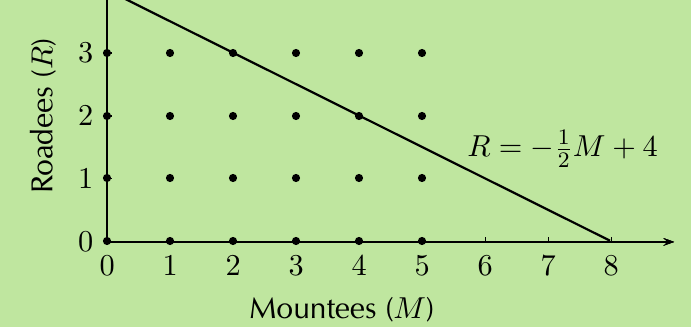
Step 5: Identify the feasible region The feasible region is where all constraints are satisfied:
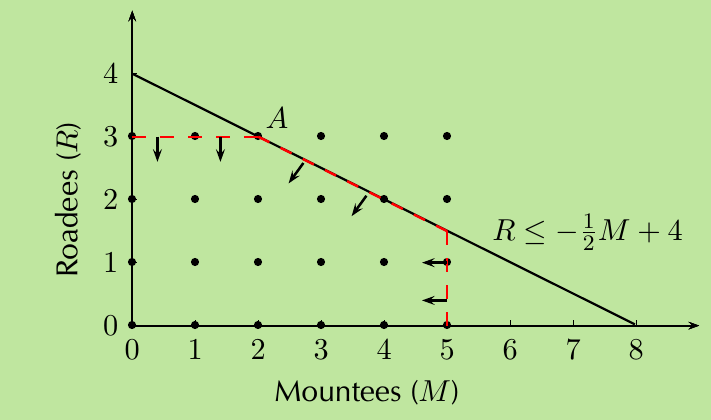
Step 6: Find the optimal point Test the corner points of the feasible region. The maximum profit of R8800 occurs at point A(2,3).
Example
Worked Example: Furniture Store (Minimization)
Problem: A furniture store wants to give away at least 40 prizes (kettles and toasters). They need at least 10 of each type. A kettle costs R120 and a toaster costs R100. Find the combination that minimizes cost.
Step 1: Assign variables
- Let = number of kettles
- Let = number of toasters
Step 2: Write constraints
- (minimum kettles)
- (minimum toasters)
- (minimum total prizes)
Step 3: Write objective function (to be minimized)
Step 4: Graph the constraints
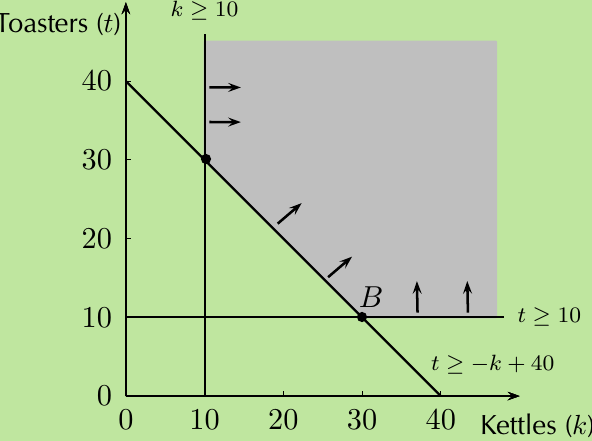
Step 5: Find the feasible region and optimal point
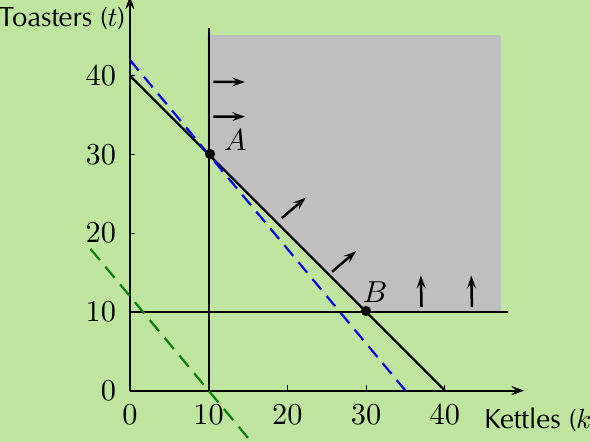
The minimum cost occurs at point A(10,30), giving a cost of R4200.
Important
Notice that in minimization problems, we're looking for the corner point that gives the smallest value of the objective function, while in maximization problems we look for the largest value.
Key steps for linear programming
The systematic approach to solving linear programming problems involves these essential steps:
- Assign variables to represent the quantities you can control
- Write constraints as inequalities based on the limitations
- Write the objective function (what you want to maximize or minimize)
- Graph the constraints and identify the feasible region
- Find the optimal point (usually at a corner of the feasible region)
- Calculate the final answer by substituting back into the objective function
Note
The optimal solution in linear programming problems almost always occurs at a corner point (vertex) of the feasible region. This is why we focus on testing these corner points rather than trying every point in the feasible region.
Summary
Key Points to Remember:
- Optimization means finding the best possible solution within given constraints
- Variables represent the quantities you can change in the problem
- Constraints are written as inequalities that limit your choices
- The feasible region shows all possible solutions that satisfy the constraints
- The optimal solution usually occurs at a corner point of the feasible region
- For small problems, use the table method; for larger problems, use the graphical method
- Always check that your solution makes practical sense in the context of the problem