Area of a Polygon (Grade 11 NSC Matric Mathematics): Revision Notes
📚Revision Notes
Area of a Polygon
A polygon is a closed shape made up of straight lines. Understanding how to calculate the area of different polygons is essential for solving many geometry problems. The area represents the amount of space inside a shape, usually measured in square units.
Basic polygon area formulas
Square
A square has four equal sides. When you know the length of one side, you can find the area easily.
Formula: Area =
Where is the length of any side.
Note
Since all sides of a square are equal, you only need to measure one side to calculate the entire area. This makes squares one of the simplest polygons to work with.
Rectangle
A rectangle has opposite sides that are equal in length. You need to know both the length and width to calculate the area.
Formula: Area =
Where is the base (length) and is the height (width).
Triangle
The area of any triangle depends on its base and the perpendicular height from that base to the opposite vertex.
Formula: Area =
Where is the base and is the perpendicular height.
Important
The height must be perpendicular to the base - this is not necessarily the length of any side of the triangle. Many students make the mistake of using a slanted side length instead of the perpendicular height.
Trapezium
A trapezium has one pair of parallel sides. The area formula uses both parallel sides and the perpendicular distance between them.
Formula: Area =
Where and are the lengths of the parallel sides, and is the perpendicular height between them.
Note
The trapezium formula essentially finds the average of the two parallel sides and multiplies by the height. This makes sense because you're finding the area of the "average rectangle" that would fit in the same space.
Parallelogram
A parallelogram has two pairs of parallel sides. Like a rectangle, but the angles don't have to be 90 degrees.
Formula: Area =
Where is the base and is the perpendicular height (not the slanted side length).
Important
For parallelograms, always use the perpendicular height, not the length of the slanted side. The perpendicular height is the shortest distance between the parallel sides.
Circle
A circle's area depends on its radius - the distance from the centre to any point on the circle.
Formula: Area =
Circumference:
Where is the radius.
Worked example: Finding the area and perimeter of a parallelogram
Let's work through a complete problem that shows how to find both area and perimeter of a parallelogram.
Example
Worked Example: Parallelogram Area and Perimeter
Question: ABCD is a parallelogram with DC = 15 cm, h = 8 cm and BF = 9 cm.
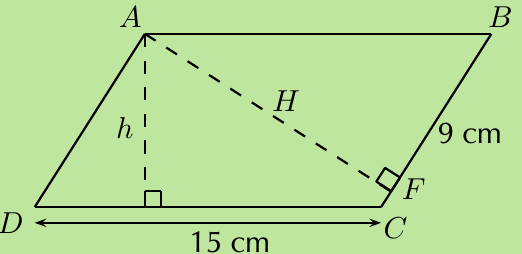
Calculate:
- The area of ABCD
- The perimeter of ABCD
Solution:
Step 1: Calculate the area
For a parallelogram, we use the formula: Area = base × height
The base DC = 15 cm and the perpendicular height h = 8 cm.
Area =
Step 2: Calculate the perimeter
The perimeter of a parallelogram equals twice the sum of two adjacent sides.
Perimeter =
We know DC = 15 cm, but we need to find BC.
To find BC, we can use the right triangle ABF and apply the Pythagorean theorem:
In triangle ABF:
Since AB = DC = 15 cm (opposite sides of parallelogram are equal) and BF = 9 cm:
Therefore:
Now we can use the area to find BC:
- Area =
Finally: Perimeter =
Summary
Key Points to Remember:
- Area formulas must be memorised - practice writing them until they become automatic
- Height means perpendicular height - not the slanted side length in parallelograms and triangles
- Use Pythagorean theorem when you need to find missing lengths in right triangles within polygons
- Check your units - area is always in square units (cm², m², etc.)
- For exam success - clearly show each step of your working and state which formula you're using