Multiplying a Dimension by a Constant Factor (Grade 11 NSC Matric Mathematics): Revision Notes
📚Revision Notes
Multiplying a Dimension by a Constant Factor
Introduction
When one or more dimensions of a prism or cylinder are multiplied by a constant, both the surface area and volume will change. Understanding these relationships is crucial for solving measurement problems efficiently.
Note
The key insight is recognising the relationship between changes in dimensions and the resulting changes in surface area and volume. These relationships make it much simpler to calculate new measurements when dimensions are scaled up or down.
Understanding scaling effects
When we multiply dimensions by a constant factor, the effects on volume and surface area follow predictable patterns. Let's examine what happens to a rectangular prism with dimensions l, b, and h when we multiply its dimensions by different factors.
Original measurements
For a rectangular prism:
- Volume:
- Surface area:
Scaling one dimension
When we multiply just one dimension (like height) by factor 5:
- New volume:
- New surface area:
The volume increases by exactly 5 times the original volume.
Scaling two dimensions
When we multiply two dimensions (length and height) by factor 5:
- New volume:
- New surface area:
The volume increases by times the original volume.
Scaling all three dimensions
When we multiply all three dimensions by factor 5:
- New volume:
- New surface area:
The volume increases by times, while the surface area increases by times.
General scaling by factor k
For any constant factor k:
- New volume:
- New surface area:
Important
This is the most important relationship to remember: volume scales by and surface area scales by .
Worked example: The Nash family room problem
Example
Worked Example: Doubling Room Area
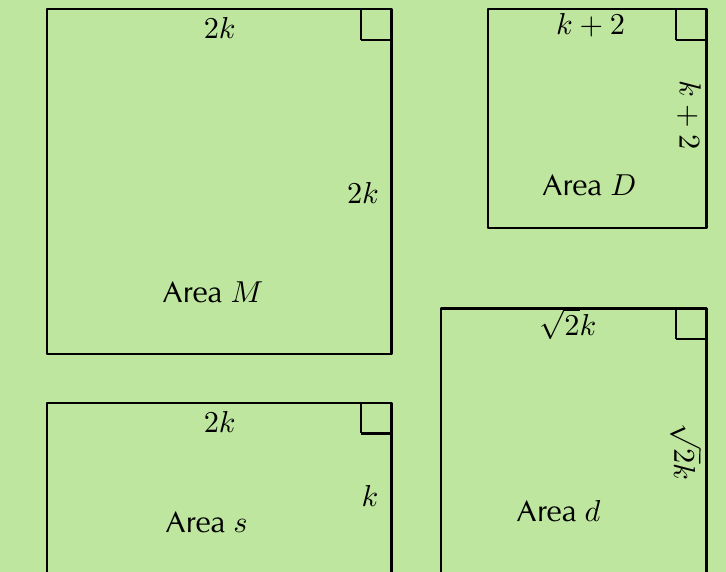
Problem: The Nash family wants to double the area of their square room. The original room has side length k metres. Which suggestion will work?
- Mum suggests doubling the length of the sides
- Dad recommends adding 2 m to each side
- Daughter suggests multiplying sides by
- Son suggests doubling only the width
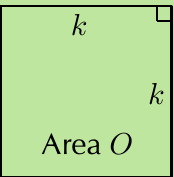
Step 1: Calculate the original area Original area =
To double this area, we need:
Step 2: Test each suggestion
Mum's suggestion (double the sides): Area M = This gives 4 times the original area, not double.
Dad's suggestion (add 2 m to each side): Area D = This does not equal , so it won't double the area.
Daughter's suggestion (multiply by ): Area d = This exactly doubles the area and keeps the room square!
Son's suggestion (double the width only): Area s = This also doubles the area, but the room becomes rectangular instead of square.
Step 3: Answer
Both the daughter's and son's suggestions will double the area. However, if they want to keep the room square, the daughter's suggestion of multiplying each side by is the best solution.
Key scaling formulas
Summary
Key Scaling Relationships:
For uniform scaling (all dimensions multiplied by factor k):
- Linear dimensions: multiply by k
- Areas: multiply by
- Volumes: multiply by
For partial scaling:
- Scaling one dimension by factor k: Volume multiplied by k
- Scaling two dimensions by factor k: Volume multiplied by
- Scaling all three dimensions by factor k: Volume multiplied by
Exam tips
Note
Helpful Tips for Success:
- Always identify which dimensions are being scaled
- Remember the rule for areas and rule for volumes
- When doubling area, multiply linear dimensions by , not 2
- Check your answer makes logical sense - bigger dimensions should give bigger areas and volumes
Remember!
Summary
Key Points to Remember:
- Volume scales by when all dimensions are multiplied by constant k
- Surface area scales by when all dimensions are multiplied by constant k
- To double an area, multiply each linear dimension by ≈ 1.41
- Partial scaling affects volume differently - one dimension scaled by k gives volume scaled by k
- Always check whether the shape needs to be preserved in practical problems