Right Prisms and Cylinders (Grade 11 NSC Matric Mathematics): Revision Notes
📚Revision Notes
Right Prisms and Cylinders
What are right prisms and cylinders?
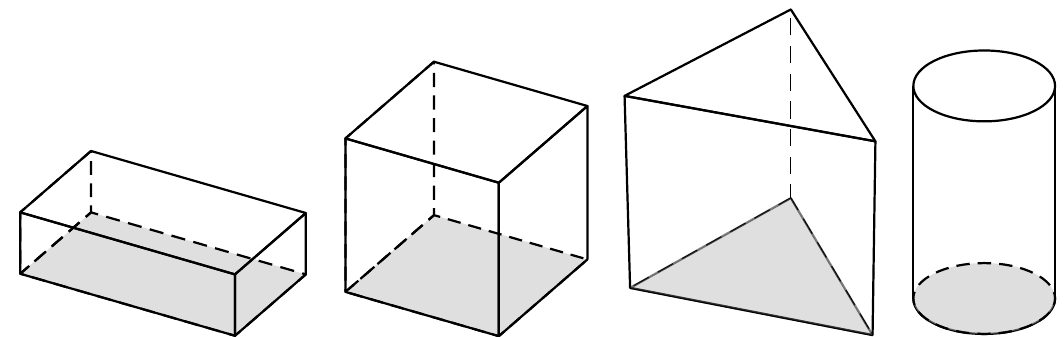
A right prism is a three-dimensional geometric solid that has a polygon as its base and vertical sides that are perpendicular to the base. The base and top surface are identical in shape and size. It is called "right" because the angles between the base and sides are right angles (90°).
Note
Understanding the term "right" is crucial - it refers to the 90° angles between the base and the vertical sides, not the orientation of the shape itself.
There are several types of right prisms you need to know:
- Rectangular prism - has a rectangle as its base
- Cube - a special rectangular prism where all sides are equal in length
- Triangular prism - has a triangle as its base
- Cylinder - has a circle as its base (technically a type of right prism)
Each type follows the same basic principles for calculating surface area and volume, but uses slightly different formulas based on the shape of the base.
Surface area of prisms and cylinders
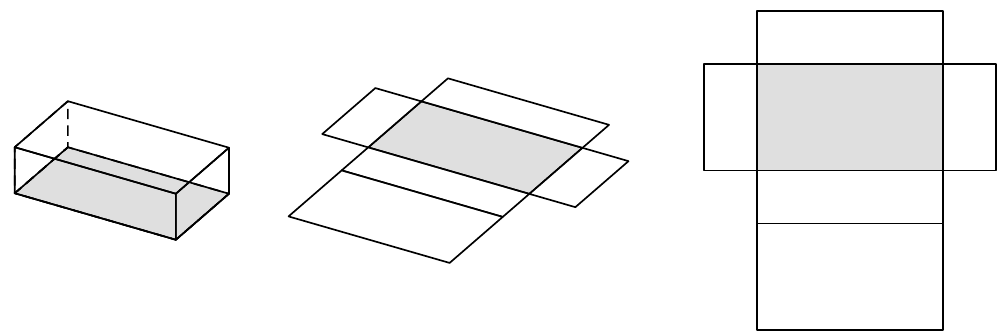
Surface area is the total area of all the exposed or outer surfaces of a three-dimensional object. To understand this concept better, imagine the prism as a cardboard box that you can unfold. When you unfold a solid like this, you create what is called a net.
Note
A net shows all the faces of a 3D shape laid out flat in 2D. This makes it much easier to see each face clearly and calculate the total surface area by finding the area of each face and adding them together.
Understanding nets for different shapes
Rectangular prism net: When unfolded, a rectangular prism creates six rectangles - two identical bases and four identical sides.
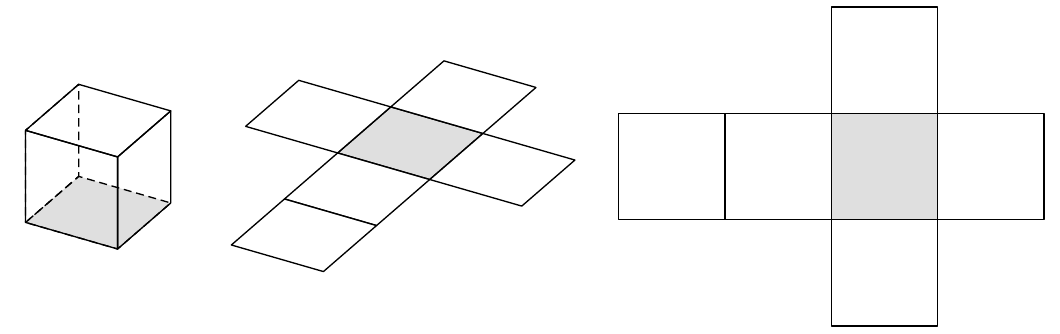
Cube net: A cube unfolds into six identical squares arranged in a cross-like pattern.
Triangular prism net: This creates two triangular faces (the bases) and three rectangular faces (the sides). The length of each rectangle equals the perimeter of the triangular base.
Cylinder net: When unfolded, a cylinder creates two identical circles (top and bottom) and one rectangle. The length of this rectangle equals the circumference of the circular base.
Surface area formulas
Important
For any right prism, the surface area formula follows this pattern: Surface area = 2 × (area of base) + (area of all side faces)
Rectangular prism: Surface area =
Cylinder: Surface area =
Triangular prism: Surface area =
Worked example: calculating surface area
Let's work through a practical example involving a chocolate box and a cylindrical tin.
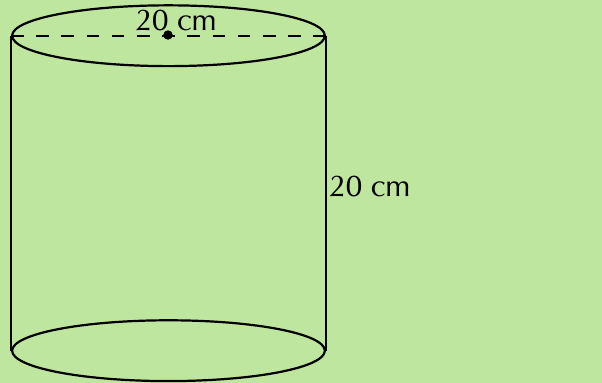
Example
Worked Example: Surface Area Calculation
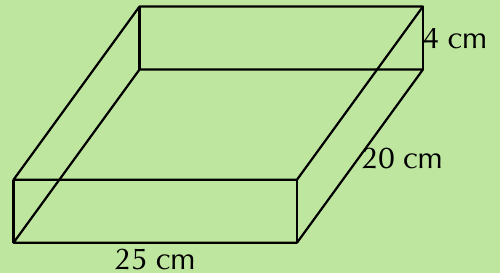
Question: A rectangular chocolate box has dimensions: length = 25 cm, width = 20 cm, height = 4 cm. A cylindrical biscuit tin has diameter = 20 cm and height = 20 cm. Calculate the area of wrapping paper needed to cover the entire box, then determine if the same amount would cover the tin.
Solution:
Step 1: Calculate the surface area of the rectangular box
Surface area =
Step 2: Calculate the surface area of the cylindrical tin
First, find the radius: cm Surface area =
Step 3: Compare the results
The box requires 1360 cm² of wrapping paper, but the tin needs approximately 1885 cm². Therefore, the same amount of wrapping paper used for the box would not be sufficient to cover the tin.
Volume of prisms and cylinders
Volume (sometimes called capacity) represents the three-dimensional space occupied by an object or the amount of substance an object can contain. Volume is always measured in cubic units (cm³, m³, etc.).
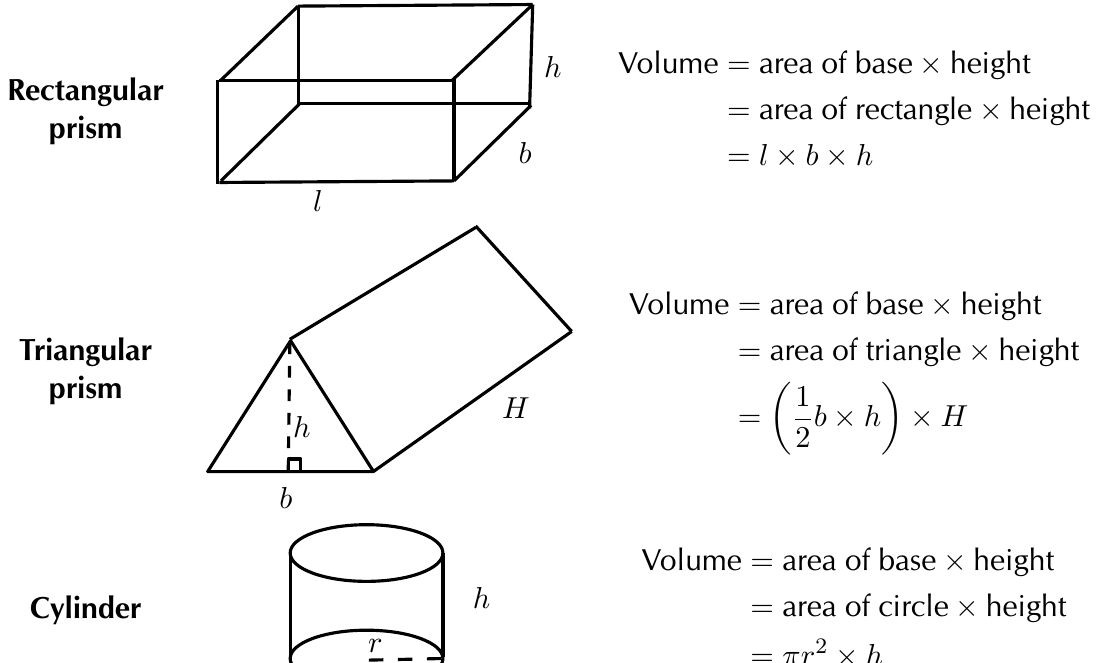
The fundamental principle for calculating the volume of any right prism is simple:
Important
Volume = area of base × height
This principle applies to all right prisms, but the formula for the base area changes depending on the shape.
Volume formulas for different shapes
Rectangular prism: (length × breadth × height)
Triangular prism: Where is the height of the prism (not the triangle)
Cylinder: (area of circle × height)
Worked example: calculating volume
Let's examine a practical problem involving containers and their capacities.
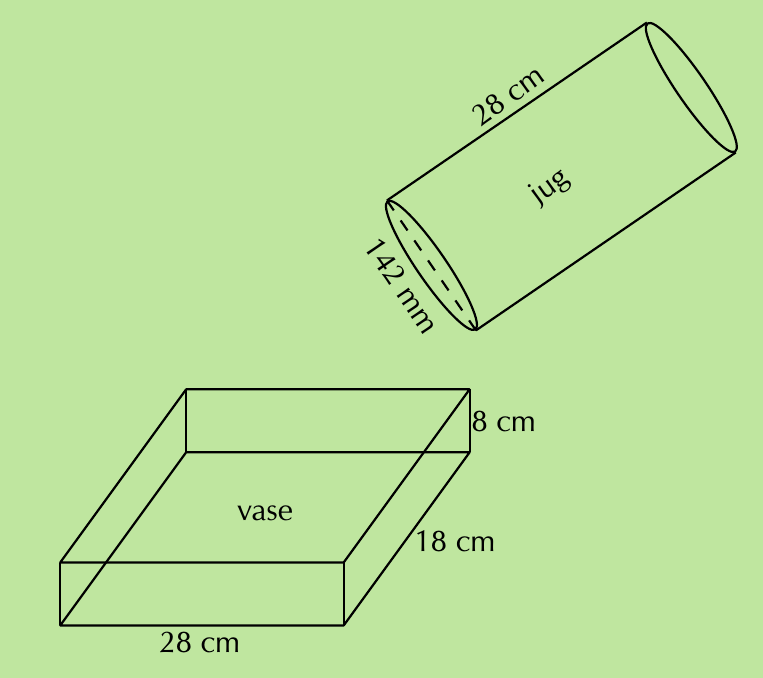
Example
Worked Example: Volume Calculation
Question: A rectangular glass vase has dimensions 28 cm × 18 cm × 8 cm. A plastic jug has a diameter of 142 mm and height of 28 cm. Will the plastic jug hold 5 ℓ of water? Will a full jug of water be enough to fill the glass vase?
Solution:
Step 1: Calculate the volume of the plastic jug
First, convert diameter to radius:
Volume =
Convert to litres: ℓ
Since ℓ ℓ, the jug cannot hold 5 litres of water.
Step 2: Calculate the volume of the glass vase
Volume =
- ℓ
Step 3: Compare volumes
The jug holds 4.434 ℓ while the vase holds 4.032 ℓ. Since ℓ ℓ, yes, a full jug of water would be enough to fill the glass vase.
Important
Common Mistakes to Avoid:
- Always check your units - ensure all measurements are in the same units before calculating
- Remember that diameter = 2 × radius, so always convert when necessary
- For cylinders, don't forget both circular faces when calculating surface area
- Volume is always in cubic units (cm³, m³), while surface area is in square units (cm², m²)
- When calculating surface area using nets, count all faces carefully
- For triangular prisms, distinguish between the height of the triangle (for base area) and the height of the prism
Summary
Key Points to Remember:
- Right prisms have polygonal bases with vertical sides perpendicular to the base
- Surface area is found by calculating the area of all faces - use nets to visualise this clearly
- Volume = area of base × height applies to all right prisms and cylinders
- Cylinder volume: and surface area:
- Always check units and convert when necessary - especially diameter to radius for cylinders