Right Pyramids, Right Cones and Spheres (Grade 11 NSC Matric Mathematics): Revision Notes
📚Revision Notes
Right Pyramids, Right Cones and Spheres
Understanding the basic shapes
Pyramids are three-dimensional geometric solids that have a polygon as their base and triangular faces that meet at a single point called the apex. The key feature of pyramids is that their sides are not perpendicular to the base.
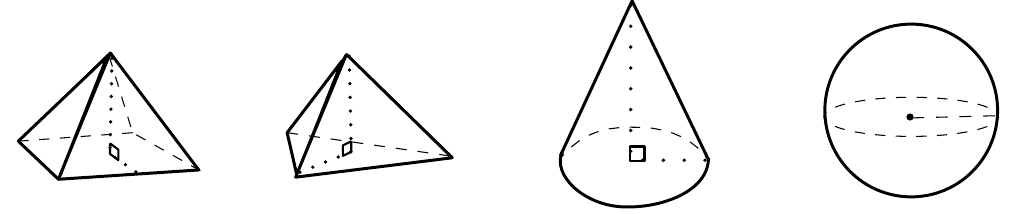
A pyramid becomes a right pyramid when the line connecting the apex to the centre of the base is perpendicular to the base. This perpendicular line represents the true height of the pyramid.
Important
A "right" pyramid doesn't mean it's standing upright - it means the height line from the apex to the base center is perpendicular to the base. This is a crucial distinction for calculations.
Cones work similarly to pyramids, but instead of having a polygon as their base, they have a circular base. The curved surface of a cone connects the circular base to the apex point.
Spheres are perfectly round three-dimensional solids that look identical from any direction. Every point on the surface of a sphere is exactly the same distance from the centre.
Note
The names of pyramids come from the shape of their base - triangular pyramids have triangular bases, while square pyramids have square bases.
Surface area calculations
Surface area represents the total area of all the surfaces that make up a three-dimensional shape. For pyramids and cones, this includes the base area plus the area of all the triangular faces or curved surface.
Square pyramid surface area
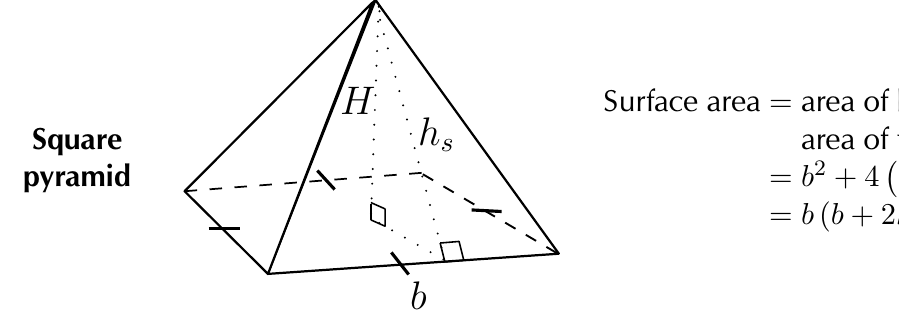
For a square pyramid with base side length b and slant height hs:
Surface area = area of base + area of triangular sides
Surface area =
This simplifies to: Surface area =
Note
The base area is simply since it's a square. The four triangular faces each have area , so we multiply by 4.
Triangular pyramid surface area
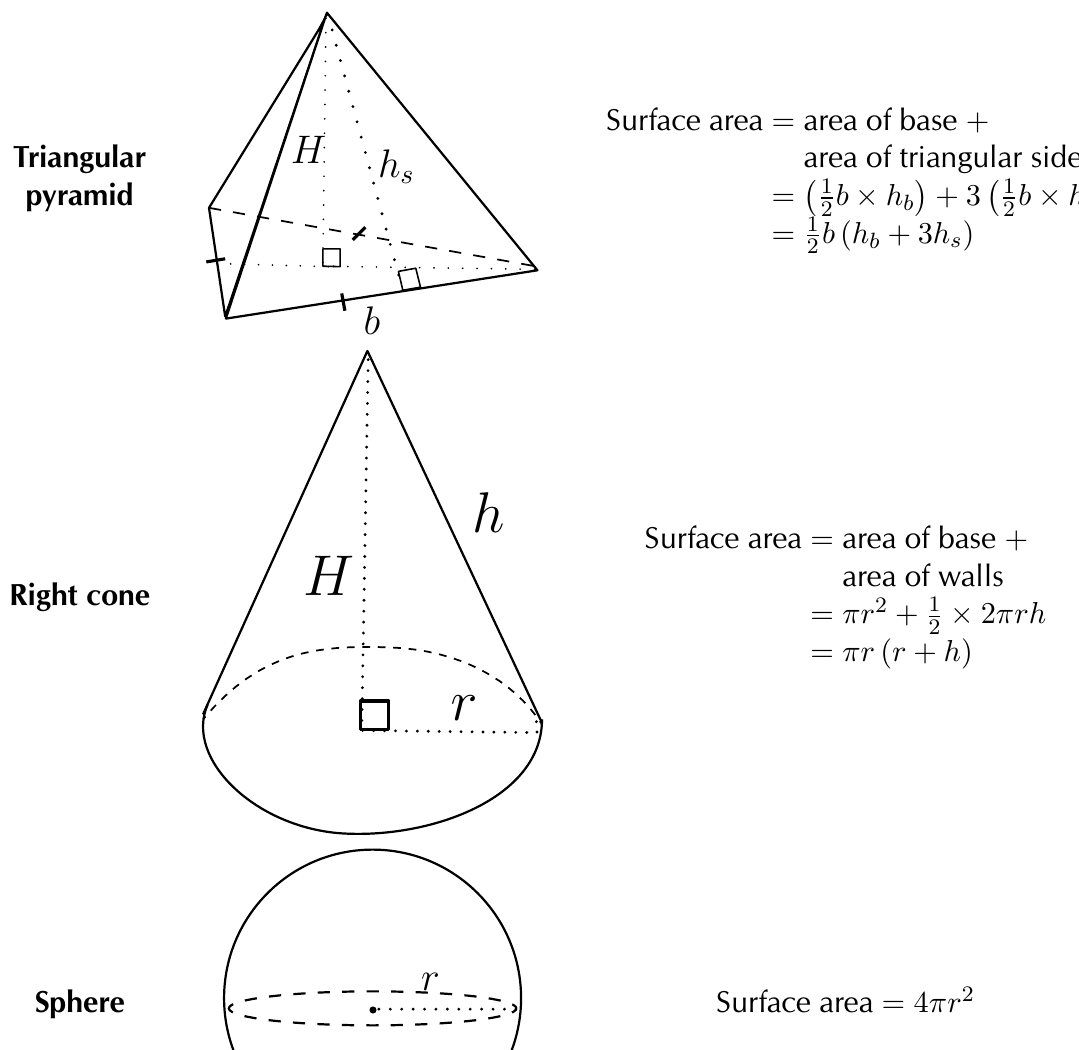
For a triangular pyramid with base width b, base height hb, and slant height hs:
Surface area = area of base + area of triangular sides
Surface area =
This simplifies to: Surface area =
Note
The triangular base has area , and there are three identical triangular faces each with area .
Right cone surface area
For a right cone with radius r and slant height h:
Surface area = area of base + area of curved surface
Surface area =
This simplifies to: Surface area =
Note
The circular base has area , and the curved surface area equals (this comes from "unrolling" the curved surface).
Sphere surface area
For a sphere with radius r:
Surface area =
This formula represents the total area of the curved surface that encloses the sphere.
Volume calculations
Volume measures the amount of three-dimensional space contained within a shape. For pyramids and cones, the volume formula follows a consistent pattern.
Important
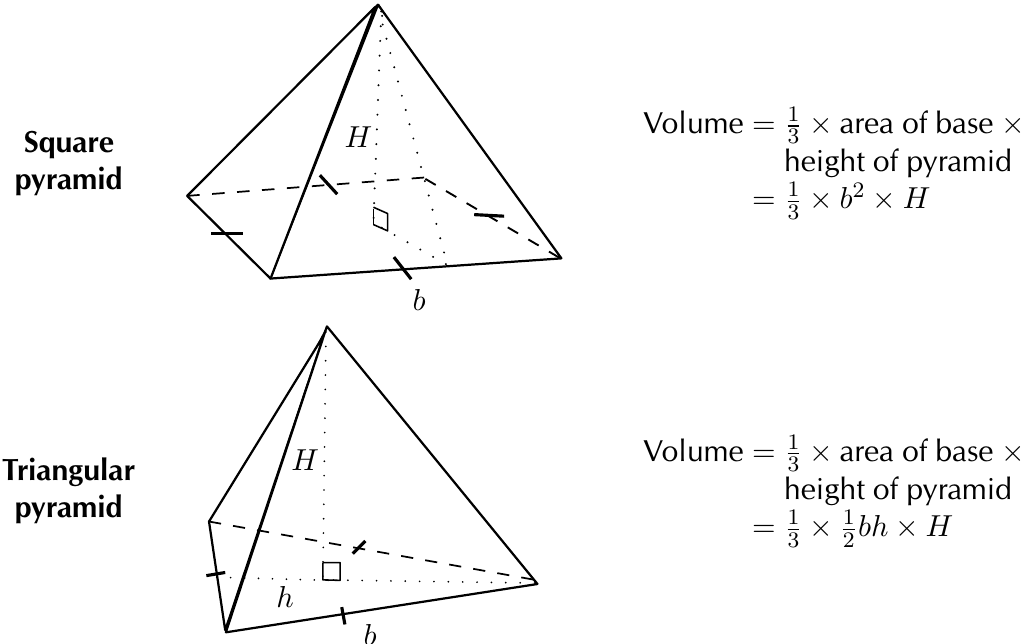
For volume calculations, you must use the perpendicular height (H), not the slant height. The perpendicular height is the straight-line distance from the apex to the base, measured at a 90° angle to the base.
Square pyramid volume
For a square pyramid with base side length b and height H:
Volume = area of base height
Volume =
The height H is the perpendicular distance from the apex to the base, not the slant height.
Triangular pyramid volume
For a triangular pyramid with base area and height H:
Volume = area of base height
Volume =
Where represents the area of the triangular base.
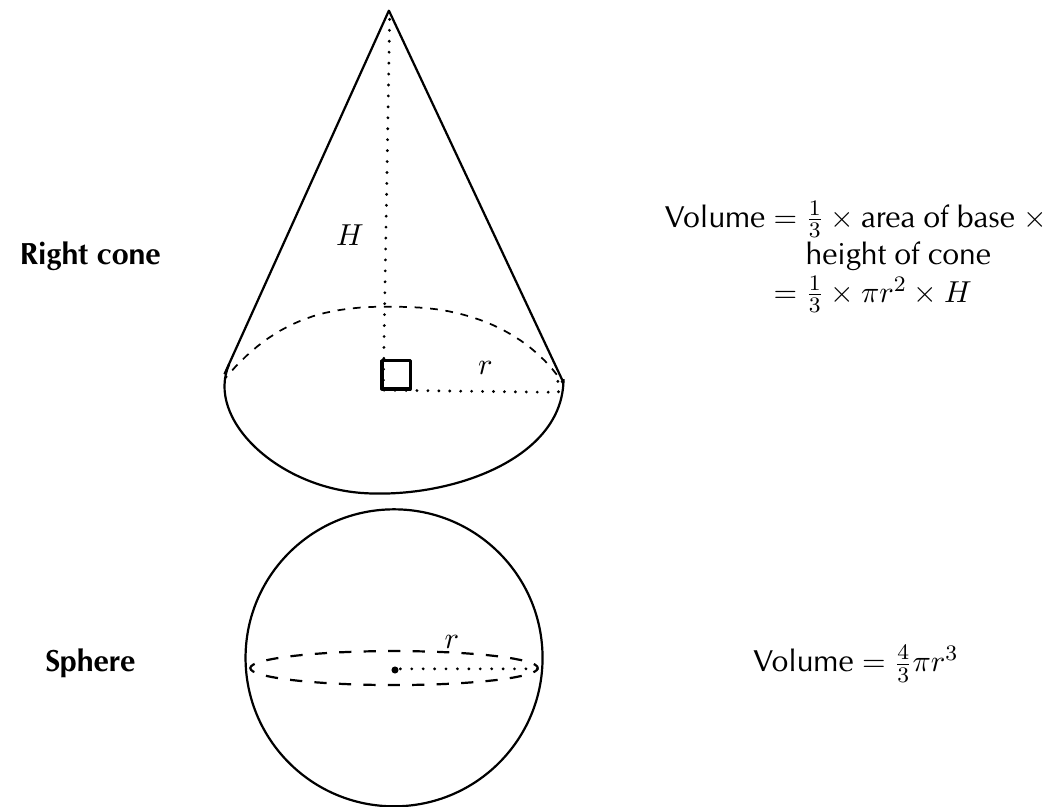
Right cone volume
For a right cone with radius r and height H:
Volume = area of base height
Volume =
Note
Notice that all pyramids and cones use the same factor in their volume calculations.
Sphere volume
For a sphere with radius r:
Volume =
Important
The sphere is the only shape in this group that doesn't use the factor - instead it uses .
Worked example: SALT telescope building
Example
Worked Example: SALT Telescope Building Calculations
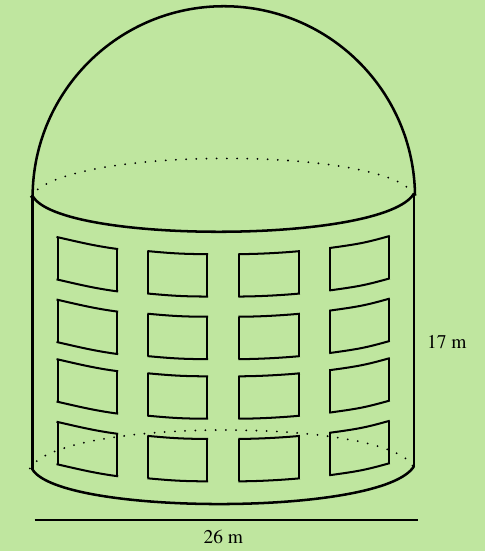
Question: The Southern African Large Telescope (SALT) is housed in a cylindrical building with a domed roof in the shape of a hemisphere. The height of the building wall is 17 m and the diameter is 26 m.
Part 1: Calculate the total surface area
The building consists of a cylinder with a hemisphere on top. The radius is 13 m (half the diameter).
Total surface area = area of dome + area of cylinder walls
For the hemisphere: Surface area =
For the cylinder walls: Surface area = (we don't include the top since it's covered by the dome)
- Surface area =
- Surface area =
- Surface area =
- Surface area ≈ 2450 m²
Part 2: Calculate the total volume
Total volume = volume of hemisphere + volume of cylinder
Hemisphere volume =
Cylinder volume =
- Volume =
- Volume =
- Volume =
- Volume ≈ 9543 m³
Key formulas summary
Summary
Surface area formulas:
- Square pyramid:
- Triangular pyramid:
- Right cone:
- Sphere:
Volume formulas:
- Square pyramid:
- Triangular pyramid:
- Right cone:
- Sphere:
Remember!
Summary
Key Points to Remember:
- All pyramids and cones use in their volume formula, while spheres use
- Surface area always equals base area plus lateral (side) surface area
- A "right" pyramid means the height is perpendicular to the base
- For surface area calculations, you need the slant height, but for volume you need the perpendicular height
- When working with composite shapes, break them down into familiar shapes and add their areas or volumes together