Summary (Grade 11 NSC Matric Mathematics): Revision Notes
📚Revision Notes
Summary
What is area?
Area measures the amount of flat surface space contained within the boundaries of a 2D shape. Think of it as how much paint you would need to cover a flat surface completely.
Note
Area is always measured in square units such as cm², m², or km² because we're measuring two-dimensional space.
Area formulae for common shapes
Understanding how to calculate area is essential for solving measurement problems. Here are the key formulae you need to memorise:
- Square: (where is the side length)
- Rectangle: (where is breadth and is height)
- Triangle: (where is base and is height)
- Trapezium: (where and are parallel sides, is height)
- Parallelogram: (where is base and is perpendicular height)
- Circle: (where is the radius)
Example
Worked Example: Finding the Area of a Rectangle
A rectangular garden has a length of 8 metres and a width of 5 metres. What is its area?
Step 1: Identify the formula Area of rectangle =
Step 2: Substitute the values Area = m²
Therefore, the garden has an area of 40 square metres.
What is surface area?
Surface area represents the total area of all the exposed outer surfaces of a 3D object or prism. Imagine wrapping a present - the surface area is the total amount of wrapping paper you would need.
What is a net?
A net is the unfolded flat pattern of a 3D solid. When you cut along the edges of a 3D shape and flatten it out, you create its net. This helps us visualise and calculate surface areas.
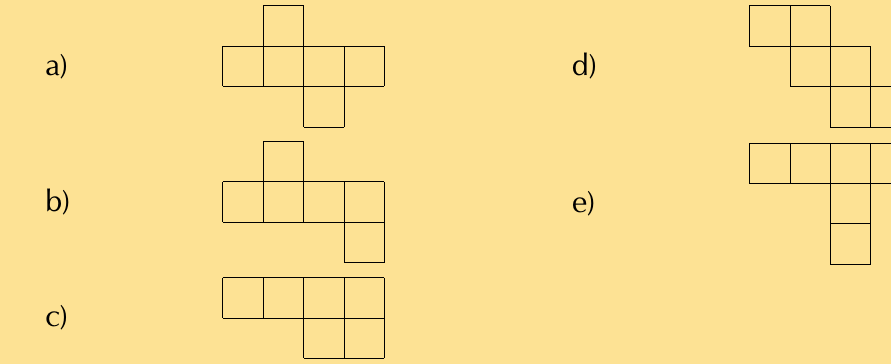
The diagram above shows different possible nets for a cube. Each arrangement can be folded to form a complete cube.
Note
Different 3D shapes can have multiple possible net arrangements, but they all fold into the same solid when assembled correctly.
What is volume?
Volume measures the amount of 3D space occupied by an object, or alternatively, how much the object can contain. Think of it as how much water could fill a container.
Volume formulae for prisms and basic solids
- Rectangular prism: (length × breadth × height)
- Triangular prism: (area of triangle × height of prism)
- Square prism (cube): (side length cubed)
- Cylinder: (area of circular base × height)
Note
Notice that all prism volumes follow the same pattern: base area × height. This makes them easier to remember!
What is a pyramid?
A pyramid is a 3D geometric solid that has a polygon as its base. All the triangular sides meet at a single point called the apex. The sides are not perpendicular to the base, which distinguishes pyramids from prisms.
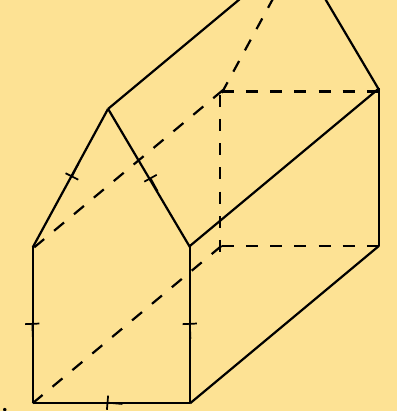
Surface area formulae for pyramids and curved solids
- Square pyramid: (where is base side, is slant height)
- Triangular pyramid: (where is base height, is slant height)
- Right cone: (where is radius, is slant height)
- Sphere: (where is radius)
Volume formulae for pyramids and curved solids
All pyramid volumes use the same principle: one-third of the base area multiplied by the perpendicular height.
- Square pyramid: (where is base side, is perpendicular height)
- Triangular pyramid: (where is base area, is perpendicular height)
- Right cone: (where is radius, is perpendicular height)
- Sphere: (where is radius)
Example
Worked Example: Finding the Volume of a Square Pyramid
A square pyramid has a base side of 6 cm and a perpendicular height of 9 cm. Calculate its volume.
Step 1: Identify the formula
Volume of square pyramid =
Step 2: Substitute the values
cm³
Therefore, the volume is 108 cubic centimetres.
Important
Common Mistake to Avoid:
Don't confuse slant height with perpendicular height in pyramid calculations:
- Slant height is used for surface area calculations
- Perpendicular height is used for volume calculations
The perpendicular height is the vertical distance from the apex straight down to the base.
Summary
Key Points to Remember:
- Area measures flat surface space using square units
- Volume measures 3D space using cubic units
- Surface area is the total outer area of all faces of a 3D object
- Nets are unfolded 2D patterns of 3D solids
- Pyramid volume formula always includes the factor
- Remember the difference: Area is 2D (flat surfaces), Volume is 3D (space inside)
- Triangle area memory aid: "Half base times height"
- Pyramid volume memory aid: "One-third base area times height"
- Always check your units: Area uses square units (cm², m²), Volume uses cubic units (cm³, m³)
- Draw diagrams: Sketching the shape helps identify which formula to use
- Label your variables: Clearly mark what each measurement represents