Trigonometry (Grade 11 NSC Matric Mathematics): Revision Notes
📚Revision Notes
Area, Sine, and Cosine Rules
Introduction
When working with triangles, there are three essential rules that help us find unknown sides, angles, and areas. These powerful tools extend beyond basic right-angled triangle trigonometry and work with any triangle:
- The area rule - for calculating triangle areas
- The sine rule - for finding unknown sides and angles
- The cosine rule - for finding unknown sides and angles
Understanding when and how to apply each rule is crucial for solving triangle problems effectively.
The area rule
What is the area rule?
The area rule provides a way to calculate the area of any triangle when you know two sides and the angle between them (the included angle). This is particularly useful when the triangle doesn't have a clear base and height that you can easily measure.
Note
The included angle is the angle that lies between the two known sides. This is essential for using the area rule correctly.
Deriving the area rule
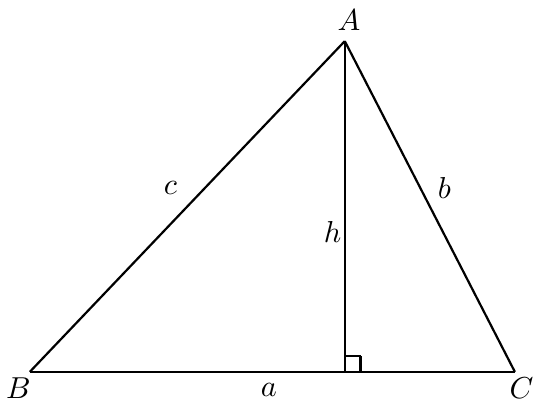
For any triangle ABC with sides a, b, and c, we can construct a perpendicular height from vertex A to the base BC. Using basic trigonometry in the right triangle formed:
In triangle ABC:
- Therefore:
Since Area = :
- Area =
- Area =
- Area =
Similarly, by drawing heights from different vertices, we can show that:
- Area =
- Area =
The area rule formula
For any triangle with sides a, b, c and opposite angles A, B, C:
The area equals half the product of any two sides multiplied by the sine of the included angle.
When to use the area rule
Use the area rule when:
- You need to find the area of a triangle
- You know two sides and the included angle
- No perpendicular height is given or easily determined
Example
Worked Example: Using the area rule
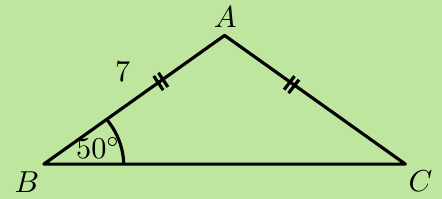
Question: Find the area of triangle ABC where AB = AC = 7 and angle B = 50°.
Solution:
Step 1: Identify what we know
- AB = AC = 7 (given)
- Angle B = 50° (given)
- Since AB = AC, this is an isosceles triangle
- Therefore angle C = 50° (angles opposite equal sides)
- Angle A = 180° - 50° - 50° = 80° (angles in triangle sum to 180°)
Step 2: Apply the area rule We need to choose the form that uses known information. We know sides AB (c = 7) and AC (b = 7), and angle A = 80°.
Area =
Area =
Area = 24.13 square units
Answer: The area is 24.13 square units.
The sine rule
What is the sine rule?
The sine rule establishes a relationship between the sides of a triangle and their opposite angles. It's particularly powerful for solving triangles when you don't have a right angle to work with.
Deriving the sine rule
Consider any triangle ABC with perpendicular height h drawn from vertex A to side BC:
From the two right triangles formed:
- In triangle ABF: , so
- In triangle ACF: , so
Since both expressions equal h:
Dividing both sides by bc:
Similarly, by drawing heights from other vertices:
The sine rule formula
For any triangle with sides a, b, c and opposite angles A, B, C:
or equivalently:
Note
The sine rule shows that in any triangle, the ratio of each side to the sine of its opposite angle is constant. This fundamental relationship is what makes the sine rule so useful.
When to use the sine rule
Use the sine rule when:
- Two angles and one side are known
- Two sides and a non-included angle are known
- You need to find an angle opposite a known side
The ambiguous case
Important
When using the sine rule with two sides and a non-included angle, there might be two possible triangles that satisfy the given conditions. This is called the ambiguous case.
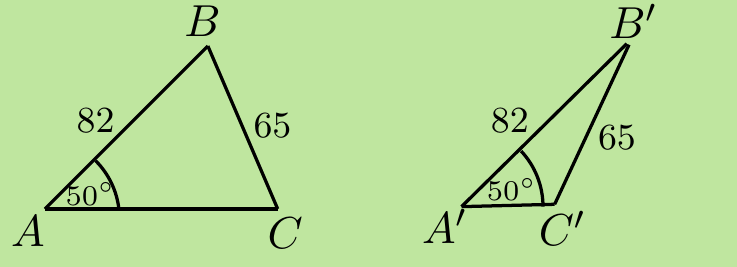
This happens when:
- You know two sides and an angle opposite the shorter side
- The angle is acute (less than 90°)
Exam tip: Always check if a second solution is possible by using the fact that .
Example
Worked Example: Using the sine rule
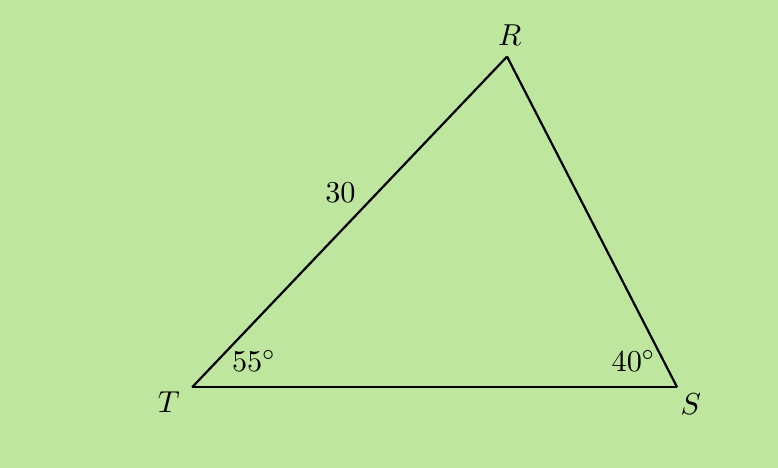
Question: In triangle TRS with angle STR = 55°, TR = 30 and angle RST = 40°, find RS and ST.
Solution:
Step 1: Find the third angle
TRS + RST + STR = 180° (angles in triangle)
TRS = 180° - 40° - 55° = 85°
Step 2: Apply the sine rule to find the unknown sides
To find RS (let RS = t):
To find ST (let ST = r):
Answer: RS = 38.2 and ST = 46.5
The cosine rule
What is the cosine rule?
The cosine rule is like an extended version of Pythagoras' theorem that works for any triangle, not just right-angled ones. It relates the length of one side to the lengths of the other two sides and the included angle.
Deriving the cosine rule
Consider triangle ABC with perpendicular height h drawn from C to side AB:
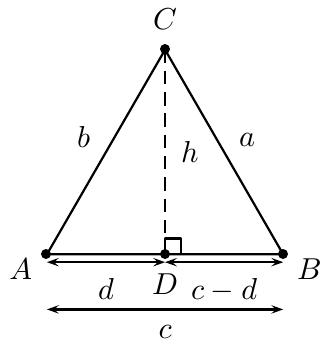
Using Pythagoras' theorem in both right triangles and eliminating the height h, we can derive:
This is the cosine rule. Notice that when angle A = 90°, , and the formula becomes , which is Pythagoras' theorem.
The cosine rule formula
For any triangle with sides a, b, c and opposite angles A, B, C:
These can be rearranged to find angles:
When to use the cosine rule
Use the cosine rule when:
- Two sides and the included angle are known
- All three sides are known (to find an angle)
- The sine rule would result in the ambiguous case
Example
Worked Example: Using the cosine rule to find a side
Question: Find the length of QR in triangle PQR where angle P = 70°, PQ = 13 cm, and PR = 4 cm.
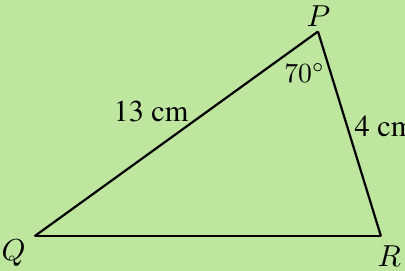
Solution:
Step 1: Apply the cosine rule
Let QR = p. We know angle P = 70°, side q = 4 cm, side r = 13 cm.
Answer: QR = 12.2 cm
Example
Worked Example: Using the cosine rule to find an angle
Question: Find angle A in triangle ABC where AB = 5, BC = 8, and AC = 7.
Solution:
Step 1: Apply the cosine rule (rearranged for angle)
We want angle A, so we use:
Where a = 8 (opposite angle A), b = 7, c = 5:
Therefore:
Answer: Angle A = 81.8°
How to determine which rule to use
Note
Decision-making guide
1. Area rule:
- Use when you need to find the area
- Requires two sides and the included angle
2. Sine rule:
- Use when no right angle is given
- Use when two sides and a non-included angle are given
- Use when two angles and one side are given
- Caution: Watch for the ambiguous case
3. Cosine rule:
- Use when no right angle is given
- Use when two sides and the included angle are given
- Use when all three sides are given
- Use to avoid the ambiguous case of the sine rule
Important
Important exam tips
Always remember to:
- Not round off before the final answer (affects accuracy)
- Take the square root when using the cosine rule for sides
- Include units in your final answer
- Check for the ambiguous case when using the sine rule
- Choose the most appropriate rule based on given information
Remember!
Summary
Key Points to Remember:
- Area rule: Area = - use when you have two sides and the included angle
- Sine rule: - use when you have two angles and a side, or two sides and a non-included angle
- Cosine rule: - use when you have two sides and the included angle, or three sides
- Watch for the ambiguous case with the sine rule when given two sides and a non-included angle
- Choose your rule carefully based on what information you're given - this is often the key to solving triangle problems efficiently