Reduction Formula (Grade 11 NSC Matric Mathematics): Revision Notes
📚Revision Notes
Reduction Formula
What are reduction formulae?
Reduction formulae are mathematical rules that allow us to express trigonometric functions of compound angles (like 90° ± θ, 180° ± θ, and 360° ± θ) in terms of the basic angle θ. These formulae are essential tools that simplify complex trigonometric expressions by reducing them to simpler forms involving acute angles.
Important
Key Principle: Any trigonometric function whose argument contains 90° ± θ, 180° ± θ, or 360° ± θ can be written simply in terms of θ.
Function values of 180° ± θ
Understanding these relationships helps us work with angles in the second and third quadrants. The geometric foundation lies in the symmetry properties of the unit circle.
Function values of 180° - θ
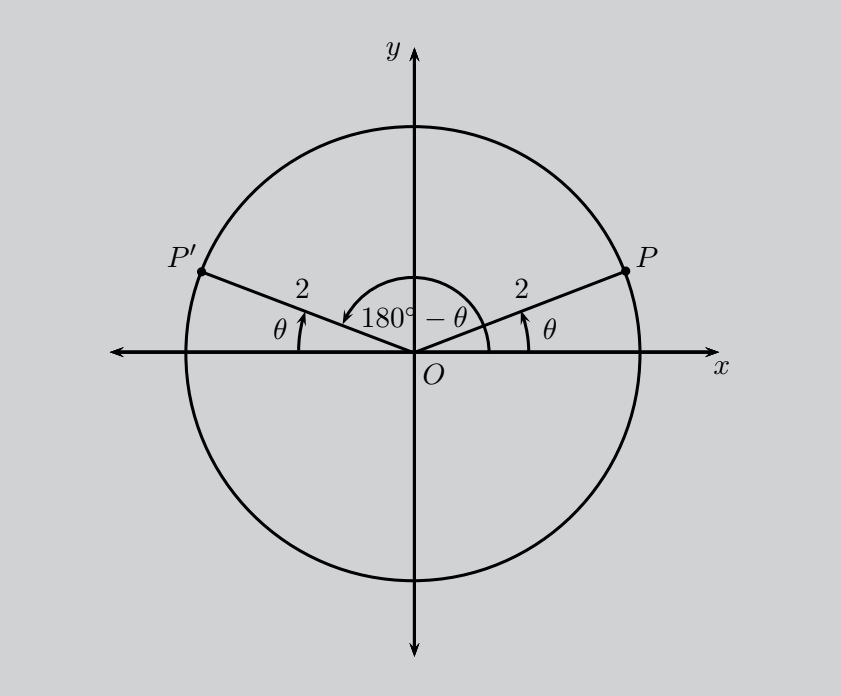
When we consider angles of the form 180° - θ, we are looking at angles in the second quadrant. Using the unit circle, we can see that points are symmetrical about the y-axis.
Note
For any point P on the circle making angle θ with the x-axis, there is a corresponding point P' that makes angle 180° - θ. These points are symmetrical about the y-axis, which is the key to understanding these reduction formulae.
This symmetry gives us the reduction formulae:
- sin(180° - θ) = sin θ (y-coordinates are the same)
- cos(180° - θ) = -cos θ (x-coordinates have opposite signs)
- tan(180° - θ) = -tan θ (ratio changes sign)
Function values of 180° + θ
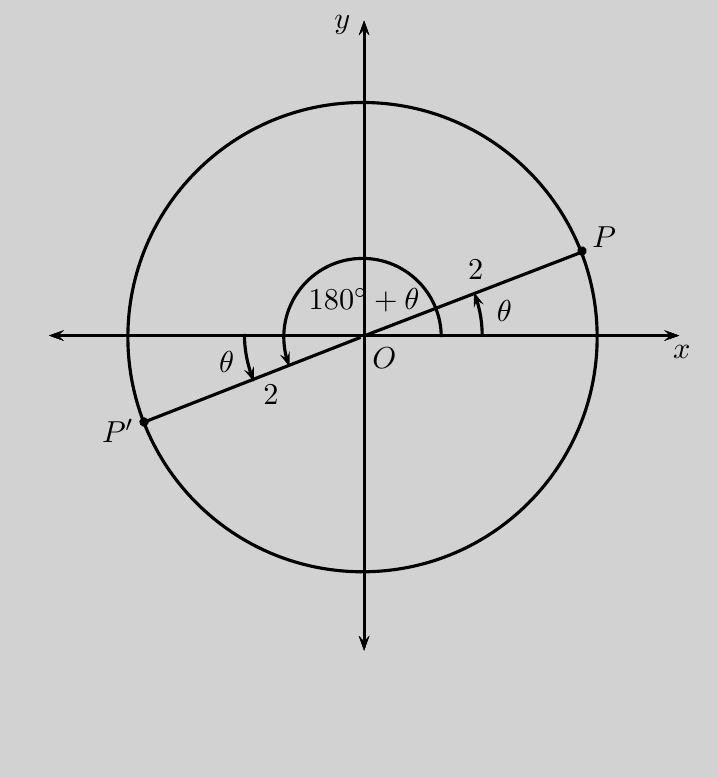
When we consider angles of the form 180° + θ, we are looking at angles in the third quadrant. These points are symmetrical about the origin.
Note
The symmetry about the origin means both x and y coordinates change signs, leading to specific patterns in the trigonometric function values.
This gives us the reduction formulae:
- sin(180° + θ) = -sin θ (y-coordinate changes sign)
- cos(180° + θ) = -cos θ (x-coordinate changes sign)
- tan(180° + θ) = tan θ (both coordinates change sign, so ratio stays the same)
Function values of 360° ± θ
These relationships demonstrate the periodic nature of trigonometric functions, which is fundamental to understanding their behavior over extended domains.
Function values of 360° - θ
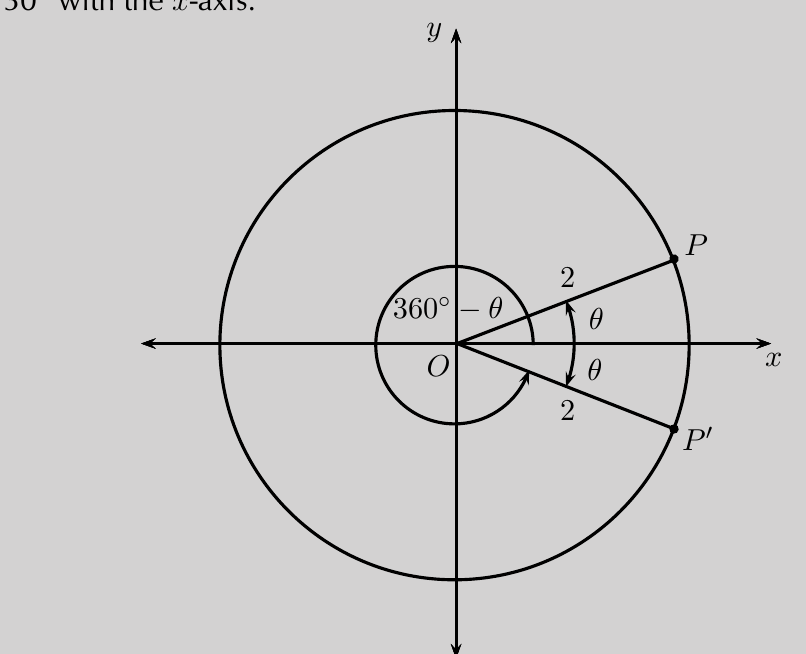
For angles of the form 360° - θ, we are in the fourth quadrant. Points are symmetrical about the x-axis.
Note
The symmetry about the x-axis means y-coordinates change sign while x-coordinates remain the same, creating a predictable pattern for the trigonometric functions.
The reduction formulae are:
- sin(360° - θ) = -sin θ (y-coordinate changes sign)
- cos(360° - θ) = cos θ (x-coordinate stays the same)
- tan(360° - θ) = -tan θ (ratio changes sign)
Function values of 360° + θ
Due to the periodicity of trigonometric functions, completing a full revolution brings us back to the same position:
- sin(360° + θ) = sin θ
- cos(360° + θ) = cos θ
- tan(360° + θ) = tan θ
Note
Periodicity Property: More generally, for any integer k:
- sin(k × 360° + θ) = sin θ
- cos(k × 360° + θ) = cos θ
- tan(k × 360° + θ) = tan θ
This means trigonometric functions repeat their values every 360°.
Function values of 90° ± θ and co-functions
These relationships reveal the special connection between sine and cosine functions called co-functions. This concept is fundamental to understanding complementary angle relationships.
What are co-functions?
Important
Co-functions are pairs of trigonometric functions that are equal when their arguments are complementary angles (angles that sum to 90°). In any right-angled triangle, the two acute angles are complementary.
The fundamental co-function relationships are:
- sin(90° - θ) = cos θ
- cos(90° - θ) = sin θ
Function values of 90° - θ
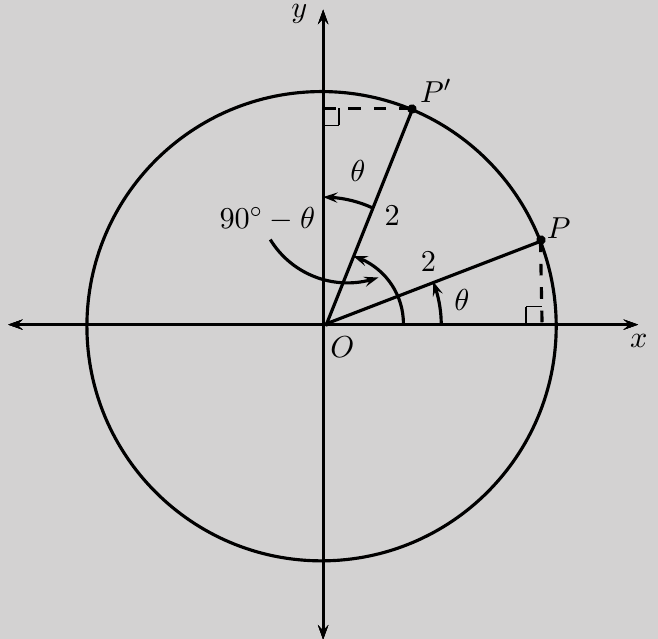
Using the unit circle, we can see that points corresponding to θ and 90° - θ have a special relationship.
Note
When we rotate a point through 90° - θ, the coordinates interchange with specific sign changes. This geometric transformation is the foundation for co-function relationships.
The reduction formulae are:
- sin(90° - θ) = cos θ
- cos(90° - θ) = sin θ
Function values of 90° + θ
Similarly, for angles of the form 90° + θ:
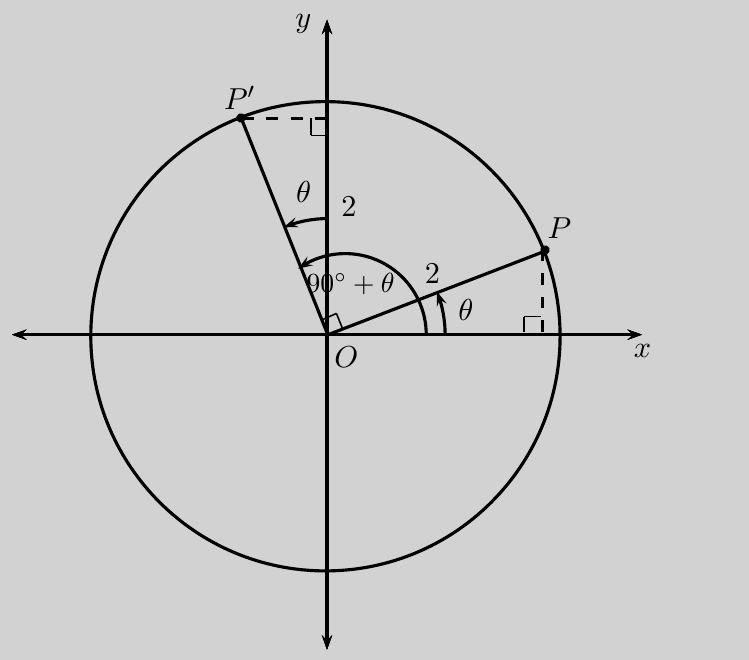
The reduction formulae are:
- sin(90° + θ) = cos θ
- cos(90° + θ) = -sin θ
Function values of θ - 90°
We can also express:
- sin(θ - 90°) = -cos θ
- cos(θ - 90°) = sin θ
Note
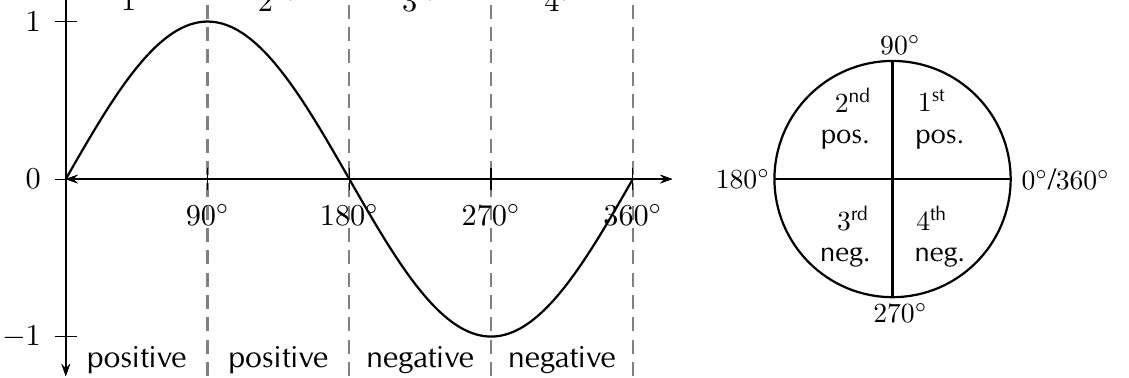
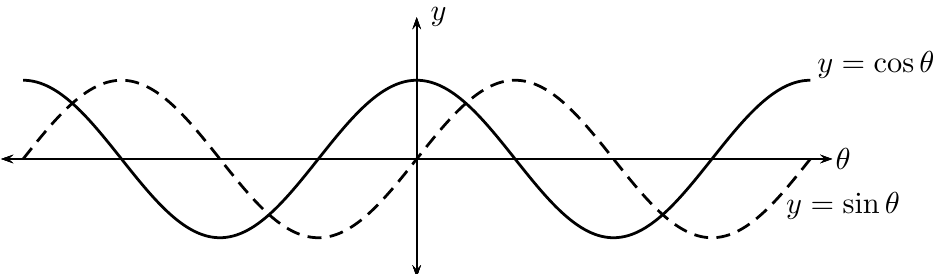
The sine and cosine graphs clearly show this relationship - they are identical except for a 90° phase difference. This visual representation helps understand why co-function relationships exist.
Worked examples
Example
Worked Example 1: Using reduction formulae for 180° ± θ
Question: Write the following as a single trigonometric ratio:
Solution:
Step 1: Use reduction formulae to write the trigonometric function values in terms of acute angles and θ
Step 2: Simplify
Example
Worked Example 2: Using reduction formulae for 360° ± θ
Question: If f = tan 67°, express the following in terms of f:
Solution:
Step 1: Using reduction formulae
Example
Worked Example 3: Using co-functions
Question: Write each of the following in terms of sin 40°:
- cos 50°
- sin 320°
- cos 230°
- cos 130°
Solution:
- cos 50° = sin(90° - 50°) = sin 40°
- sin 320° = sin(360° - 40°) = -sin 40°
- cos 230° = cos(180° + 50°) = -cos 50° = -cos(90° - 40°) = -sin 40°
- cos 130° = cos(90° + 40°) = -sin 40°
Complete reference table
Here is a comprehensive summary of all reduction formulae organized by quadrant. This table serves as a quick reference for applying the appropriate formula based on the quadrant and angle form.
| Second Quadrant (180° - θ) or (90° + θ) | First Quadrant (θ) or (90° - θ) |
|---|---|
| sin(180° - θ) = +sin θ | All trig functions are positive |
| cos(180° - θ) = -cos θ | sin(360° + θ) = sin θ |
| tan(180° - θ) = -tan θ | cos(360° + θ) = cos θ |
| sin(90° + θ) = +cos θ | tan(360° + θ) = tan θ |
| cos(90° + θ) = -sin θ | sin(90° - θ) = cos θ |
| cos(90° - θ) = sin θ |
| Third Quadrant (180° + θ) | Fourth Quadrant (360° - θ) |
|---|---|
| sin(180° + θ) = -sin θ | sin(360° - θ) = -sin θ |
| cos(180° + θ) = -cos θ | cos(360° - θ) = +cos θ |
| tan(180° + θ) = +tan θ | tan(360° - θ) = -tan θ |
Note
Using the Table: To use this reference table effectively, first identify which quadrant your angle falls into, then apply the corresponding reduction formula. Remember that the CAST rule helps determine the correct signs in each quadrant.
Summary
Key Rules to Remember:
-
The reduction formulae hold for any angle θ. For convenience, we usually assume θ is an acute angle (0° < θ < 90°).
-
When determining function values of (180° ± θ), (360° ± θ) and (-θ), the function does not change.
-
When determining function values of (90° ± θ) and (θ ± 90°), the function changes to its co-function.
-
Use the CAST rule to determine the correct signs in each quadrant.
Summary
Essential Points to Master:
- Reduction formulae allow you to express any trigonometric function of 90° ± θ, 180° ± θ, or 360° ± θ in terms of the basic angle θ
- Co-functions (sine and cosine) swap when dealing with 90° ± θ relationships
- Signs matter - use the CAST rule to determine whether functions are positive or negative in each quadrant
- 360° rotations bring you back to the same values due to periodicity
- Practice identifying patterns - the formulae follow logical geometric relationships on the unit circle