Revision (Grade 11 NSC Matric Mathematics): Revision Notes
📚Revision Notes
Revision
Trigonometric ratios
Trigonometric ratios are fundamental relationships between the sides of a right triangle and its angles. These ratios help us solve problems involving triangles and are essential for understanding periodic functions.
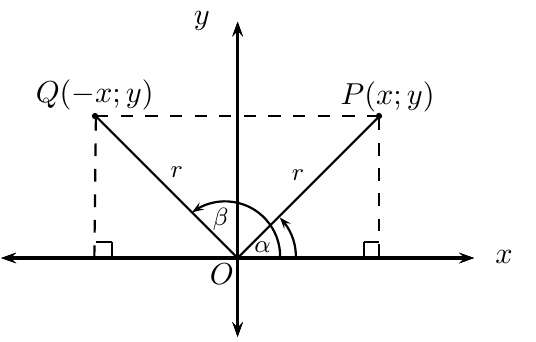
When we plot points on a coordinate plane, we can define trigonometric ratios using the coordinates. For any point P(x; y) on a circle with radius r centered at the origin, the basic trigonometric ratios are:
- Sine (sin):
- Cosine (cos):
- Tangent (tan):
The Pythagorean theorem shows us that , which means the distance from the origin to any point P is constant for points on the same circle.
Signs in different quadrants
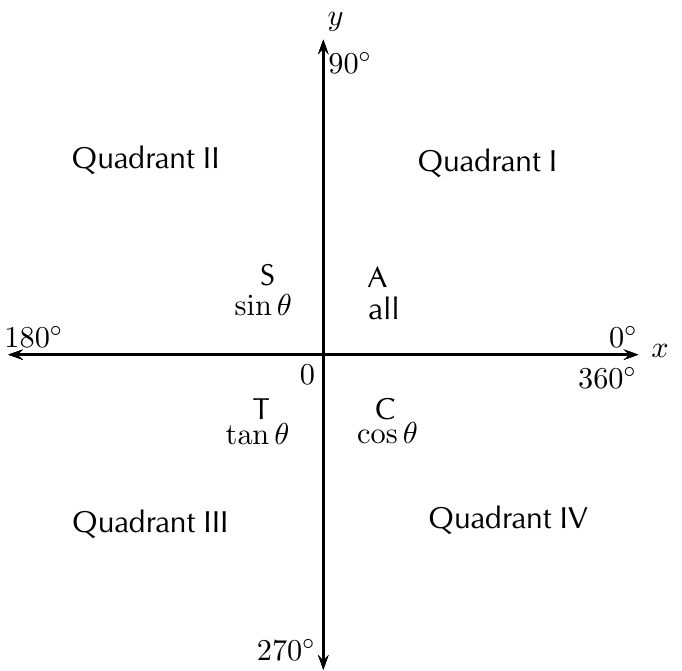
The ASTC rule helps us remember which trigonometric functions are positive in each quadrant. This rule is crucial for solving trigonometric equations correctly.
Note
Quadrant signs:
- Quadrant I (0° to 90°): All functions are positive
- Quadrant II (90° to 180°): Only Sine is positive
- Quadrant III (180° to 270°): Only Tangent is positive
- Quadrant IV (270° to 360°): Only Cosine is positive
The mnemonic "All Students Take Calculus" helps remember this pattern. Understanding these signs is essential when working with angles greater than 90°.
Special angles and exact values
Certain angles have exact trigonometric values that you must memorise. These special angles appear frequently in examinations and real-world applications.
Important
Key exact values:
| θ | 0° | 30° | 45° | 60° | 90° |
|---|---|---|---|---|---|
| cos θ | 1 | 0 | |||
| sin θ | 0 | 1 | |||
| tan θ | 0 | 1 | undefined |
These values come from special right triangles: the 30-60-90 triangle and the 45-45-90 triangle. Memorising these exact values will save you time in examinations and ensure accuracy in your calculations.
Solving for sides of triangles
When solving trigonometric problems, always follow a systematic approach to avoid errors and ensure accuracy.
Example
Worked Example: Finding unknown sides
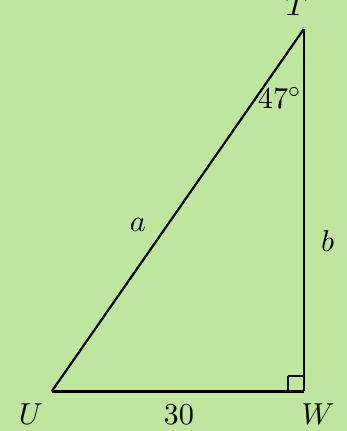
Problem: Determine the values of a and b in the right-angled triangle TUW.
Solution steps:
Step 1: Identify the triangle components
- Given angle: 47°
- Given side: UW = 30 (adjacent to the 47° angle)
- Unknown sides: a (hypotenuse), b (opposite to the 47° angle)
Step 2: Find the hypotenuse (a) Using cosine ratio:
Rearranging:
Step 3: Find the opposite side (b)
Using tangent ratio:
Rearranging:
Answer: a = 41,0 units and b = 28,0 units
Important
Exam tip: Always use given information for calculations rather than previously calculated values to avoid compounding errors.
Finding unknown angles
When finding angles, we use inverse trigonometric functions (sin⁻¹, cos⁻¹, tan⁻¹). These functions help us work backwards from ratios to find the angle measurement.
Example
Worked Example: Finding an angle using sides
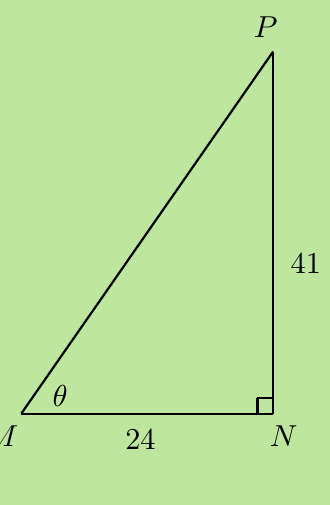
Problem: Calculate the value of θ in the right-angled triangle ANP.
Solution steps:
Step 1: Identify known sides
- Adjacent to θ: AN = 24
- Opposite to θ: NP = 41
Step 2: Choose the appropriate ratio
Since we know opposite and adjacent sides:
Step 3: Use inverse tangent
Example
Worked Example: Solving trigonometric equations
Problem: Given for θ ∈ [0°; 90°], find θ.
Solution steps:
Step 1: Simplify the equation
Step 2: Calculate the numerical value
Step 3: Use inverse sine
Therefore:
Important
Exam tip: Avoid rounding intermediate steps. Keep full accuracy until the final answer.
Two-dimensional problems
Trigonometry has many real-world applications. Two-dimensional problems often involve situations like navigation, construction, and physics.
Example
Worked Example: Kite flying problem
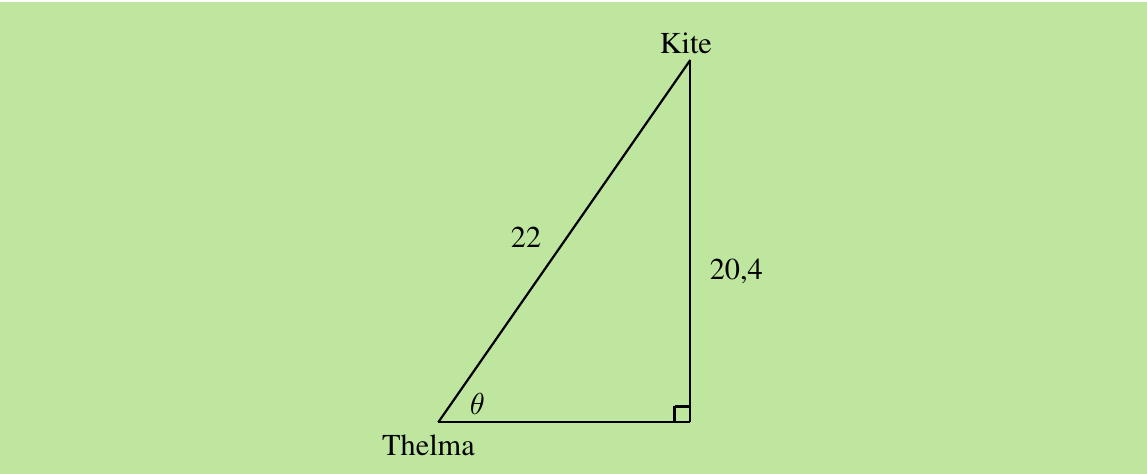
Problem: Thelma flies a kite on a 22 m string. The height of the kite above ground is 20,4 m. Find the angle of inclination of the string.
Solution steps:
Step 1: Set up the problem
- Hypotenuse: string length = 22 m
- Opposite: height = 20,4 m
- Required: angle of inclination θ
Step 2: Apply sine ratio
Step 3: Calculate the angle
This type of problem demonstrates how trigonometry connects mathematical concepts to practical situations you encounter in daily life.
Problem-solving strategies
Developing effective problem-solving strategies is crucial for success in trigonometry. A structured approach helps you tackle even complex problems systematically.
Summary
Key strategies for trigonometry problems:
- Always draw a diagram when none is provided
- Label all known and unknown quantities clearly
- Identify which sides are opposite, adjacent, and hypotenuse relative to the given angle
- Choose the appropriate trigonometric ratio based on what you know and what you need to find
- Use given information for calculations, not previously calculated values
- Keep full calculator accuracy until the final step
- Check your answer makes sense in the context of the problem
Common exam traps:
- Confusing which side is opposite or adjacent to the given angle
- Using degrees instead of the correct angle measurement
- Rounding too early in multi-step calculations
- Forgetting to check if your angle is in the correct quadrant
Summary
Key Points to Remember:
- Memorise the exact values for 0°, 30°, 45°, 60°, and 90° - these appear frequently in exams
- Use the ASTC rule to determine signs in different quadrants: All Students Take Calculus
- Always identify opposite, adjacent, and hypotenuse before choosing your trigonometric ratio
- Draw clear diagrams for word problems to visualise the situation correctly
- Keep full calculator accuracy throughout your working and only round your final answer