Trigonometric Equations (Grade 11 NSC Matric Mathematics): Revision Notes
📚Revision Notes
Trigonometric Equations
What are trigonometric equations?
Trigonometric equations are equations that contain trigonometric functions such as sine, cosine, or tangent. Solving these equations means finding the values of angles that make the equation true.
Note
The key challenge with trigonometric equations is that trigonometric functions are periodic. This means they repeat their values at regular intervals, so there are often multiple (or even infinite) solutions to a single equation.
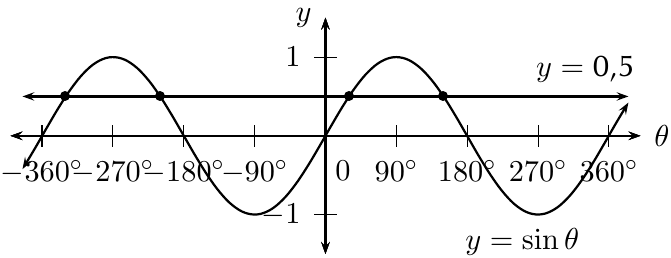
The diagram above shows the sine function and illustrates how the horizontal line intersects the sine curve at multiple points, demonstrating the periodic nature of trigonometric solutions.
Method for solving trigonometric equations
When solving trigonometric equations, we use a systematic approach that helps us find all possible solutions within a given interval.
Important
Critical Success Strategy
Always follow the step-by-step method in order. Skipping steps or changing the sequence often leads to missing solutions or incorrect answers. The systematic approach ensures you capture all possible solutions within the given interval.
Step-by-step method
Step 1: Find the reference angle
- The reference angle is always a positive acute angle (between and )
- Use your calculator to find this angle, ignoring any negative signs
- This gives you the basic angle in the first quadrant
Step 2: Use the CAST diagram
- Determine which quadrants contain the correct solutions
- CAST tells us which functions are positive in each quadrant:
- Cosine positive in quadrant I and IV
- All functions positive in quadrant I
- Sine positive in quadrant I and II
- Tangent positive in quadrant I and III
Step 3: Apply reduction formulae
- Use reduction formulae to find angles in the correct quadrants:
- Second quadrant:
- Third quadrant:
- Fourth quadrant:
Step 4: Check your solutions
- Substitute your answers back into the original equation
- Verify that they satisfy the equation
Step 5: Write the final answer
- List all solutions within the given interval
Example
Worked Example: Solving tan θ = 5
Question: Solve for (correct to one decimal place), given and .
Solution:
Step 1: Find the reference angle
This is an acute angle in the first quadrant (the reference angle).
Step 2: Use CAST diagram for tangent The CAST diagram shows that is positive in the first and third quadrants.
Step 3: Find angles in correct quadrants
- First quadrant:
- Third quadrant:
Step 4: Check solutions using calculator
Final answer: or
Example
Worked Example: Solving cos α = -0.7
Question: Solve for (correct to one decimal place), given and .
Solution:
Step 1: Find the reference angle We use the positive value:
Step 2: Use CAST diagram for cosine Cosine is negative in the second and third quadrants.
Step 3: Find angles in correct quadrants
- Second quadrant:
- Third quadrant:
Final answer: or
General solution
When no specific interval is given, we need to find the general solution. This means finding a formula that represents all possible solutions to the equation.
The periodic nature of trigonometric functions means:
- Sine and cosine have a period of
- Tangent has a period of
General solution method
- Find the reference angle using a positive value
- Use the CAST diagram to determine where the function is positive or negative
- Find angles in the interval that satisfy the equation
- Add multiples of the period to each solution
Example
Worked Example: General solution for sin θ = 0.3
Question: Determine the general solution for .
Solution:
Step 1: Find the reference angle
Step 2: Use CAST diagram Sine is positive in the first and second quadrants.
Step 3: Find basic solutions
- First quadrant:
- Second quadrant:
Step 4: Add multiples of the period ()
General solution:
or , where
Example
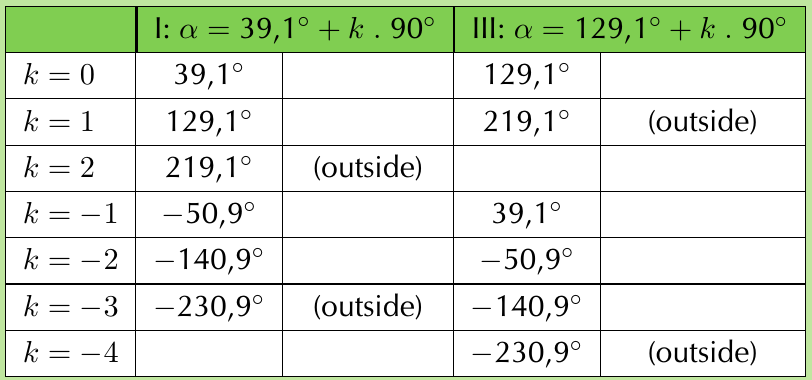
Worked Example: General solution for cos 2θ = -0.6427
Question: Determine the general solution for .
Solution:
Step 1: Find the reference angle
Step 2: Use CAST diagram Cosine is negative in the second and third quadrants.
Step 3: Find solutions for the angle
- Second quadrant:
- Third quadrant:
Step 4: Solve for
Important: Remember to divide the period () by the coefficient of .
General solution: or , where
Quadratic trigonometric equations
Some trigonometric equations are quadratic in nature. We can solve these using algebraic methods like factoring or substitution.
Note
Two Main Approaches for Quadratic Trigonometric Equations
- Factoring method: Factor the equation if possible - this works well when the equation can be written as a product of simpler expressions
- Substitution method: Let , solve the quadratic, then substitute back - useful for more complex quadratic forms
Example
Worked Example: Solving 4sin²θ = 3
Question: Find the general solution of .
Solution:
Step 1: Simplify the equation
Step 2: Find reference angle
Step 3: Determine quadrants
- For : first and second quadrants
- For : third and fourth quadrants
Step 4: Find all solutions
- (first quadrant)
- (second quadrant)
- (third quadrant)
- (fourth quadrant)
General solution: , , , or , where
Example
Worked Example: Solving 2cos²θ - cos θ - 1 = 0
Question: Find if for .
Solution:
Step 1: Factor the equation
Step 2: Solve each factor
Either or
From :
Solutions: and (or within the given interval)
From :
Step 3: Check which solutions lie in
Final answer:
Key reduction formulae
Important
Essential Reduction Formulae
These formulae help you find angles in different quadrants and are crucial for solving trigonometric equations:
- Second quadrant: ,
- Third quadrant: ,
- Fourth quadrant: ,
- Tangent: (period of )
Memorizing these formulae will significantly speed up your problem-solving process.
Summary
Key Points to Remember:
- Trigonometric equations have multiple solutions due to the periodic nature of trig functions
- Always find the reference angle first (positive, acute angle in the first quadrant)
- Use the CAST diagram to determine which quadrants contain valid solutions
- For general solutions, add multiples of the appropriate period ( for sin/cos, for tan)
- Quadratic trigonometric equations can be solved using factoring or substitution methods
- Always check your answers by substituting back into the original equation
- The systematic step-by-step approach is essential for capturing all possible solutions