Molecular Shape (Grade 11 NSC Matric Physical Sciences): Revision Notes
📚Revision Notes
Molecular Shape
What is molecular shape?
Molecular shape refers to the three-dimensional arrangement of atoms in a molecule. This shape is crucial because it determines how molecules interact with each other and affects important properties like boiling points, melting points, and chemical reactivity.
The shape of a molecule influences many of its characteristics. For example, if water molecules were linear instead of bent, water would not have its unique properties that make life possible. Understanding molecular shape helps us predict and explain the behaviour of different compounds.
Note
Why does molecular shape matter?
Molecular shape affects virtually every property of a compound - from how it dissolves in water to its biological activity in living organisms. This is why understanding VSEPR theory is fundamental to chemistry.
Valence Shell Electron Pair Repulsion (VSEPR) theory
Definition
Valence Shell Electron Pair Repulsion (VSEPR) theory is a model used to predict the three-dimensional shape of molecules. The theory is based on the idea that electron pairs around a central atom will arrange themselves to minimize repulsion between their negative charges.
Basic principle
The core concept of VSEPR theory is simple: electron pairs behave like negatively charged regions that repel each other. To minimize this repulsion, the electron pairs position themselves as far apart as possible around the central atom.
Important
Key VSEPR Principle
Both bonding electron pairs (shared between atoms) and non-bonding electron pairs (lone pairs) contribute to determining the molecular shape. However, only the positions of the atoms (not the lone pairs) define the actual molecular geometry we observe.
Determining molecular shape
To predict the shape of any covalent molecule, follow these three steps:
Step 1: Draw the Lewis diagram
Create a Lewis diagram showing all valence electrons around the central atom. Make sure to include both bonding pairs and lone pairs.
Step 2: Count the electron pairs
Count the total number of electron pairs around the central atom. This includes both bonding pairs and lone pairs. Remember that double and triple bonds count as single electron pairs for shape determination.
Step 3: Use the reference table
Use the electron pair counts to determine the molecular geometry from the reference table below.
Note
Important tip for counting electron pairs
When determining molecular shape, a double bond (C=O) or triple bond (C≡N) counts as just one electron pair, not two or three. This is because these multiple bonds occupy the same general region of space around the central atom.
Common molecular geometries
The following table shows how the number of bonding and lone electron pairs determines molecular shape:
| Number of bonding electron pairs | Number of lone pairs | Geometry | General formula |
|---|---|---|---|
| 1 or 2 | 0 | linear | AX or AX₂ |
| 2 | 2 | bent or angular | AX₂E₂ |
| 3 | 0 | trigonal planar | AX₃ |
| 3 | 1 | trigonal pyramidal | AX₃E |
| 4 | 0 | tetrahedral | AX₄ |
| 5 | 0 | trigonal bipyramidal | AX₅ |
| 6 | 0 | octahedral | AX₆ |
In the general formula notation:
- A represents the central atom
- X represents terminal atoms (atoms bonded to the central atom)
- E represents lone electron pairs
Visual representations
Understanding molecular shapes is easier with visual aids. The diagrams below show the common molecular geometries in both 2D and 3D representations.
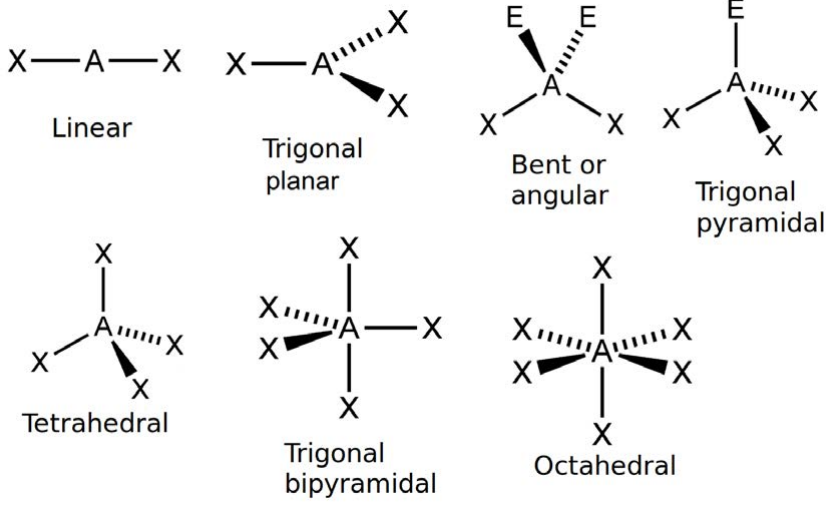
The 3D ball-and-stick models help visualize how these shapes actually appear in space:
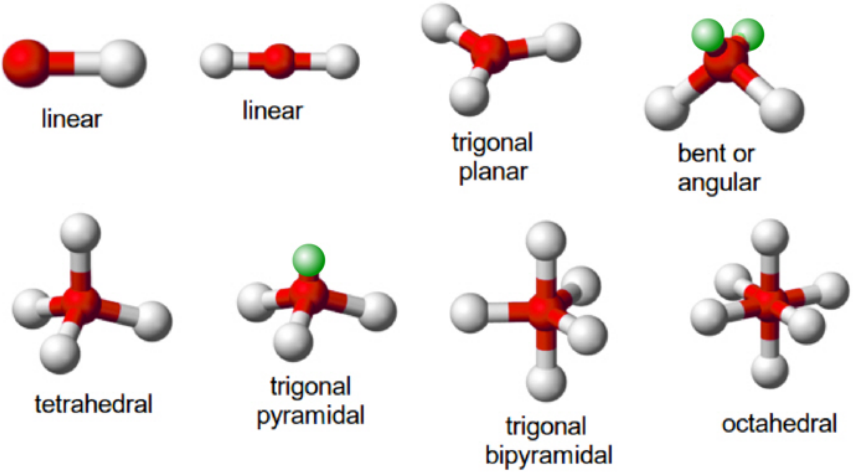
In these models:
- Red atoms represent the central atoms
- White atoms represent terminal atoms
- Green regions represent lone electron pairs
Key points about molecular shapes
The shapes with no lone pairs (linear, trigonal planar, tetrahedral, trigonal bipyramidal, and octahedral) are called the ideal shapes. These represent the most common molecular geometries.
Important
Essential Rule
All diatomic molecules (molecules with only two atoms) are linear. Examples include H₂, HCl, and Cl₂. This is true regardless of what atoms are involved.
Worked examples
Example
Worked Example 1: Determining the shape of BeCl₂
Question: Determine the molecular shape of BeCl₂.
Solution:
Step 1: Draw the Lewis diagram The central atom is beryllium (Be). The Lewis structure shows: :Cl:Be:Cl:
Step 2: Count electron pairs around the central atom There are two electron pairs around beryllium.
Step 3: Determine the geometry With two electron pairs and no lone pairs, BeCl₂ has the general formula AX₂. According to the table, this gives a linear shape.
Answer: The molecular shape of BeCl₂ is linear.
Example
Worked Example 2: Determining the shape of BF₃
Question: Determine the molecular shape of BF₃.
Solution:
Step 1: Draw the Lewis diagram The central atom is boron (B). The Lewis structure shows three fluorine atoms bonded to boron.
Step 2: Count electron pairs around the central atom There are three electron pairs around boron.
Step 3: Determine the geometry With three electron pairs and no lone pairs, BF₃ has the general formula AX₃. According to the table, this gives a trigonal planar shape.
Answer: The molecular shape of BF₃ is trigonal planar.
Example
Worked Example 3: Determining the shape of NH₃
Question: Determine the molecular shape of NH₃.
Solution:
Step 1: Draw the Lewis diagram The central atom is nitrogen (N). The Lewis structure shows three hydrogen atoms bonded to nitrogen, with one lone pair on nitrogen.
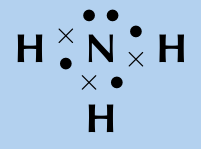
Step 2: Count electron pairs around the central atom There are four electron pairs around nitrogen (three bonding pairs and one lone pair).
Step 3: Determine the geometry
With three bonding pairs and one lone pair, NH₃ has the general formula AX₃E. According to the table, this gives a trigonal pyramidal shape.
Answer: The molecular shape of NH₃ is trigonal pyramidal.
Exam tips
Note
Essential Exam Strategies
- Always identify the central atom first - this is the atom around which other atoms are arranged
- Remember that double and triple bonds count as single electron pairs when determining shape
- Lone pairs affect the molecular shape even though they are not visible in the final geometry
- Practice drawing Lewis diagrams accurately - they are essential for applying VSEPR theory correctly
- When counting electron pairs, include both bonding and non-bonding pairs
Summary
Key Points to Remember:
- VSEPR theory states that electron pairs arrange themselves to minimize repulsion
- The general formula AXₙEₘ helps identify molecular shapes: A = central atom, X = terminal atoms, E = lone pairs
- Follow the three steps: draw Lewis diagram, count electron pairs, use reference table
- All diatomic molecules are linear regardless of the atoms involved
- Lone pairs influence molecular shape but are not part of the visible molecular geometry