Activation Energy and the Activated Complex (Grade 11 NSC Matric Physical Sciences): Revision Notes
📚Revision Notes
Activation Energy and the Activated Complex
What is activation energy?
Think about lighting a match. You cannot simply hold the match and expect it to light - you need to strike it against the matchbox first. This action provides the initial energy needed to start the combustion reaction. All chemical reactions work in a similar way.
Note
The match analogy is a perfect way to understand activation energy - just like you need to strike a match to provide the initial energy for combustion, all chemical reactions need an initial energy input to get started, even if they release energy overall.
Activation energy is the minimum amount of energy that must be added to a system before a chemical reaction can begin. Even reactions that release energy overall (exothermic reactions) still need this initial energy input to get started.
Understanding energy diagrams
When we study chemical reactions, we use energy diagrams to show how the potential energy changes as the reaction proceeds. These diagrams help us visualise the energy barrier that reactants must overcome.
The energy diagrams show a curved path rather than a straight line from reactants to products. This curve represents the energy changes that occur as bonds break and new bonds form during the reaction.
Exothermic reactions and activation energy
Let's examine the reaction between hydrogen gas and fluorine gas:
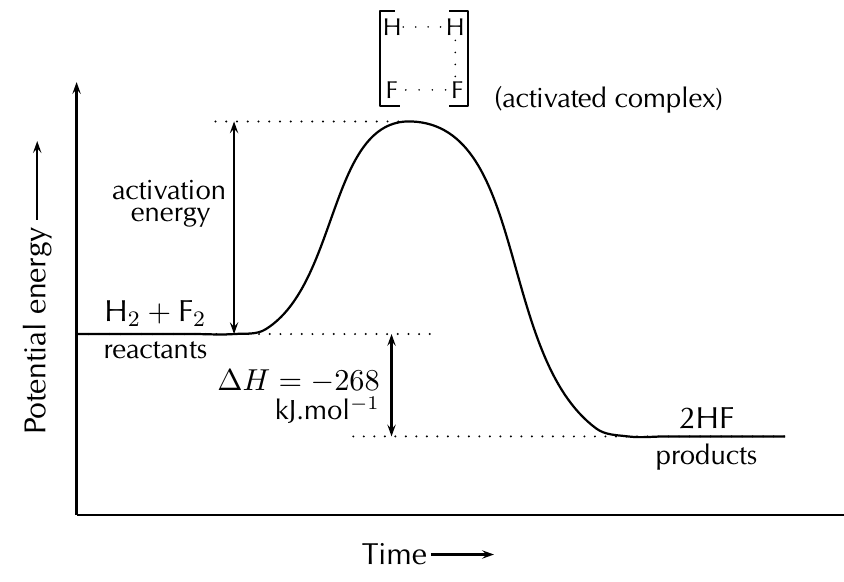
This energy diagram shows several important features:
- Reactants: start at a lower energy level
- Activation energy: The upward arrow shows the energy that must be supplied to reach the activated complex
- Activated complex: The peak of the curve where bonds are breaking and forming
- Products: ends at a much lower energy level than the reactants
- : This negative value confirms the reaction is exothermic
Note
During this reaction, the H-H bond in hydrogen must break, and the F-F bond in fluorine must also break. Simultaneously, new H-F bonds form. This process requires energy input initially, even though the overall reaction releases energy.
The activated complex
The activated complex (also called the transition state) is a temporary, high-energy arrangement of atoms that exists at the peak of the energy curve. This complex forms as the reactant bonds are breaking and the product bonds are beginning to form.
Important
Key points about the activated complex:
- It exists for only a very short time
- It represents the highest energy point in the reaction pathway
- It occurs when the system has maximum potential energy
- After this point, either the original bonds reform (no reaction) or new bonds complete formation (reaction proceeds)
For the reaction, we can represent the activated complex as:
The dotted lines show that bonds are partially broken and new bonds are beginning to form.
Endothermic reactions and activation energy
Endothermic reactions also require activation energy. Consider this reaction:
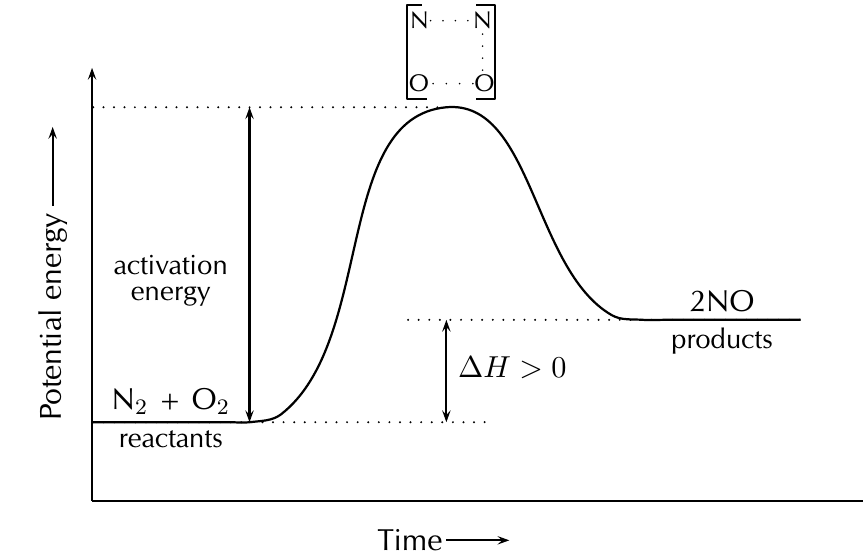
This energy diagram shows:
- Reactants: at a lower energy level
- Activation energy: A large energy barrier that must be overcome
- Products: at a higher energy level than reactants
- : This positive value confirms the reaction is endothermic
Note
Notice that the activation energy for endothermic reactions is typically much larger than for exothermic reactions. This makes endothermic reactions generally more difficult to initiate.
Calculating activation energy
The activation energy can be calculated using the formula:
Let's work through a practical example:
Example
Worked Example: Calculating Activation Energy
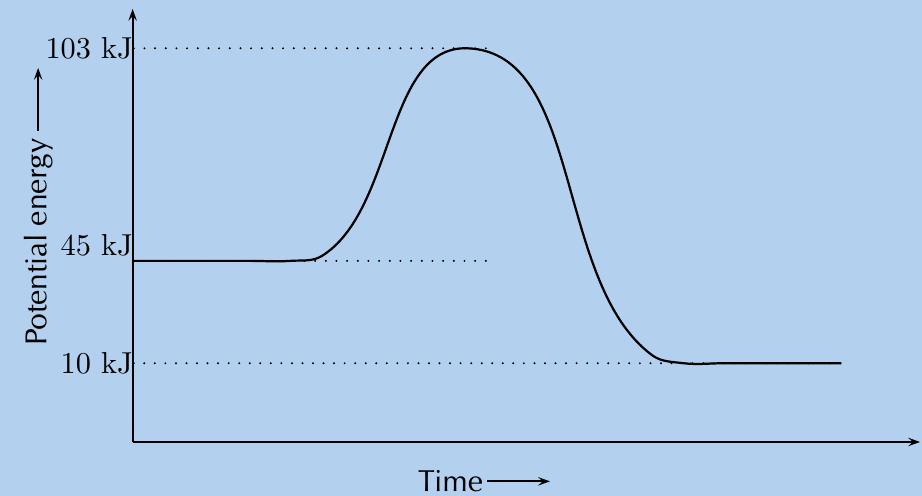
Question: Using the energy diagram above:
- Calculate
- Determine if the reaction is endothermic or exothermic
- Calculate the activation energy
Solution:
Step 1: Calculate
Step 2: Determine reaction type
Since , this is an exothermic reaction. The products have lower energy than the reactants, so energy is released overall.
Step 3: Calculate activation energy
This means 58 kJ of energy must be supplied to start this reaction, even though it eventually releases 35 kJ of energy.
Important
Exam Tips
- Always read energy values carefully from diagrams - check which line represents reactants, products, and the activated complex
- Remember the sign convention: negative = exothermic, positive = endothermic
- Activation energy is always positive because it represents energy that must be supplied
- Both exothermic and endothermic reactions require activation energy to proceed
Summary
Key Points to Remember:
- Activation energy is the minimum energy needed to start any chemical reaction
- The activated complex is the high-energy transition state where bonds break and form
- Energy diagrams use curves to show the energy barrier that must be overcome
- Exothermic reactions release energy overall but still need activation energy to begin
- Endothermic reactions absorb energy overall and typically have higher activation energies
- Calculations: ; Activation energy = activated complex - reactants