Pressure-Temperature Relation (Grade 11 NSC Matric Physical Sciences): Revision Notes
📚Revision Notes
Pressure-Temperature Relation
What is the pressure-temperature relationship?
The pressure-temperature relationship states that the pressure of a gas is directly proportional to its absolute temperature when the volume and amount of gas remain constant.
This relationship is also known as Gay-Lussac's Law. When we say "directly proportional," we mean that as one variable increases, the other increases by the same ratio, and as one decreases, the other decreases by the same ratio.
The science behind the relationship
Understanding why this relationship exists helps us remember and apply it correctly. The explanation comes from kinetic molecular theory:
When the temperature of a gas increases, the kinetic energy of the gas particles also increases. Higher kinetic energy means the particles move more rapidly, and faster-moving particles collide with each other and with the container walls more frequently and with greater force.
Since pressure is a measure of these particle collisions with the container walls, an increase in collisions means an increase in pressure. Conversely, when temperature decreases, particles move more slowly, collide less frequently, and pressure decreases.
Note
Think of it this way: "Hot gas pushes harder!" Higher temperature means the gas particles are moving faster and hitting the container walls with more force, creating higher pressure.
Mathematical representation
The pressure-temperature relationship can be expressed mathematically in several ways:
Proportionality: (temperature is proportional to pressure)
Direct relationship: (where k is a constant)
Ratio form: (pressure divided by temperature equals a constant)
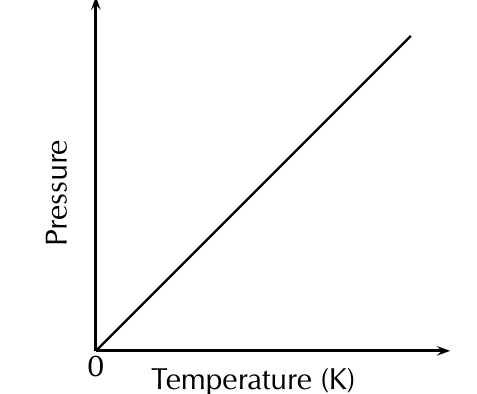
The graph shows this linear relationship clearly - as temperature increases, pressure increases in a straight line starting from the origin.
Gay-Lussac's Law equation
For practical calculations, we use the most useful form of this relationship:
This equation tells us that the ratio of pressure to temperature remains constant for a fixed amount of gas at constant volume.
Important
Critical Requirements for Calculations:
- Temperature must always be converted to Kelvin before using this equation
- To convert Celsius to Kelvin:
- Volume and amount of gas must remain constant for this law to apply
Step-by-step calculation method
Follow this systematic approach for all pressure-temperature problems:
Step 1: Write down all known information about the gas
Step 2: Convert all temperatures to Kelvin if necessary
Step 3: Choose the appropriate gas law equation ()
Step 4: Substitute known values and solve for the unknown variable
Step 5: Check your answer makes sense with the relationship
Worked example 1: Pressure increase
Example
Worked Example: Calculating Temperature Change
Question: At a temperature of 298 K, a certain amount of oxygen gas has a pressure of 0,4 atm. What temperature will the gas be at if its pressure is increased to 0,7 atm?
Solution:
Step 1: Write down known information
- K
- atm
- atm
Step 2: Convert temperatures to Kelvin
The temperature is already in Kelvin, so no conversion needed.
Step 3: Choose appropriate equation
Since volume is constant and pressure and temperature are changing:
Step 4: Substitute and solve
Cross multiply:
K
Step 5: Check answer
Since pressure increased from 0,4 to 0,7 atm, temperature should increase from 298 K. Our answer of 521,5 K is higher, which makes sense.
Worked example 2: Pressure decrease
Example
Worked Example: Calculating Pressure Change
Question: A fixed volume of carbon monoxide gas has a temperature of 32°C and a pressure of 680 Pa. If the temperature is decreased to 15°C, what will the pressure be?
Solution:
Step 1: Write down known information
- Pa
Step 2: Convert temperatures to Kelvin
- K
- K
Step 3: Choose appropriate equation
, rearranged to
Step 4: Substitute and solve
Cross multiply:
Pa
Step 5: Check answer
Since temperature decreased from 305 K to 288 K, pressure should decrease from 680 Pa. Our answer of 642,1 Pa is lower, which is correct.
Common exam tips
Important
Avoid These Common Mistakes:
- Always convert to Kelvin: This is the most common mistake in exam questions
- Check units are consistent: Make sure pressure units match on both sides
- Understand the relationship: Higher temperature = higher pressure, lower temperature = lower pressure
- Show all working: Include all steps even if they seem obvious
- Verify your answer: Does the final result make sense with the pressure-temperature relationship?
Remember!
Summary
Key Points to Remember:
- Pressure and temperature are directly proportional - when one increases, the other increases proportionally
- Always convert temperature to Kelvin before using the equation
- Volume and amount of gas must remain constant for Gay-Lussac's Law to apply
- Higher temperature means faster particle movement which causes more collisions and higher pressure
- The relationship is linear - it forms a straight line when graphed with temperature in Kelvin