Mining, Mineral Processing, and Energy Resources (Grade 11 NSC Matric Physical Sciences): Revision Notes
📚Revision Notes
Mining, Mineral Processing, and Energy Resources
Element abundance and classification
Elements in Earth's lithosphere vary greatly in their abundance. Understanding this helps us know which elements are easily available and which are rare and valuable.
Rock-forming elements are the most abundant elements in Earth's crust. These include:
- Oxygen (O) - most abundant element
- Silicon (Si) - second most abundant
- Aluminium (Al), Iron (Fe), Calcium (Ca), Sodium (Na), Magnesium (Mg), and Potassium (K)
Major industrial metals (shown in red) have moderate abundance and include metals like copper, zinc, and chromium used in manufacturing.
Precious metals (shown in purple) are much rarer, including gold and platinum, which explains their high value.
Rare earth elements (shown in blue) are among the least abundant but are essential for modern technology.
Important
The rarest metals include platinum group elements like ruthenium, rhodium, palladium, osmium, iridium, platinum, gold, and rhenium. Their extreme scarcity directly contributes to their high economic value and strategic importance in industry.
Mining stages
Mining involves several key stages that transform raw mineral deposits into useful materials.
Exploration
Definition: The process of locating suitable mineral deposits that can be mined profitably.
In ancient times, people simply looked for accessible metals and minerals to help with daily survival. Today, exploration focuses on finding economically viable deposits. For example, diamond deposits in Kimberley and gold deposits in Johannesburg were large enough to make mining profitable.
Note
As known deposits become scarcer, geologists develop new techniques to find suitable ore bodies. This process often takes years of study and exploration before mining can begin.
Obtaining the ore
Definition: The physical extraction of mineral-bearing rock from the Earth.
Once a deposit is found, mining can begin. There are two main approaches:
Surface mining includes:
- Open pit mining - removing topsoil and blasting rock layers to access minerals
- Quarrying - extracting building materials like limestone
- Strip mining - removing surface layers in strips
- Panning - using water and gravity to separate heavy minerals
Underground mining involves:
- Shaft mining - digging vertical shafts and horizontal tunnels
- Pipe mining - following mineral veins underground
Note
Surface mining is used when minerals are found within 1000m of the surface. Underground mining is needed for deeper deposits but is more dangerous due to tunnel collapse risks and gas buildup.
Extracting the minerals
Definition: The process of separating useful minerals from unwanted rock after mining.
Once ore is mined, it must be processed to extract the valuable minerals. Modern extraction methods include:
Smelting - heating ore to high temperatures with reducing agents to extract metals through chemical reactions.
Leaching - using carefully chosen liquids (often acids) to dissolve either the valuable mineral or unwanted materials.
Flotation - using air bubbles to separate valuable minerals, which attach to bubbles and rise to the surface for collection.
Mining and extraction techniques for different materials
Note
Different materials require specific combinations of mining and extraction techniques based on their geological occurrence, depth, and chemical properties.
| Metal | Mining techniques | Extraction techniques |
|---|---|---|
| Gold | Underground mining (shaft mining) and surface mining | Gold cyanidation is used. The ore is chemically treated to extract the gold |
| Iron | Surface mining (open pit mining) | Smelting and chemical reduction |
| Phosphate | Surface mining (open pit mining) | Treatment with acid |
| Coal | Surface mining (open pit mining). Underground mining is now starting to become more common | Coal is extracted in almost pure form |
| Diamonds | Surface mining (alluvial deposits) and underground mining (pipe mining) | Diamonds are extracted from rocks and in almost pure form |
| Copper | Surface mining (open pit mining) | Leaching is used to extract the copper using an acid |
| Platinum | Underground mining (shaft mining) | Chemical methods and as a byproduct of copper mining |
| Zinc | Underground mining (shaft mining) | Smelting and leaching |
| Chromium (Chrome) | Surface mining (open pit mining) and underground mining (shaft mining) | Smelting, redox reactions |
| Asbestos | Surface mining (open pit mining) | Extracted in fairly pure form |
| Manganese | Surface mining (open pit mining) and underground mining (shaft mining) | Smelting and chemical processes |
Gold mining case study
Gold mining provides an excellent example of modern mining and processing techniques.
Mining techniques for gold
1. Panning Definition: A manual technique using wide, shallow pans to separate gold from sediments.
Panning uses water and gravity to separate dense gold particles from lighter materials. Sand and gravel from river beds are placed in pans with water, then shaken so gold settles to the bottom.
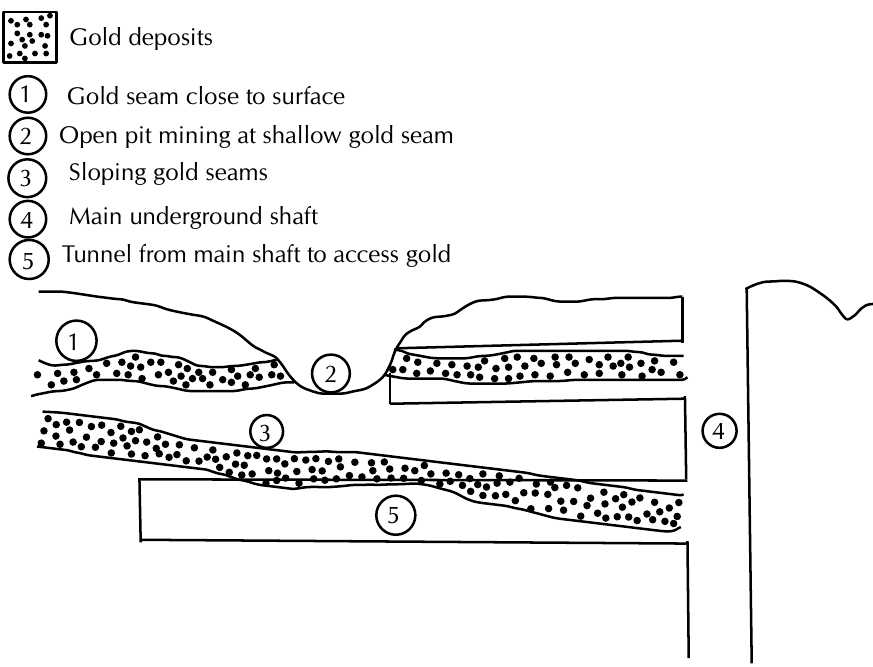
2. Surface mining (open pit mining) This involves removing topsoil and surface rock layers to expose gold-bearing rock beneath. The valuable rocks are then blasted and transported for processing. This method works for gold deposits up to 1000m deep.
3. Underground mining (shaft mining) South Africa's gold reefs slope at angles deep underground. Shaft mining requires drilling vertical shafts and creating horizontal tunnels to access these deep gold deposits. This is more dangerous and expensive than surface mining.
Gold extraction process
Example
Worked Example: The MacArthur-Forrest Process (Gold Cyanidation)
The MacArthur-Forrest process is the most common method for extracting gold from ore:
Step 1: Crush the gold-bearing ore into fine powder
Step 2: Mix sodium cyanide (NaCN) solution with the ground rock
- Chemical equation:
- Gold is oxidised in this reaction
Step 3: Separate the gold-bearing solution from remaining solid ore through filtration
Step 4: Add zinc to precipitate gold from the cyanide solution
- The gold is reduced and precipitated out of solution
This process transforms gold-bearing ore into pure gold through chemical extraction.
Properties and uses of gold
Gold's unique properties make it valuable for many applications:
Shiny - Beautiful appearance makes it perfect for jewellery
Durable - Does not tarnish or corrode easily, so it maintains quality over time. Sometimes used in dentistry for tooth crowns.
Malleable and ductile - Can be bent, twisted, and flattened into very thin sheets, making it useful for fine wires and thin, flat sheets.
Good conductor - Conducts electricity well, so it's used in transistors, computer circuits, and telephone exchanges.
Heat ray reflector - Reflects heat very effectively, so it's used in space suits, vehicles, and protective coatings on artificial satellites. Also used in firefighting masks to protect firefighters from heat.
Environmental impacts of mining
Despite gold's value and usefulness, all mining has environmental costs:
Resource consumption - Mining uses large amounts of electricity and water, often from non-renewable sources.
Important
Poisoned water - If not properly monitored, acids and chemicals from processing can leak into water systems, damaging animals, plants, and human water supplies.
Changing the landscape - Surface mines create large holes and rock piles that permanently change the land's shape. Open pit mines create very large holes (pits) in the ground.
Air pollution - Dust from open pit mines and harmful gases like sulphur dioxide and nitrogen dioxide can contribute to air pollution.
Threaten natural areas - Mining activities often encroach on protected areas and threaten biodiversity in their operation areas.
Mine rehabilitation
Definition: The process of restoring old mine sites to safe, stable, and environmentally acceptable conditions.
Mine rehabilitation aims to:
- Ensure the site is safe and stable
- Remove pollutants contaminating the site
- Restore biodiversity that existed before mining
- Restore waterways to their previous condition
Note
Rehabilitation methods include using plants to remove metals from polluted soils and water, and land contouring to help restore drainage.
Energy resources
Currently, we rely mainly on oil and coal to meet our energy needs. However, these are non-renewable energy sources with negative environmental effects. Alternative energy sources are being investigated to meet growing energy demands and replace depleting fossil fuel reserves.
Important
Climate change is one of the most debated topics around energy resources. Scientists largely agree that:
- Climate is changing irreversibly
- Humans are a significant cause of this change
- Human activities like mining, burning fossil fuels, and agriculture affect climate
- Global temperatures are increasing and polar ice caps are decreasing
Despite ongoing debate about the extent of human impact, humans need to be aware of their environmental impact and find ways to reduce it.
Summary
Key Points to Remember:
- Element abundance determines availability and value - rock-forming elements are abundant, precious metals are rare
- Mining stages include exploration (finding deposits), extraction (removing ore), and processing (separating minerals)
- Surface vs underground mining depends on depth - surface methods work up to 1000m, underground mining is needed for deeper deposits
- Gold cyanidation process uses the equation to extract gold chemically
- Environmental impacts of mining include resource consumption, water pollution, landscape changes, air pollution, and threats to natural areas