Acids and Bases (Grade 11 NSC Matric Physical Sciences): Revision Notes
📚Revision Notes
Acids and Bases
What are acids and bases?
Chemical reactions are happening all around us constantly. Plants perform photosynthesis, car engines burn petrol with air, and our bodies carry out countless complex reactions. Two particularly important types of reactions that occur both in nature and in chemistry laboratories are acid-base reactions and redox reactions.
Acids and bases are substances that have distinct characteristics and can be identified by their behaviour in chemical reactions. Understanding these substances is essential because they play crucial roles in many chemical processes we encounter daily.
Note
Acid-base reactions are so fundamental that they occur in processes ranging from digestion in our stomachs to the functioning of cleaning products in our homes. Mastering these concepts will help you understand countless real-world applications.
Common acids and bases
Here are some frequently encountered acids and bases with their chemical formulas:
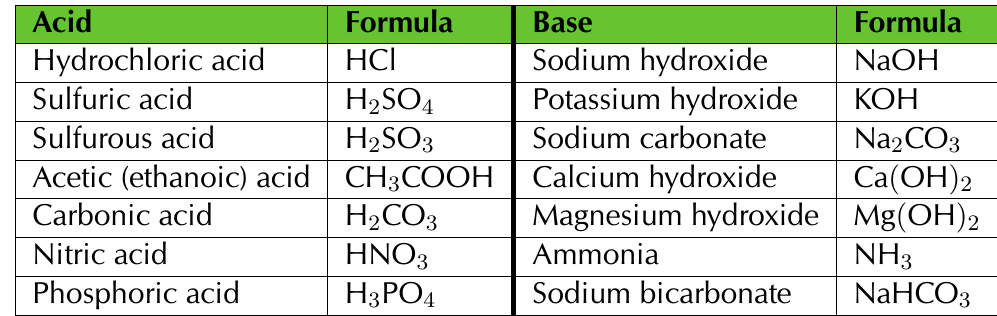
Most acids share similar characteristics, and most bases also have common properties. Having clear definitions for acids and bases helps us identify them correctly in chemical reactions and predict how they will behave.
Defining acids and bases
The arrhenius definition
One of the earliest definitions came from Arrhenius in 1887. He observed that when certain substances dissolve in water, they split apart (dissociate) into H₃O⁺ and OH⁻ ions.
The water dissociation equation is:
According to Arrhenius:
- An acid is a substance that increases the concentration of H₃O⁺ ions when dissolved in water
- A base is a substance that increases the concentration of OH⁻ ions when dissolved in water
Example
Worked Example: Arrhenius Acid-Base Identification
-
Hydrochloric acid dissolving in water: This increases H₃O⁺ concentration, so HCl is an acid.
-
Sodium hydroxide dissolving in water: This increases OH⁻ concentration, so NaOH is a base.
Important
The Arrhenius definition has a significant limitation: it only works for reactions in water. Since many acid-base reactions occur without water present, chemists needed a broader definition.
The brønsted-lowry definition
In 1923, Lowry and Brønsted developed a more comprehensive definition based on proton transfer rather than just water dissociation.
DEFINITION: Acids A Brønsted-Lowry acid is a substance that gives away protons (hydrogen cations H⁺) and is therefore called a proton donor.
DEFINITION: Bases
A Brønsted-Lowry base is a substance that takes up protons (hydrogen cations H⁺) and is therefore called a proton acceptor.
Worked examples of proton transfer
Example
Worked Example 1: Identifying Proton Transfer
To identify the acid and base, we track what happens to each reactant:
- HCl(aq) → Cl⁻(aq) (HCl loses a proton)
- NH₃(aq) → NH₄⁺(aq) (NH₃ gains a proton)
Therefore: HCl is the proton donor (acid) and NH₃ is the proton acceptor (base).
Example
Worked Example 2: Water as a Base
Breaking this down:
- CH₃COOH(aq) → CH₃COO⁻(aq) (acetic acid loses a proton)
- H₂O(l) → H₃O⁺(aq) (water gains a proton)
Therefore: CH₃COOH is the acid and H₂O is the base.
Example
Worked Example 3: Water as an Acid
Breaking this down:
- H₂O(l) → OH⁻(aq) (water loses a proton)
- NH₃(aq) → NH₄⁺(aq) (ammonia gains a proton)
Therefore: H₂O is the acid and NH₃ is the base.
Note
Notice how in examples 2 and 3, water acts differently depending on what it reacts with. This demonstrates an important concept called amphoteric behavior.
Special types of substances
Amphoteric substances
DEFINITION: Amphoteric An amphoteric substance is one that can react as either an acid or a base.
Water is a perfect example of an amphoteric substance. In Example 2, water acted as a base (accepting a proton), but in Example 3, water acted as an acid (donating a proton). Whether water behaves as an acid or base depends on what other substance is present in the reaction.
Amphiprotic substances
DEFINITION: Amphiprotic
An amphiprotic substance is one that can react as either a proton donor (Brønsted-Lowry acid) or a proton acceptor (Brønsted-Lowry base). Examples include water, hydrogen carbonate ion (HCO₃⁻) and hydrogen sulfate ion (HSO₄⁻).
Polyprotic acids
A polyprotic acid is an acid that has more than one proton available to donate. For example, sulfuric acid can donate one proton:
Or it can donate both protons:
Common polyprotic acids include H₂SO₄, H₂SO₃, H₂CO₃ and H₃PO₄.
Conjugate acid-base pairs
Let's examine what happens when we reverse an acid-base reaction.
Consider:
In this reaction:
- HCl acts as the acid (proton donor)
- NH₃ acts as the base (proton acceptor)
But what if we wrote the reverse reaction?
Now:
- NH₄⁺(aq) → NH₃(aq) (NH₄⁺ loses a proton, so it's the acid)
- Cl⁻(aq) → HCl(aq) (Cl⁻ gains a proton, so it's the base)
Important
When HCl (the acid) loses a proton, it forms Cl⁻ (which can act as a base). Similarly, when NH₃ (the base) gains a proton, it forms NH₄⁺ (which can act as an acid).
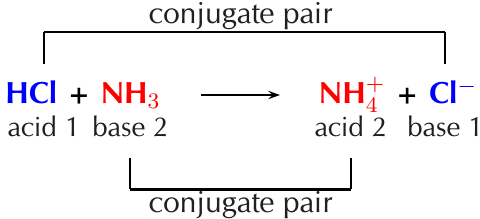
We call these related pairs conjugate acid-base pairs:
- HCl and Cl⁻ form one conjugate pair
- NH₃ and NH₄⁺ form another conjugate pair
Note
The Pattern:
- When an acid donates a proton, it becomes its conjugate base
- When a base accepts a proton, it becomes its conjugate acid
Summary
Key Points to Remember:
- Acids are proton donors - they give away H⁺ ions in reactions
- Bases are proton acceptors - they take up H⁺ ions in reactions
- Amphoteric substances can act as either acids or bases depending on what they react with
- Conjugate acid-base pairs are formed when acids lose protons or bases gain protons