Wavefronts and The Huygens Principle (Grade 11 NSC Matric Physical Sciences): Revision Notes
📚Revision Notes
Wavefronts and The Huygens Principle
What are wavefronts?
When we study waves in two and three dimensions, we need to understand how waves behave differently from the simple one-dimensional waves you may have studied before. This section focuses on wavefronts and how they help us understand wave behaviour in multiple dimensions.
Point sources and wave propagation
A point source is something that generates waves and is so small that we can treat it as a single point. Point sources are useful because they don't affect the shape of the waves they produce. When a point source emits waves, it does so isotropically, meaning the waves travel equally in all directions.
Note
Point sources are particularly valuable in wave physics because they create perfectly symmetrical wave patterns, making them ideal for theoretical analysis and practical applications.
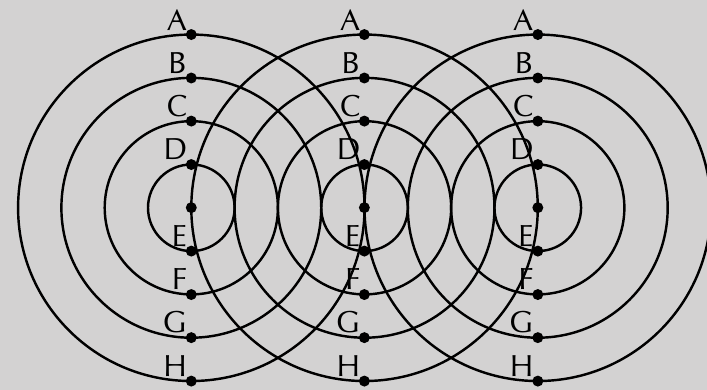
The diagram above shows what happens when three identical point sources emit waves simultaneously. Each source creates circular waves that spread outward. Notice how the waves from different sources overlap and interact with each other.
Understanding wavefronts
Important
Wavefront: An imaginary line that connects all points on a wave that are in phase with each other.
When we look at circular waves spreading from a point source, we can identify wavefronts as the circular lines that connect points with the same phase. For example:
Note
Identifying wavefronts in circular waves:
- All the wave crests at the same distance from the source form one wavefront
- All the wave troughs at the same distance form another wavefront
- Points between crests and troughs can also form wavefronts
The key point is that all points on a wavefront are in phase, meaning they are at exactly the same stage of their wave cycle.
Investigation: identifying wavefronts
When you examine the overlapping wave patterns from multiple sources, you can trace lines that connect points with the same phase. These lines show you the wavefronts. In the investigation shown, points marked with the same letter (A, B, C, etc.) are all in phase with each other.
The Huygens principle
Christiaan Huygens developed a principle that helps us predict how waves will behave and where wavefronts will be at future times.
Definition of Huygens principle
Important
Huygens Principle: Every point on a wavefront acts as a source of spherical secondary waves. After a time interval, the new position of the wavefront is found by drawing a line tangent to all these secondary waves.
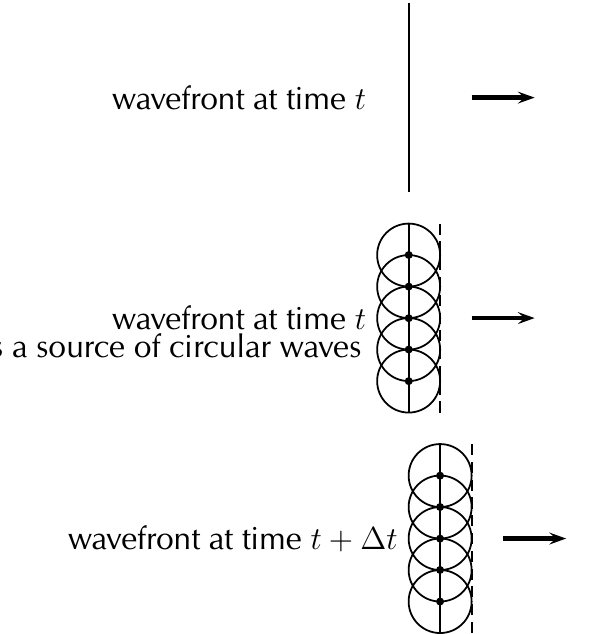
This principle works for any type of wavefront, whether it's straight, curved, or circular. It's particularly useful for understanding how waves change direction when they encounter obstacles or different materials.
How Huygens principle works
The principle involves these steps:
- Identify the current wavefront - This could be straight, curved, or circular
- Treat each point as a source - Every point on the wavefront becomes a source of circular waves
- Draw secondary wavelets - These circular waves spread out from each point
- Find the new wavefront - Draw a line that touches (is tangent to) all the secondary wavelets
Worked example: applying Huygens principle
Example
Worked Example: Applying Huygens Principle
Question: Given a curved wavefront, use Huygens principle to determine the wavefront at a later time.
Solution:
Step 1: Draw circles at various points along the given wavefront
- Select several points along the original curved wavefront
- At each point, draw a small circle representing the secondary waves that have spread out over the time interval
- All these circles should have the same radius (since they've all travelled for the same time)
Step 2: Join the circle crests to get the wavefront at a later time
- Draw a smooth curve that touches the outer edge of all the secondary wave circles
- This tangent line represents the new position of the wavefront
- The new wavefront maintains a similar curved shape but has moved forward
This method allows you to predict exactly where any wavefront will be at any future time, making it incredibly useful for understanding wave behaviour in complex situations.
Applications of Huygens principle
Huygens principle helps explain many wave phenomena:
- How waves bend around corners (diffraction)
- How waves change speed and direction in different materials (refraction)
- How waves reflect off surfaces
- How interference patterns form when waves meet
Summary
Key Points to Remember:
- Wavefronts are imaginary lines connecting points that are in phase on a wave
- Point sources emit waves equally in all directions (isotropically)
- Huygens principle states that every point on a wavefront acts as a source of secondary circular waves
- To find a future wavefront position, draw circles from points on the current wavefront and connect their outer edges
- Huygens principle applies to all types of wavefronts - straight, curved, or circular