Light Rays and Properties of Light (Grade 11 NSC Matric Physical Sciences): Revision Notes
📚Revision Notes
Light Rays and Properties of Light
What is geometrical optics?
Geometrical optics is the study of how light behaves when it interacts with materials like mirrors, lenses, telescopes, and prisms. When you see your reflection in a mirror, observe a straw appearing bent in water, or use telescopes and car headlights, you're experiencing the effects of light reflection and refraction. These everyday examples rely on the predictable ways that light reflects off surfaces or changes direction when moving between different materials.
Geometrical optics focuses on understanding the shape of materials and the angles at which light rays interact with them. From these angles, we can determine important information like the distance between an object and its reflection.
Note
Geometrical optics is one of the oldest branches of physics, dating back thousands of years. It allows us to understand and predict how light will behave in optical devices like cameras, microscopes, and eyeglasses.
Understanding light rays
What are light rays?
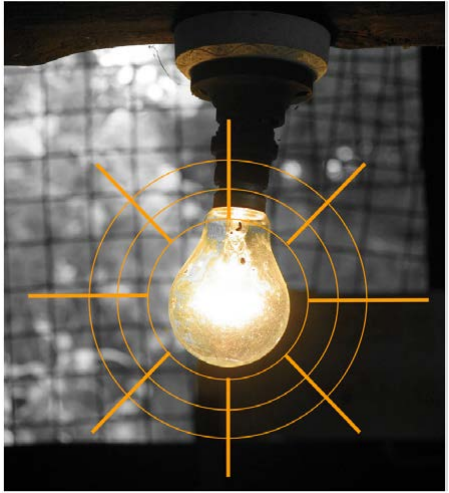
When sunlight streams through a window and lights up part of a room, you might imagine drawing parallel lines to show the path of sunlight from the window to the floor. While you cannot actually see individual lines of light in a sunbeam, this approach provides an excellent way to model and understand how light behaves.
Important
Light ray: Lines which are perpendicular to the light's wavefronts. In geometrical optics, we represent light rays with straight arrows to show how light travels.
Light rays are not exact descriptions of light itself. Instead, they show us the direction in which light wavefronts are moving. Think of a light ray as the path that a point on the crest of a light wave would follow.
How do we see objects?
We can only see objects when light from those objects enters our eyes. This happens in two ways:
- The object produces its own light (like a light bulb or candle)
- The object reflects light from another source (like the moon reflecting sunlight)
The light must travel from the object to our eye before we can see it. If there's no straight path for light to travel from an object to your eye, you won't be able to see that object.
Light travels in straight lines
One of the fundamental properties of light is that it travels in perfectly straight lines. This is why we cannot see around corners - light doesn't bend around obstacles on its own.
Example
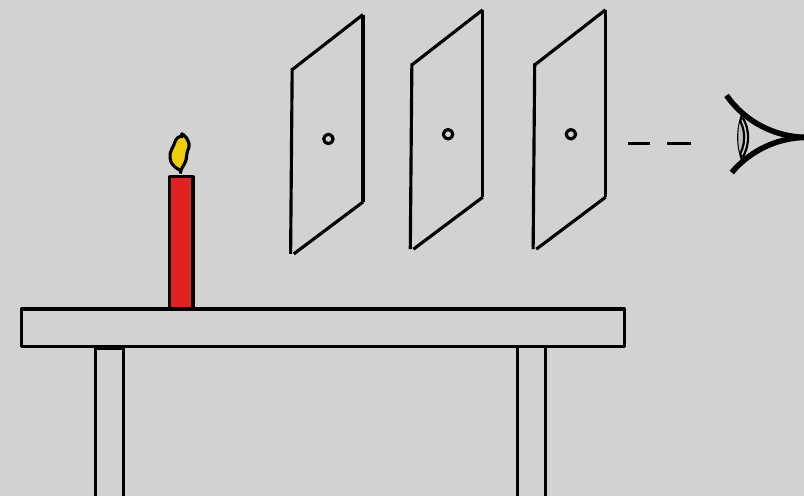
Investigation: Demonstrating straight-line travel
Apparatus needed:
- One candle
- Matches
- Three sheets of paper
Method:
- Make a small hole in the centre of each sheet of paper
- Light the candle
- Look at the burning candle through the hole in the first sheet
- Place the second sheet between you and the candle so you can still see the candle through both holes
- Add the third sheet so you can still see the candle through all three holes (sheets must not touch each other)
- Observe what you notice about the alignment of the holes
Conclusion: The holes must be in a perfectly straight line for you to see the candle. This proves that light travels in straight lines and cannot bend around corners.
Properties of light
When light interacts with objects or different materials (like glass or water), it displays three main behaviours:
- Reflection - light bounces off surfaces
- Absorption - light energy is taken in by materials
- Transmission - light passes through materials
Note
These three properties often occur simultaneously. For example, when light hits a window, some light is reflected off the surface, some is absorbed by the glass, and some is transmitted through to the other side.
Reflection in detail
Key terminology for reflection
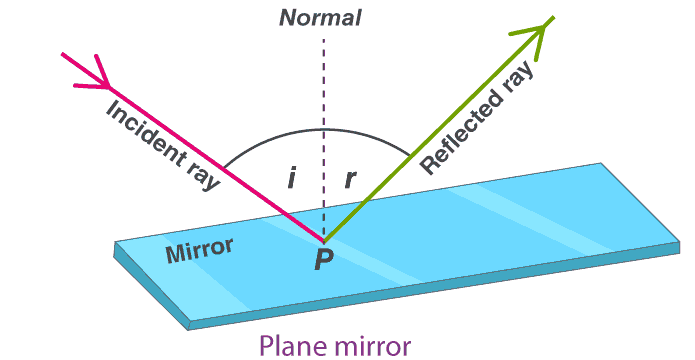
When studying reflection, we use specific terms to describe what happens when light bounces off surfaces.

- Incident ray - the light ray approaching the surface
- Reflected ray - the light ray bouncing away from the surface
- Normal - an imaginary line drawn perpendicular to the surface at the point where light hits it
- Angle of incidence () - the angle between the incident ray and the normal
- Angle of reflection () - the angle between the reflected ray and the normal
Important
Always remember that angles in reflection are measured from the normal line, not from the surface itself. This is a common source of confusion for students.
The plane of incidence
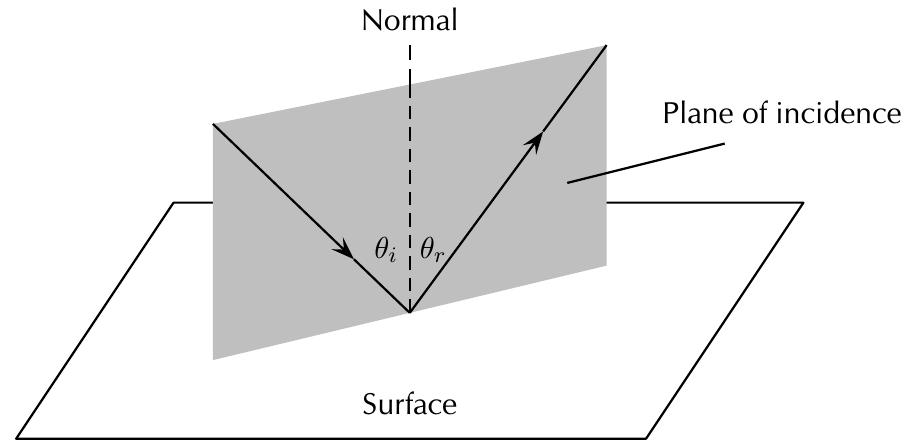
When light reflects off a surface, the incident ray, reflected ray, and normal all lie within the same flat plane called the plane of incidence.
The law of reflection
The behaviour of reflected light follows a precise mathematical relationship:
Important
Law of reflection: The angle of incidence equals the angle of reflection:
Additionally, the incident ray, reflected ray, and normal all lie in the same plane.
Worked examples of reflection
Example
Worked Example 1: Light hitting a surface straight on
When light strikes a surface at to the normal (straight on), the angle of reflection is also . This means the light reflects straight back along the same path.
Step 1: Identify the angle of incidence (light hits straight on)
Step 2: Apply the law of reflection
Result: The light reflects directly back along its original path.
Example
Worked Example 2: Light at 60° to the normal
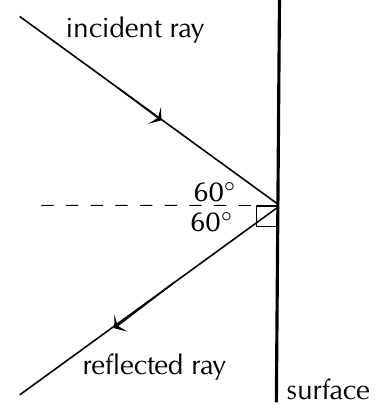
If a light ray strikes a surface at to the normal, it will reflect at exactly to the normal on the other side.
Step 1: Identify the angle of incidence
Step 2: Apply the law of reflection
Important: The angles are always measured from the normal line, not from the surface itself.
Real world applications of parabolic reflectors
Parabolic reflectors are specially curved mirrors that have extremely useful properties for focusing or directing light:
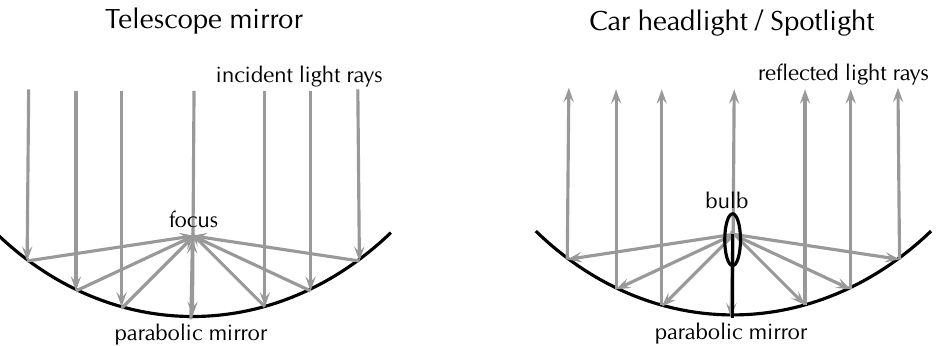
Telescope mirrors: Parallel light rays from distant stars hit the parabolic mirror and all reflect to converge at a single focal point, where an image can be formed.
Car headlights and spotlights: A light bulb placed at the focal point of a parabolic mirror produces parallel reflected rays, creating a powerful beam of light that travels in the same direction.
Note
The same parabolic shape works in both directions - it can collect incoming parallel light to a point, or take light from a point and create a parallel beam. This dual functionality makes parabolic reflectors incredibly versatile in optical applications.
Absorption
Light can be absorbed by materials, which explains why objects appear to have different colours. When white light (containing all wavelengths/colours) hits an object:
- The object absorbs certain wavelengths
- The remaining wavelengths are reflected back to our eyes
- We see the colour of the reflected wavelengths
For example, when white light hits a red apple:
- The apple's surface absorbs most wavelengths except red
- Red wavelengths are reflected back to our eyes
- We perceive the apple as red
- The apple feels warm because it's absorbing energy from the other wavelengths
Note
This is why wearing a white t-shirt in the sun keeps you cooler than wearing a black t-shirt. White reflects most light wavelengths, while black absorbs them all and converts the energy to heat.
Transmission
Light can pass through certain materials in a process called transmission:
- Transparent objects allow light to pass through them (like glass windows)
- Opaque objects block light from passing through (like brick walls)
Note
Interestingly, transparency depends on the type of electromagnetic wave. Brick walls are opaque to visible light but transparent to radio waves - which is why you can receive radio signals and mobile phone calls inside buildings.
Speed of light
Light travels at a constant speed within any given medium. In a vacuum (empty space), light reaches its maximum possible speed:
Important
Speed of light in vacuum:
This is one of the fundamental constants in physics and represents the fastest speed at which anything can travel in the universe.
The speed of light in air is very close to this vacuum value.
Summary
Key Points to Remember:
- Light rays are straight lines that show the direction light travels - we use them to model and predict light behaviour
- We only see objects when light from them enters our eyes - either from light sources or reflected light
- Light travels in perfectly straight lines and cannot bend around corners on its own
- The law of reflection states - angle of incidence equals angle of reflection, with all rays in the same plane
- Light can be reflected, absorbed, or transmitted when it interacts with materials, giving objects their colours and determining what we can see through
- The speed of light in vacuum is - the fastest speed possible in the universe