Snell’s Law (Grade 11 NSC Matric Physical Sciences): Revision Notes
📚Revision Notes
Snell's Law
What is Snell's Law?
Snell's Law describes how light bends when it passes from one medium to another. This bending of light is called refraction. The law was discovered by Dutch physicist Willebrord Snell in 1621 and explains how to calculate the angle at which light will bend.
When light travels from one material (like air) into another material (like water or glass), it changes direction. The amount of bending depends on the refractive indices of both materials.
Note
Refraction occurs because light travels at different speeds in different materials. When light enters a new medium, it either speeds up or slows down, causing the change in direction.
Definition and formula
Snell's Law states that:
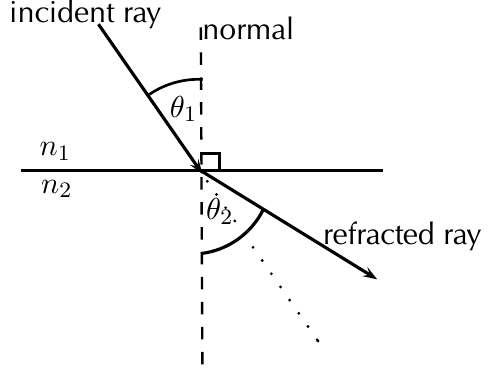
Where:
- = Refractive index of the first material
- = Refractive index of the second material
- = Angle of incidence (measured from the normal)
- = Angle of refraction (measured from the normal)
Important
All angles are measured from the normal, which is an imaginary line perpendicular to the surface where the light hits. This is a common source of errors in calculations!
Understanding refraction direction
The direction light bends depends on the refractive indices of the two materials:
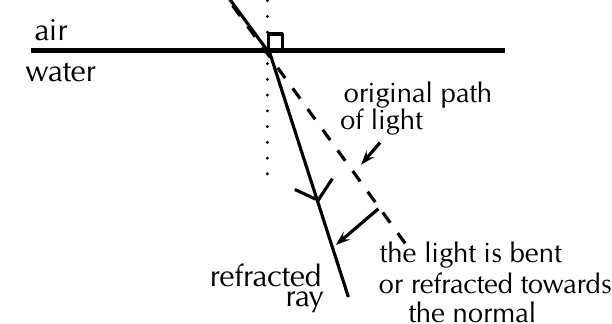
When light enters a denser medium (higher refractive index):
- Light bends towards the normal
- The angle of refraction is smaller than the angle of incidence
- Example: Light going from air into water or glass
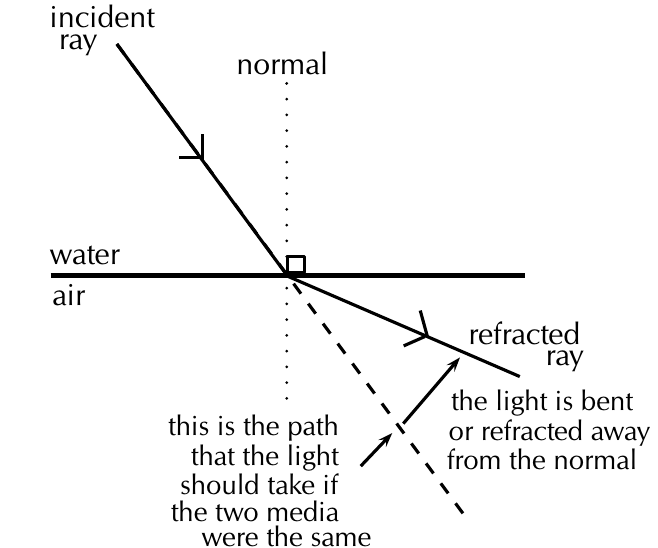
When light enters a less dense medium (lower refractive index):
- Light bends away from the normal
- The angle of refraction is larger than the angle of incidence
- Example: Light going from water into air
Note
Memory Aid: Think "Dense = Towards" - when light enters a denser medium, it bends towards the normal. When it enters a less dense medium, it bends away from the normal.
Formal experiment 1: Verifying Snell's law
Aim:
To verify that Snell's Law is correct by measuring angles and calculating the relationship.
Apparatus:
- Glass block
- Ray box
- 360° protractor
- 5 pieces of A4 paper
- Pencil
- Ruler
Method:
-
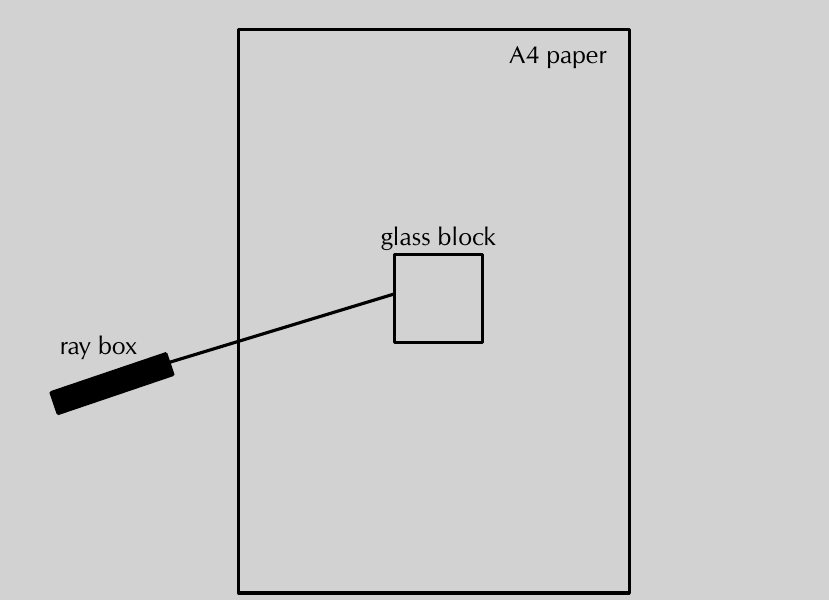
Set up the apparatus: Place the glass block in the middle of an A4 paper. Draw around the block with a pencil to mark its outline.
-
Create light rays: Turn on the ray box and aim the light towards the glass block at different angles. Change the angle for each piece of paper.
-
Mark the light path: Draw dots to mark where the incoming light ray hits the surface and where the outgoing ray leaves the block.
-
Remove the block: Switch off the ray box and remove the glass block. Use a ruler to join the dots, creating straight lines that show the complete light path.
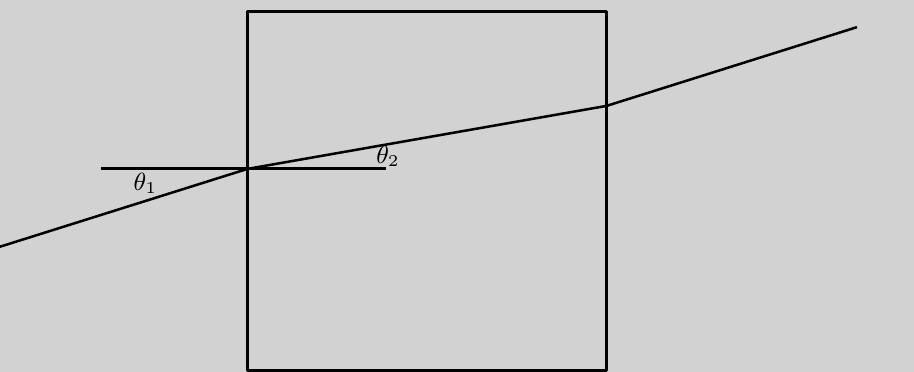
-
Measure the angles: Draw the normal (perpendicular line) to the surface where light enters the block. Use the protractor to measure and .
-
Record data: Enter your measurements into a data table:
For this experiment:
- (air)
- (glass)
Results:
If Snell's Law is correct, the values in the last two columns should be equal ().
Note
Experimental Tips:
- Use at least 5 different angles for better accuracy
- Ensure the ray box produces a thin, clear beam
- Draw the normal carefully using a set square for accuracy
- Take multiple readings and calculate averages to reduce errors
Formal experiment 2: Determining unknown refractive index
Aim:
To find the refractive index of an unknown transparent material using Snell's Law.
Apparatus:
- Ray box
- 360° protractor
- 5 pieces of A4 paper
- Block of unknown transparent material
- Pencil
- Ruler
Method:
Follow the same procedure as Experiment 1, but this time:
- (air - known)
- (unknown material)
Calculate using the rearranged formula:
Discussion:
Take the average of your calculated values to get a good approximation of the unknown material's refractive index.
Special case: Normal incidence
When light hits a surface at 0° (along the normal), something interesting happens:
If , then
From Snell's Law:
Therefore: , so
Important
This means: Light travelling along the normal passes straight through without bending, even though refraction still occurs (the speed changes but not the direction).
Understanding refraction with analogies
Note
The Lawnmower Analogy
Think of a lawnmower moving from short grass into long grass. The wheels in the long grass move slower, causing the mower to turn towards the area with longer grass. This is similar to light entering a denser medium - it slows down and bends towards the normal.
The opposite happens when moving from long grass to short grass - the mower turns away from the normal, just like light exiting a dense medium.
Worked example 1: Finding an unknown refractive index
Example
Worked Example: Finding an Unknown Refractive Index
Question: Light refracts at the boundary between water and an unknown medium. The angle of incidence is 25° and the angle of refraction is 20.6°. Calculate the refractive index of the unknown medium.
Solution:
Step 1: Identify the given information
- (water)
- (unknown)
Step 2: Apply Snell's Law
Step 3: Solve for
Answer: The unknown medium has a refractive index of 1.6, which is typical glass.
Worked example 2: Light from water to air
Example
Worked Example: Light from Water to Air
Question: A light ray with an angle of incidence of 35° passes from water to air. Find the angle of refraction.
Solution:
Step 1: Identify known values
- (water)
- (air)
Step 2: Apply Snell's Law
Step 3: Interpret the result Since the light moves from a denser to less dense medium, it bends away from the normal (angle increases from 35° to 49.7°).
Worked example 3: Light from water to diamond
Example
Worked Example: Light from Water to Diamond
Question: A light ray passes from water to diamond with an angle of incidence of 75°. Calculate the angle of refraction.
Solution:
Step 1: Identify the refractive indices
- (water)
- (diamond)
Step 2: Apply Snell's Law
Step 3: Interpret the result
The light bends towards the normal because it's entering a denser medium (angle decreases from 75° to 32.1°).
Key exam tips
Summary
Key Points for Exam Success:
- Always measure angles from the normal, not from the surface
- Remember the direction rules: dense to less dense = away from normal; less dense to dense = towards normal
- Check your calculator is in degree mode when calculating trigonometric functions
- When solving for angles using , remember there can be two possible answers - choose the one less than 90°
- Show all working clearly in calculations, including the rearranged formula
Remember!
Summary
Essential Concepts to Remember:
- Snell's Law: - this relationship always holds true at the boundary between two media
- Light bends towards the normal when entering a denser medium (higher refractive index)
- Light bends away from the normal when entering a less dense medium (lower refractive index)
- All angles are measured from the normal, which is perpendicular to the surface
- Normal incidence (0°) results in no bending, but refraction still occurs as the light speed changes