Force (Grade 11 NSC Matric Physical Sciences): Revision Notes
📚Revision Notes
Force
What is force?
Force is anything that can cause a change to objects. Forces are incredibly important in physics because they explain how and why things move, stop, or change shape around us.
Note
Forces can affect objects in three main ways:
- Change the shape of an object
- Accelerate or stop an object
- Change the direction of a moving object

Force is a vector quantity, which means it has both magnitude (size) and direction. We use the symbol for force, and the SI unit for force is the newton, with symbol N. This unit is named after Sir Isaac Newton, who first defined the concept of force scientifically.
Contact and non-contact forces
Forces can be classified as either contact forces or non-contact forces.
Contact forces
A contact force must touch or be in contact with an object to cause a change. When you push a door open, your hand makes contact with the door - this is a contact force in action.
Examples of contact forces include:
- The force used to push or pull things, like opening or closing a door
- The force a sculptor uses to turn clay into a pot
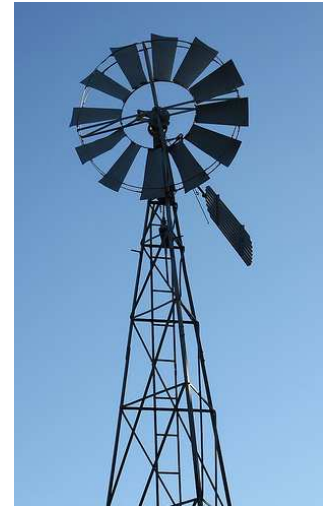
- The force of wind turning a windmill
Non-contact forces
A non-contact force does not have to touch an object to cause a change. These forces can act across distances without any physical contact.
Examples of non-contact forces include:
- Gravity - like the Earth pulling the Moon towards itself
- Electricity - like a proton and electron attracting each other
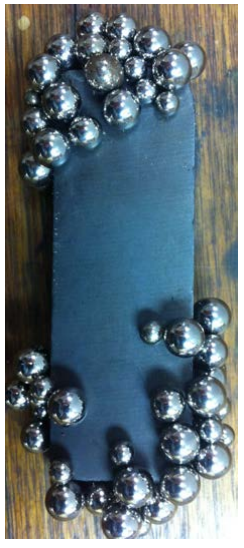
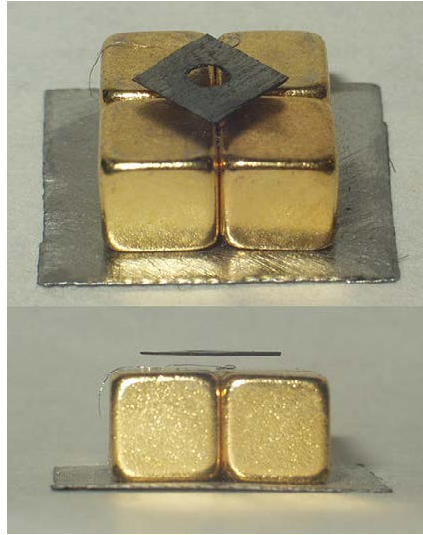
- Magnetism - like a magnet pulling a paper clip towards itself
Resultant force
When working with forces, we often need to consider the resultant force acting on an object. The resultant force is simply the vector sum of all the forces acting on the object.
Important
It's very important to remember that all forces must be acting on the same object. The resultant force is the single force that has the same effect as all the other forces added together.
Types of forces in physics
Physics helps us understand the natural world, and you probably know more physics than you think! You see forces in action every day - when you throw a stone, it eventually falls to the ground due to gravity.
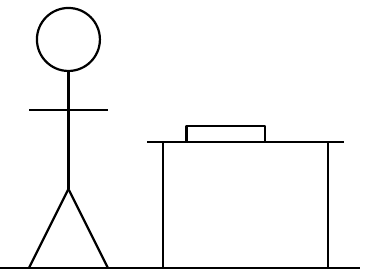
Let's explore some important types of forces by considering a practical situation. Imagine you have a table and some books with different masses. When you place a book on a flat table, nothing happens - the book just rests there. But if you slowly lift one side of the table so the top becomes tilted, the book will eventually start to slide off. This simple situation demonstrates several important forces.
Normal force
When an object is placed on a surface, several forces come into play. If you put a book on a table, gravity pulls the book downward. However, the table stops the book from falling to the floor. The table must exert an upward force on the book to balance out the downward gravitational force.
Important
Definition: The normal force, , is the force exerted by a surface on an object in contact with it.
The normal force is what prevents objects from falling through surfaces. When you stand on the ground, the gravitational force pulls you down, but the ground exerts an equal and opposite normal force upward to balance this out.
Note
An important characteristic of normal force is that it's always perpendicular to the surface, even when the surface is tilted. If you tilt a table slightly, the direction of gravity doesn't change, but the direction of the normal force adjusts to remain perpendicular to the surface.
Friction forces
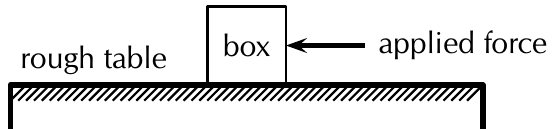
Why does a box sliding on a surface eventually come to a stop? The answer is friction. Friction arises when two surfaces are in contact and moving relative to each other.
You can experience friction by pressing your hands together and moving one backwards and forwards. Your hands get warm because friction generates heat through the interaction of the surfaces.
Important
Definition: Frictional force is the force that opposes the motion of an object in contact with a surface and it acts parallel to the surface the object is in contact with.
Friction occurs because surfaces interact with each other. Even smooth-looking surfaces have tiny bumps and grooves. When surfaces slide against each other, these microscopic irregularities catch and resist the motion.
Note
Key characteristics of friction:
- Frictional forces act parallel to surfaces
- Friction opposes motion
- The magnitude of friction depends on the surface type and the normal force
- Friction is proportional to the normal force:
Static and kinetic friction
There are two main types of friction:
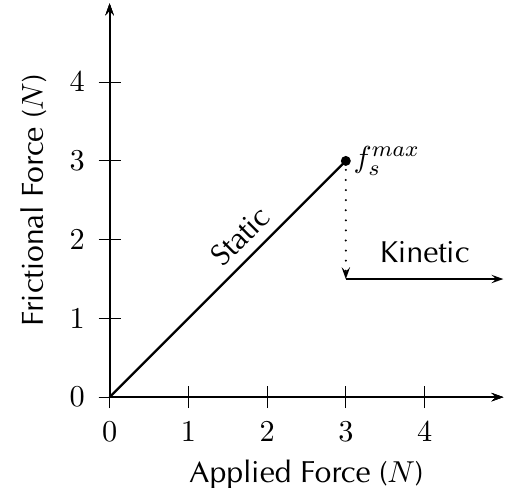
Static friction occurs when an object is not moving. If you try to push a heavy crate but it doesn't move, static friction is balancing your applied force. Static friction can vary from zero up to a maximum value, depending on how hard you push.
Kinetic friction occurs when an object is already moving. Once the crate starts sliding, kinetic friction acts to slow it down. Kinetic friction remains constant regardless of how fast the object moves.
Friction coefficients and calculations
For every surface, we can determine constant factors called coefficients of friction:
- is the coefficient of static friction
- is the coefficient of kinetic friction
These coefficients allow us to calculate frictional forces when we know the normal force.
The maximum static friction is given by:
The kinetic friction is given by:
Important
When the applied force is greater than the maximum static friction, the object will start to move. Once moving, it experiences kinetic friction, which is usually smaller than the maximum static friction.
Practical applications of friction
Friction is very useful in everyday life. Without friction:
- You couldn't walk (your feet would slip)
- Cars couldn't brake effectively
- Rock climbers couldn't grip cliff faces
- Ladders would slide down walls

Early humans discovered they could create fire using friction. When you rub two pieces of wood together rapidly with sufficient pressure, the friction generates enough heat to ignite dry tinder.

Worked examples
Example
Worked Example 1: Maximum static friction
Question: A box resting on a surface experiences a normal force of magnitude 30 N and the coefficient of static friction between the surface and the box, , is 0.34. What is the maximum static frictional force?
Solution:
Step 1: Use the maximum static friction formula
Step 2: Substitute the known values N
The maximum magnitude of static friction is 10.2 N.
Example
Worked Example 2: Finding minimum force to start motion
Question: Rugby players are trying to push their scrum machine. The normal force exerted on the machine is 10 000 N. If the coefficient of static friction is 0.78, what is the minimum force they need to exert to get the machine to start moving?
Solution:
Step 1: Understand what's required
- To get the machine moving, the players must overcome the maximum static friction.
Step 2: Calculate maximum static friction
- N
The players need to exert at least 7800 N to start the machine moving.
Example
Worked Example 3: Coefficients of friction
Question: A pram experiences a normal force of 100 N. The owner pushes harder until it starts to move when the applied force is three-quarters of the normal force. After starting, it can be kept moving with a force that is half the starting force. What are the coefficients of static and kinetic friction?
Solution:
Step 1: Find the coefficient of static friction
- The pram starts moving when: N
- Using :
- Therefore:
Step 2: Find the coefficient of kinetic friction
- Force needed to keep moving: N
- Using :
- Therefore:
The coefficients are and .
Tension
Tension is the magnitude of the force that exists in objects like ropes, chains, and struts that provide support. For example, tension forces exist in the ropes supporting a child's swing hanging from a tree.
Note
Tension always acts along the length of the rope or cable and pulls on whatever is connected to each end.
Remember!
Summary
Key Points to Remember:
- Force is anything that can change the shape, speed, or direction of an object
- Forces are vector quantities measured in newtons (N)
- Contact forces require physical contact, while non-contact forces act at a distance
- Normal force acts perpendicular to surfaces and balances gravitational force
- Friction opposes motion and acts parallel to surfaces
- Static friction varies up to a maximum value, while kinetic friction remains constant
- The coefficients of friction ( and ) help us calculate frictional forces using the normal force