Consequences of Market Failures (Grade 12 NSC Matric Economics): Revision Notes
📚Revision Notes
Consequences of Market Failures
When markets fail, they create several important consequences that affect both individuals and society as a whole. Understanding these consequences helps us see why government intervention is sometimes necessary to improve economic outcomes.
Inefficiencies
Market failures lead to two main types of inefficiencies that prevent the economy from working at its best potential.
Productive inefficiency (technical inefficiency)
This occurs when resources are not used properly to produce the maximum number of goods at the lowest cost and best quality. Think of it as wasting resources or not getting the most out of what we have available. For example, if a factory could produce 100 cars per day but only produces 80 due to poor organisation, this represents productive inefficiency.
Note
Productive inefficiency can occur at any level of production - from individual businesses to entire industries. It represents a fundamental waste of society's limited resources.
Allocative inefficiency
This happens when the types and quantities of goods or services produced are not what consumers actually want or need most. Even if production is technically efficient, the wrong mix of goods is being produced. For instance, producing too many luxury cars when people need more affordable transport options.
Pareto optimum
Important
Pareto optimum refers to a situation where it is impossible to increase the welfare of one individual without making another worse off. This implies that the welfare of the community is at its maximum.
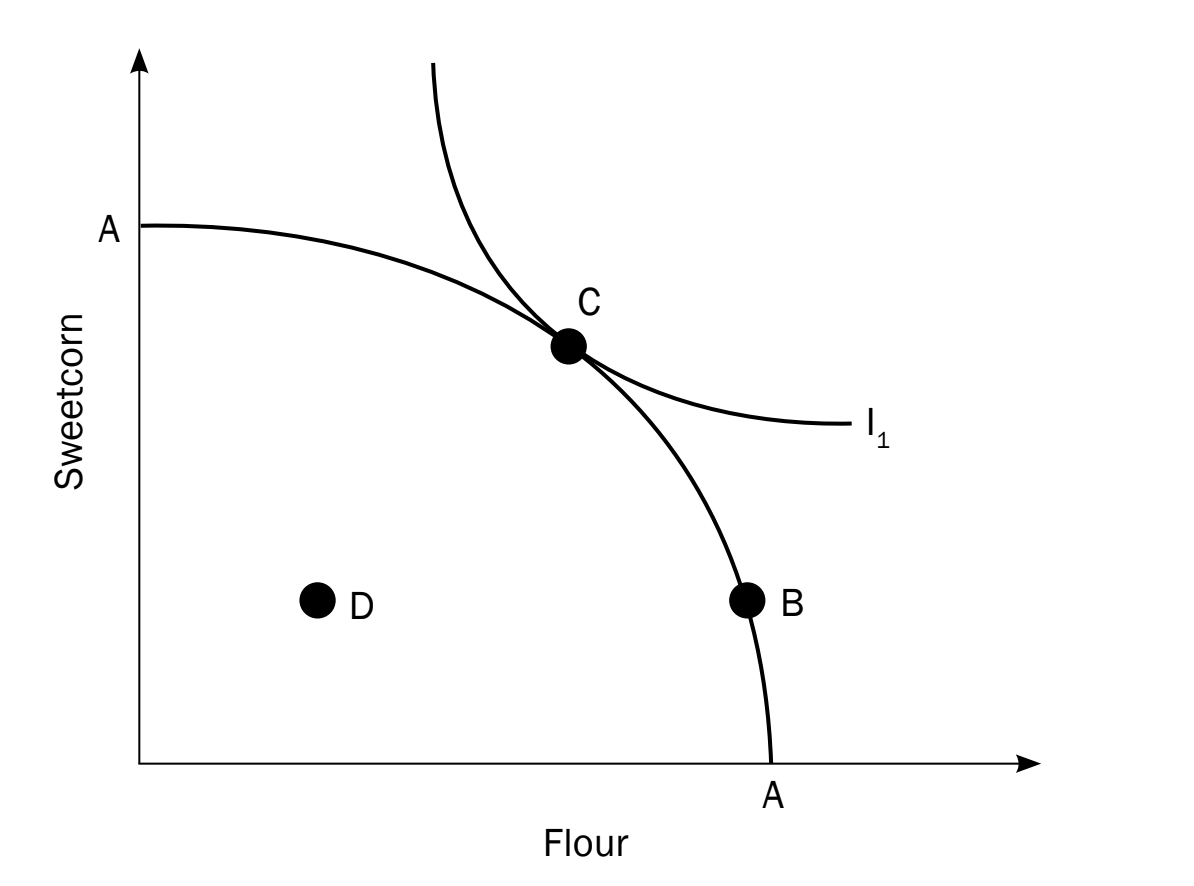
The production possibility curve shown above demonstrates how inefficiencies work:
- Any point on the curve (like point C) represents productive efficiency
- Points inside the curve (like point D) show productive inefficiency - resources are being wasted
- The curve also helps identify allocative inefficiency when the combination of goods produced doesn't match consumer preferences
Externalities (spill-over effects)
Externalities occur when the production or consumption of goods affects third parties who are not directly involved in the transaction. These create significant market failures because private costs and benefits differ from social costs and benefits.
Negative externalities
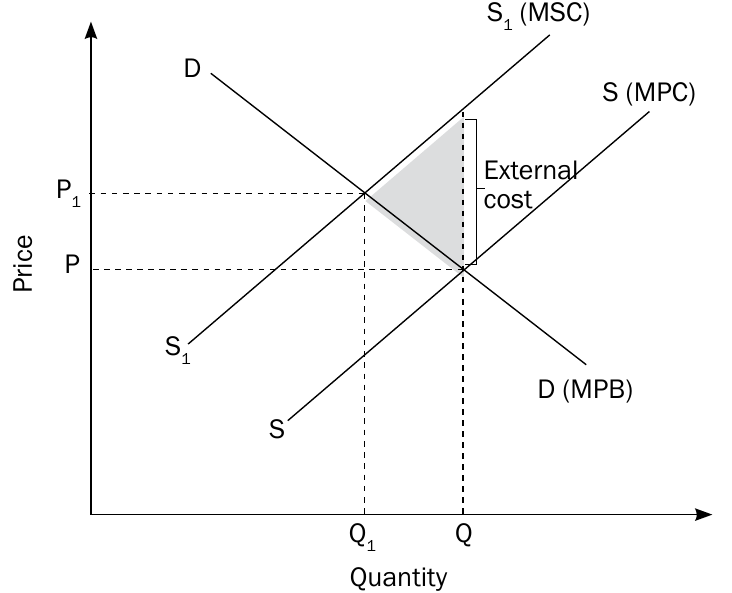
Negative externalities impose costs on society that are not reflected in the market price. The diagram shows how this creates market failure:
- Marginal Private Cost (MPC) represents the direct costs to producers
- Marginal Social Cost (MSC) includes both private costs and external costs imposed on society
- The difference between these two curves represents the external cost
- Without government intervention, the market produces quantity Q at price P, but the socially optimal level is Q₁ at price P₁
- This leads to overproduction and underpricing of goods that create negative externalities
Example
Common Examples of Negative Externalities:
- Air pollution from factories affecting public health - the factory doesn't pay for healthcare costs of affected communities
- Traffic congestion caused by individual car use - each driver doesn't consider the time costs imposed on other drivers
- Noise pollution from construction sites - nearby residents suffer reduced quality of life without compensation
Government responses to negative externalities:
- Campaigns: Public awareness programmes to discourage harmful behaviour
- Taxes: Adding costs to goods that create negative externalities (like tobacco and alcohol taxes)
- Laws and regulations: Setting limits on pollution and waste, restricting advertising of harmful products
Positive externalities
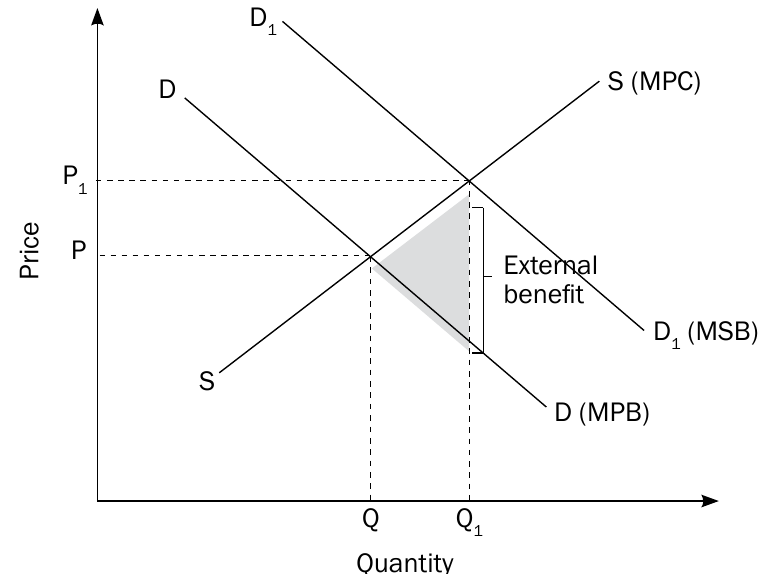
Positive externalities create benefits for society that are not fully captured in market prices. This leads to underproduction of beneficial goods and services.
Note
The key insight with positive externalities is that individuals making private decisions don't consider the full social benefits of their actions, leading to less than optimal outcomes for society.
Using education as an example:
- Marginal Private Benefit (MPB) represents the direct benefits to students
- Marginal Social Benefit (MSB) includes benefits to society (educated workforce, reduced crime, innovation)
- The market produces quantity Q, but the socially optimal level is Q₁
- This creates welfare loss because too little education is being provided
Government encouragement of positive externalities:
- Subsidies: Reducing costs to encourage consumption (free or low-cost education and healthcare)
- Direct provision: Government directly providing services like education and healthcare
- Advertising: Promoting beneficial activities through public campaigns
Government intervention
Governments use various tools to correct market failures and improve economic outcomes for society.
Rules and regulations
Direct controls: Governments pass laws to control businesses that create negative externalities. For example, environmental protection laws limit pollution from factories.
Imperfect markets: Competition laws prevent monopolies from charging excessive prices and ensure market entry remains possible for new firms.
Minimum wages
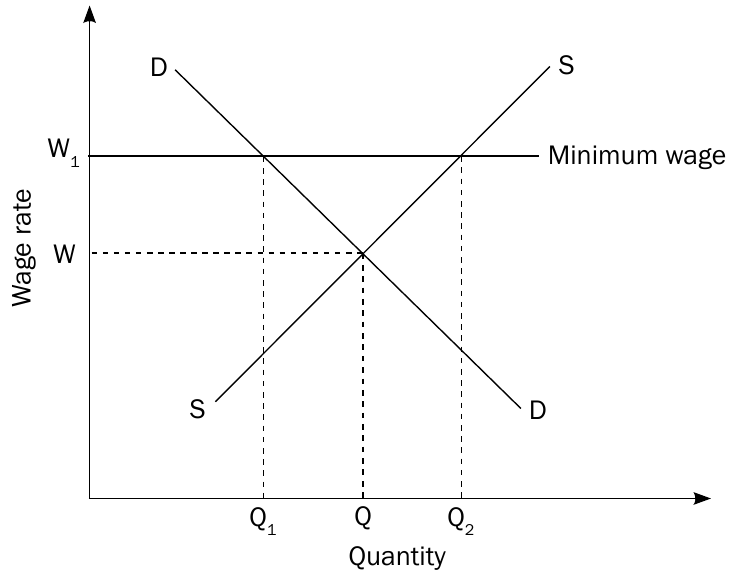
When governments set minimum wages above market equilibrium:
- Benefits: Workers receive higher pay, which can reduce poverty
- Potential costs: Some workers may become unemployed as demand for labour decreases
- The diagram shows how setting minimum wage W₁ creates a gap between labour supply (Q₂) and demand (Q₁)
Important
Setting minimum wages creates a trade-off between higher wages for employed workers and potential job losses for others. Policymakers must carefully consider this balance.
Maximum prices (price ceilings)
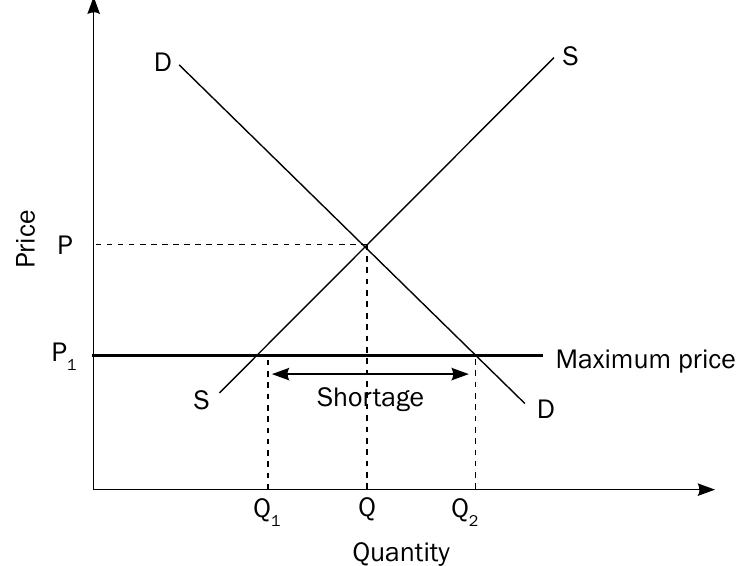
Governments sometimes set maximum prices below market equilibrium to make essential goods more affordable:
Effects of price ceilings:
- Benefits: Poor consumers can afford basic goods like food and housing
- Problems: Creates shortages because demand (Q₂) exceeds supply (Q₁)
- May lead to black markets where goods are sold illegally at higher prices
Example
South African Example: Fuel Price Controls
The government controls maximum prices for petrol, diesel fuel, and paraffin to ensure these essential goods remain affordable for consumers and businesses.
Minimum prices (price floors)
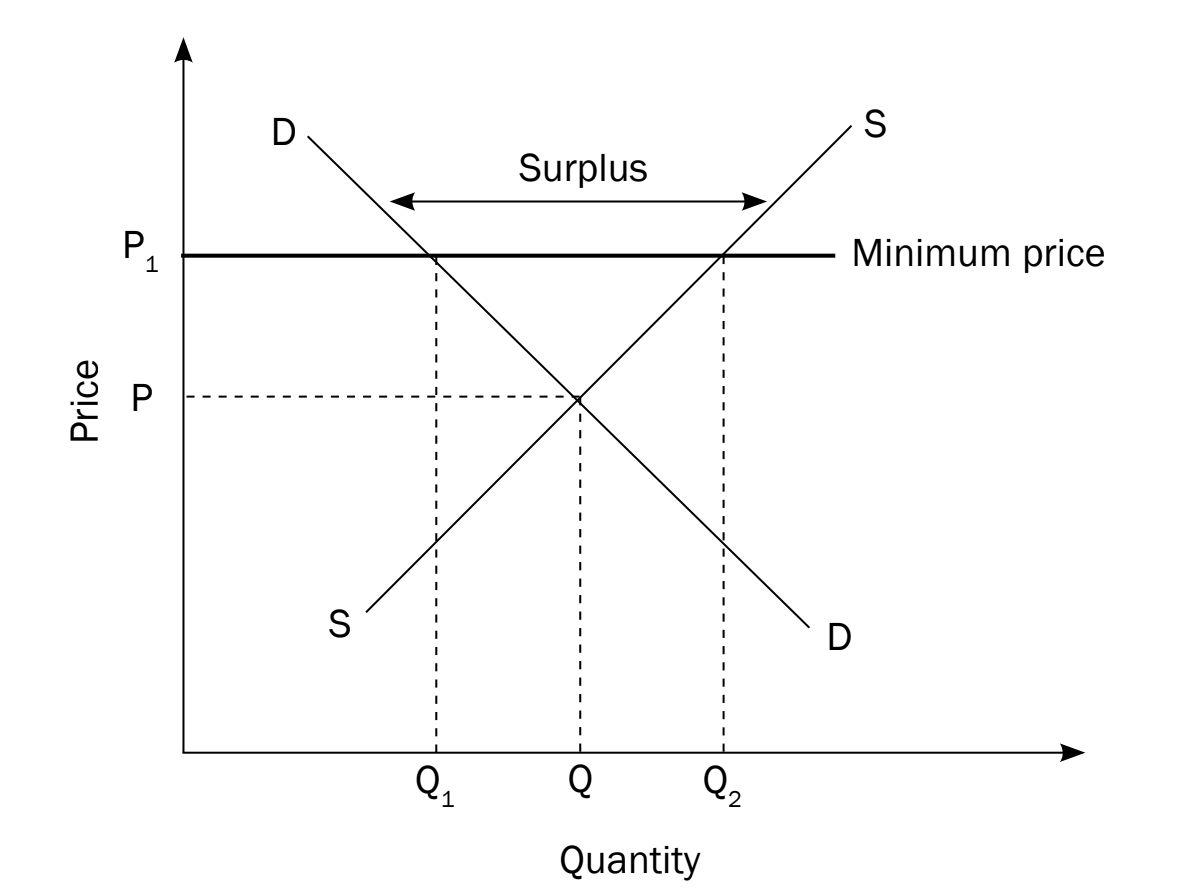
Setting minimum prices above market equilibrium protects producers:
Effects of minimum prices:
- Benefits: Producers earn better profits and are encouraged to supply essential goods
- Problems: Creates surplus because supply (Q₂) exceeds demand (Q₁)
- Government may need to buy excess production
Note
Agricultural price supports for wheat and other food crops help ensure food security by guaranteeing farmers minimum income levels, encouraging continued production of essential foods.
Taxes and subsidies
Taxes: Governments add taxes to recover external costs, particularly for goods creating negative externalities. This increases prices and reduces harmful consumption.
Producer subsidies: Government payments to producers encourage increased production, particularly for essential goods like agricultural products. This lowers market prices and increases quantity available.
Redistribution of wealth
Governments address income inequality through various methods:
Traditional approaches:
- Progressive taxation systems
- Free public services (education, healthcare)
- Cash benefits for the poor (social grants)
Redress methods in South Africa:
- Black Economic Empowerment (BEE)
- Land redistribution programmes
- Affirmative action policies
- RDP housing programmes
Additional intervention methods:
- Employment creation programmes (like public works projects)
- Consumer protection laws (enforced by bodies like the South African Bureau of Standards)
- Information campaigns to prevent misleading advertising
Summary
Key Points to Remember:
-
Two types of inefficiencies result from market failures: productive inefficiency (wasting resources) and allocative inefficiency (producing the wrong mix of goods)
-
Externalities create spill-over effects: negative externalities lead to overproduction of harmful goods, while positive externalities result in underproduction of beneficial goods
-
Government intervention takes many forms: price controls (ceilings and floors), taxes and subsidies, regulations, and wealth redistribution programmes
-
Every intervention has trade-offs: while government actions can correct market failures, they may also create new problems like shortages, surpluses, or unemployment
-
South African context matters: understanding local examples like petrol price controls, BEE policies, and RDP housing helps connect theory to real-world applications