Oligopolies (Grade 12 NSC Matric Economics): Revision Notes
📚Revision Notes
Oligopolies
What is an oligopoly?
An oligopoly is a market structure where a small number of large companies control the supply of a product or service. These few powerful firms can significantly influence market conditions, including prices and the overall supply available to consumers.
Note
Definition: An oligopoly exists when a small number of large companies are able to influence the supply of a product or service to a market.
A special case of oligopoly is called a duopoly, where only two companies dominate an entire industry. Think of this as the "big players" market structure - instead of many small competitors, you have just a handful of major companies calling the shots.
Oil companies provide an excellent example of oligopolistic behaviour. Companies like Shell, BP, and Caltex often have similar pricing strategies and market approaches, demonstrating how oligopolies function in real markets.
Key characteristics of oligopolies
Understanding oligopolies means recognising their distinctive features that set them apart from other market structures:
Important
The Six Key Characteristics of Oligopolies:
- Limited competition - Only a few suppliers produce the same or similar products
- Mutual dependence - Each company's decisions directly affect its competitors
- Frequent price changes - Can lead to destructive price wars
- Non-price competition - Focus on advertising, service, and brand loyalty
- Considerable price control - Significant influence over market prices
- High barriers to entry - Protect existing firms from new competitors
Mutual dependence creates a unique dynamic where each company's decisions directly affect its competitors. When one firm changes its price, advertising strategy, or product features, the others must respond. This interdependence makes decision-making more complex than in other market structures.
Frequent price changes can occur as companies try to increase their market share. However, this often leads to destructive price wars where all firms end up worse off, which is why oligopolies often avoid competing primarily on price.
Non-price competition becomes crucial in oligopolistic markets. Instead of competing mainly through price cuts, firms focus on advertising, improving customer service, enhancing product quality, and building brand loyalty to attract customers.
Considerable price control exists, though not as much as in monopolies. Oligopolistic firms can influence prices because they control significant market share, but they must still consider how competitors might react.
High barriers to entry protect existing oligopolies from new competitors. These barriers include the need for large capital investments, strong brand loyalty among existing customers, and the challenge of competing against well-established market leaders.
The kinked demand curve theory
American economist Paul Sweezy developed an important theory to explain why prices in oligopolistic markets tend to remain stable, even when costs change. This theory uses the concept of a kinked demand curve.
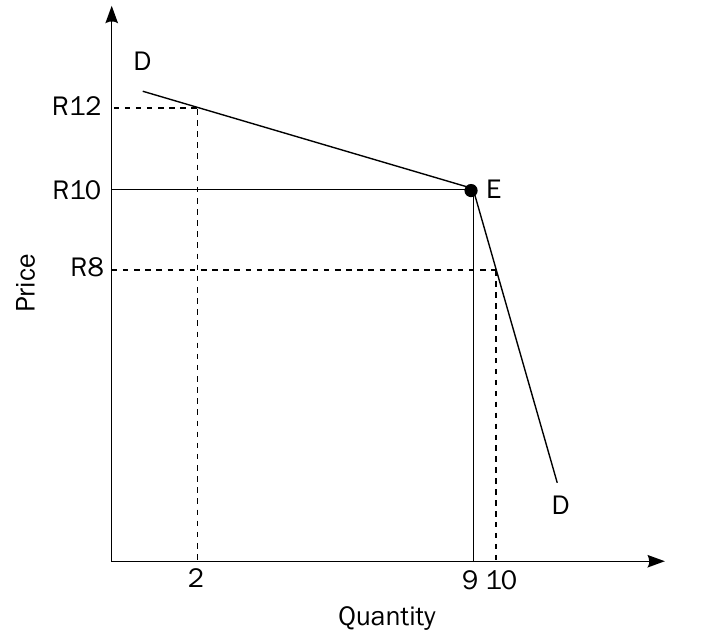
The kinked demand curve consists of two distinct sections that reflect different customer responses to price changes:
The upper section represents high price levels where demand is very elastic. This means customers are highly sensitive to price increases - if a firm raises its prices above the current level, it will lose many customers to competitors who maintain lower prices.
The lower section shows low price levels where demand is very inelastic. Here, customers are not very responsive to price decreases. If a firm cuts its prices, competitors will likely match these cuts, so the firm won't gain many new customers.
Example
Worked Example: Revenue Impact of Price Changes
Consider a firm currently selling at the kink point:
- Current situation: 9 units at R10 each
- Total revenue: 9 times R10 = R90
If price increases to R12:
- Quantity demanded falls to: 2 units
- New total revenue: 2 times R12 = R24
- Revenue change: R24 - R90 = -R66 significant loss
If price decreases to R8:
- Quantity demanded rises to: 10 units
- New total revenue: 10 times R8 = R80
- Revenue change: R80 - R90 = -R10 still a loss
Why prices stay sticky: This creates a difficult situation where neither raising nor lowering prices significantly improves the firm's revenue position, leading to price stability in oligopolistic markets.
Non-price competition strategies
Since price wars can be destructive, oligopolistic firms prefer to compete through non-price methods. These strategies allow companies to attract customers and increase market share without triggering damaging price competition.
Building brand loyalty is fundamental to non-price competition. Through advertising and marketing, companies work to create strong customer preferences for their specific products or services. This loyalty makes customers less likely to switch to competitors, even if prices differ slightly.
Note
Product Differentiation Strategy
Product differentiation involves making products seem unique or superior to competitors' offerings. This might include special features, better quality, attractive packaging, or superior design that justifies customer preference.
Common non-price competition strategies include:
- Extended shopping and business hours to provide convenience
- Conducting business online to reach more customers
- Offering comprehensive after-sales services
- Providing additional services beyond the core product
- Creating loyalty reward programmes for regular customers
- Offering door-to-door deliveries
South African examples include major banks like ABSA and FNB, which compete through service quality, branch networks, online banking features, and customer rewards programmes rather than simply offering the lowest fees.
Collusion and cartels
Sometimes oligopolistic firms decide that cooperation is more profitable than competition. Collusion occurs when rival companies work together to maximise their combined profits by coordinating their pricing and production decisions.
Formal collusion creates what economists call a cartel - a group of producers who agree to act like a collective monopoly. Cartels aim to fix prices at high levels and restrict supply to increase their profits. Well-known examples include the Organisation of Petroleum Exporting Countries (OPEC) and historically, the De Beers diamond cartel in South Africa.
Note
Cartel Definition
A cartel is a group of producers whose goal is to form a collective monopoly in order to fix prices and limit supply and competition.
However, cartels face significant challenges. There's always an incentive for individual members to "cheat" by secretly cutting prices or increasing production beyond agreed quotas to gain additional profits. This instability explains why many cartels eventually break down.
Informal collusion can occur without explicit agreements. Price leadership happens when a dominant firm in the industry sets prices, and other firms follow these pricing signals. This is sometimes called tacit collusion because firms coordinate their behaviour without formal communication.
Important
Legal Warning
Most countries, including South Africa, have laws prohibiting formal collusion because it harms consumers through higher prices and reduced competition. However, these arrangements continue to exist both nationally and internationally, often operating in legal grey areas.
Remember!
Summary
Key Points to Remember:
- Oligopolies feature few large firms that can influence market supply and prices, with oil companies being prime examples
- Mutual dependence means each firm's decisions significantly impact competitors, creating complex strategic interactions
- The kinked demand curve explains why oligopolistic prices tend to remain stable - both price increases and decreases can reduce total revenue
- Non-price competition dominates oligopolistic markets through advertising, brand building, service improvements, and product differentiation
- Collusion and cartels allow firms to cooperate for higher profits, but these arrangements are often unstable and frequently illegal