Evolution in Present Times (Grade 12 NSC Matric Life Sciences): Revision Notes
📚Revision Notes
Evolution in Present Times
Understanding evolution today
Evolution is a continuous process that never stops happening around us. While we often think of evolution as something that takes millions of years to observe, this isn't always the case. Most species do evolve very slowly through a process called gradualism, which makes it nearly impossible for us to see changes within our lifetime.
However, certain organisms provide us with fascinating examples of evolution happening much more rapidly. Pathogens such as bacteria and viruses are particularly good at showing us evolution in action because they reproduce extremely quickly and have high levels of natural variation in their populations. When mutations occur frequently in rapidly reproducing organisms, evolution can happen at a speed we can actually observe and study.
Note
The key to observing evolution in real-time lies in the reproduction rate of organisms. While large mammals might take years to reproduce and show evolutionary changes over millennia, bacteria can reproduce every 20 minutes under ideal conditions, allowing us to witness evolutionary changes within days or weeks.
Antibiotic resistance in tuberculosis
What is tuberculosis?
Tuberculosis, commonly known as TB, is a serious chronic bacterial infection caused by a bacterium called Mycobacterium tuberculosis. Unfortunately, TB remains a significant health concern in South Africa, with increasing numbers of cases being reported in recent years.
Note
South Africa has one of the highest TB infection rates globally, making the study of antibiotic resistance particularly relevant and urgent for our healthcare system.
How resistance develops
The standard treatment for TB involves using antibiotics to kill the bacteria. However, a major problem arises because some bacteria in any population are naturally resistant to these antibiotics. This natural variation is the raw material that natural selection works with.
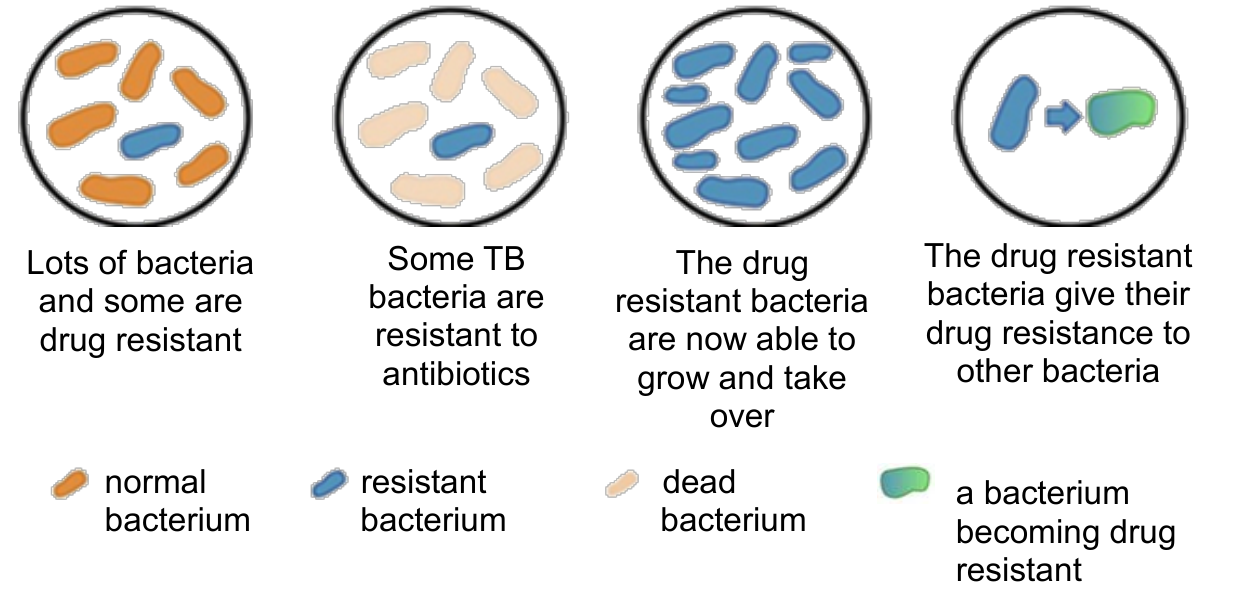
The diagram above shows exactly how antibiotic resistance develops through natural selection. Let's examine each stage in detail:
Example
Worked Example: The Four Stages of Antibiotic Resistance Development
Stage 1: In any bacterial population, there's a mixture of normal bacteria (shown in orange) and some naturally resistant bacteria (shown in blue). Most bacteria are normal and susceptible to antibiotics.
Stage 2: When antibiotics are introduced, the normal bacteria begin to die (shown in beige), while the resistant bacteria survive. This is natural selection in action - the environment (presence of antibiotics) selects which bacteria survive.
Stage 3: The resistant bacteria that survived now have less competition for resources, so they multiply rapidly and become the dominant population in the patient's body.
Stage 4: The resistant bacteria can even transfer their resistance genes to other bacteria through a process called horizontal gene transfer (shown by the blue bacterium transferring resistance to the green bacterium).
The problem with incomplete treatment
A critical issue contributing to the rise of TB resistance in South Africa is that many patients don't complete their full course of antibiotic treatment. When this happens, the naturally resistant bacteria survive and reproduce.
Important
Critical Warning: Incomplete Treatment Consequences
If the patient develops TB again after incomplete treatment, most of the bacteria will now be resistant to the previous antibiotic, making treatment much more difficult. This is why completing the full course of antibiotics is absolutely essential, even when patients start feeling better before finishing their medication.
Multi-drug resistant tuberculosis
Initially, doctors tried to solve the resistance problem by treating TB patients with multiple different antibiotics at the same time. The thinking was that bacteria couldn't possibly develop resistance to several different drugs simultaneously. Unfortunately, this assumption proved incorrect.
TB bacteria have now evolved resistance to multiple drugs, creating what we call multi-drug resistant (MDR) TB. These MDR bacteria are extremely difficult to treat and require aggressive treatment using five different drugs. Even with this intensive treatment, patients with MDR TB often don't survive.
Important
The Severity of MDR TB
Multi-drug resistant tuberculosis represents one of the most serious challenges in modern medicine. The evolution of bacteria that can survive multiple antibiotics simultaneously demonstrates the remarkable adaptability of microorganisms and the urgent need for new treatment strategies.
Why this matters in South Africa
The development of antibiotic-resistant TB is particularly concerning in South Africa because of several interconnected factors:
- TB rates are already high in our country
- Many patients struggle to complete long treatment courses
- Resistant strains are more deadly and expensive to treat
- The spread of resistance threatens public health on a national scale
Summary
Key Points to Remember:
- Evolution happens continuously, but we can observe it most easily in rapidly reproducing organisms like bacteria
- Natural selection drives antibiotic resistance - bacteria with natural resistance survive treatment and multiply
- Incomplete antibiotic treatment creates ideal conditions for resistant bacteria to take over
- Multi-drug resistant TB has evolved because bacteria can develop resistance to multiple antibiotics
- Completing the full course of antibiotics is crucial for preventing resistance development