Genetics and Inheritance (Grade 12 NSC Matric Life Sciences): Revision Notes
📚Revision Notes
Mitochondrial DNA and Tracing Genetic Links
What is mitochondrial DNA?
Mitochondrial DNA (mtDNA) is a special type of genetic material that plays a crucial role in understanding human evolution and ancestry. Unlike the DNA found in the nucleus of our cells, mitochondrial DNA is located within the mitochondria - the powerhouses of our cells that produce energy through cellular respiration.
This unique genetic material contains exactly 37 genes that are essential for making the proteins needed in cellular respiration. What makes mtDNA particularly valuable for evolutionary studies is its distinctive inheritance pattern and mutation characteristics.
Key properties of mitochondrial DNA
Understanding the unique characteristics of mitochondrial DNA is essential for appreciating why it's so valuable in evolutionary research. Three key properties make mtDNA an ideal molecular tool for tracing ancestry.
No crossing over occurs
Note
Crossing over is the process where chromosomes exchange genetic material during cell division. In nuclear DNA, this creates genetic variation between generations, but mitochondrial DNA doesn't undergo this process.
One of the most important features of mitochondrial DNA is that it does not undergo crossing over during cell division. This means that the genetic material remains largely unchanged from generation to generation, with the only alterations coming from random mutations that occur over time.
Regular mutation rate
Mitochondrial DNA mutates at a predictable and regular rate, which acts like a molecular clock. Scientists can use this consistent mutation rate to calculate how long ago different populations diverged from common ancestors, creating a timeline of genetic ancestry.
Maternal inheritance only
Here's where mitochondrial DNA becomes truly fascinating for genetic research - it is inherited exclusively from the mother. During fertilisation, the sperm contributes nuclear DNA but its mitochondria (and therefore its mtDNA) are discarded along with the sperm's tail. This means that both male and female offspring receive only their mother's mitochondrial DNA.
Using mtDNA to trace genetic ancestry
Because of these unique properties, scientists can analyse mitochondrial DNA to compare the mutations present in different people and determine how closely related they are. The more mutations that have accumulated between two mtDNA samples, the longer ago those individuals shared a common female ancestor.
This research has led to remarkable discoveries about human origins and migration patterns throughout history.
Mitochondrial Eve and human origins
Through extensive mtDNA analysis, researchers have traced back human ancestry to discover our most recent common female ancestor, nicknamed "Mitochondrial Eve". Based on the accumulation of mutations in mtDNA samples from populations worldwide, scientists estimate that this common female ancestor lived approximately 150,000 years ago in East Africa.
Example
Research Example: Tracing Mitochondrial Eve
Scientists collected mtDNA samples from people across the globe and compared their mutation patterns. By working backwards through the mutations using the known mutation rate, they calculated:
- Time calculation: More mutations = more generations = longer time periods
- Geographic origin: Highest genetic diversity found in East African populations
- Result: Common female ancestor approximately 150,000 years ago in East Africa
This finding provides strong genetic evidence supporting the theory that the human race evolved in Africa before migrating to other parts of the world, where populations adapted and evolved into the various human populations we see today.
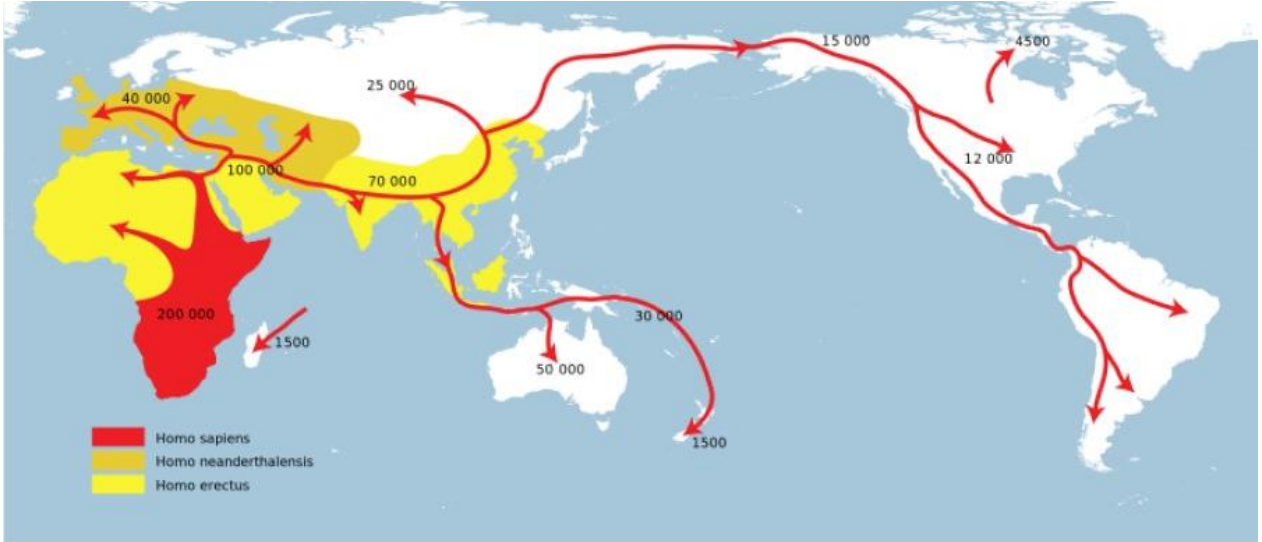
The map above illustrates the "Out of Africa" hypothesis, showing how early human populations migrated from Africa to populate other continents. The different colours represent various human species, with red arrows indicating the migration routes of modern humans (Homo sapiens) and the approximate timeframes when these movements occurred.
Supporting evidence from Y chromosome studies
Interestingly, studies of DNA on the Y chromosome, which traces paternal lineage (passed from father to son), have identified a most recent common male ancestor known as "Nuclear Adam". This research suggests that this common male ancestor lived approximately 60,000 years ago, which is more recent than Mitochondrial Eve but still supports the African origin theory of modern humans.
Note
Comparison of Genetic Lineages:
- Mitochondrial DNA: Traces maternal lineage through mothers
- Y Chromosome: Traces paternal lineage through fathers
- Both support African origins but show different timeframes for common ancestors
Exam tips and common misconceptions
Important
Common Misconception Alert:
Students sometimes think that both parents contribute mitochondrial DNA. Remember that only the mother's mtDNA is inherited - this is crucial for understanding how maternal lineages can be traced.
Essential Exam Points:
- Always mention mtDNA's key features: found in mitochondria, genes for cellular respiration, no crossing over (only mutations), regular mutation rate, and maternal inheritance only
- Real-world applications: mtDNA analysis is used in forensic science, medical genetics, and ancestry tracing through genetic testing services
Summary
Key Points to Remember:
- Mitochondrial DNA contains genes essential for cellular respiration and is inherited only from the mother
- No crossing over occurs in mtDNA, so changes are only due to mutations that happen at a regular, predictable rate
- Mitochondrial Eve lived approximately years ago in East Africa, supporting the Out of Africa theory of human evolution
- mtDNA analysis allows scientists to trace maternal lineages and determine how closely related different populations are
- The regular mutation rate acts like a molecular clock, helping scientists calculate when populations diverged from common ancestors