Cloning (Grade 12 NSC Matric Life Sciences): Revision Notes
📚Revision Notes
Cloning
What is cloning?
Cloning refers to the process of creating organisms that are genetically identical to another organism. This can happen in two main ways: naturally or through artificial scientific methods. When we talk about a clone, we mean an organism that has exactly the same DNA as its parent organism.
Note
Definition: Cloning is the natural or artificial process of creating a genetically identical copy of an organism or biological material (e.g. tissue). The organism produced in this way is called a clone.
In nature, cloning occurs during asexual reproduction. For example, when plants reproduce through self-pollination or when identical twins develop from a single fertilised egg, these processes create genetically identical individuals.
However, modern biotechnology has made it possible to create clones artificially. This scientific advancement allows researchers to produce animals that are exact genetic copies of a chosen parent animal, where the new individual is an exact copy of the organism from which the body cell was taken.
Famous cloning achievements
Two of the most significant cloning successes help us understand this technology better:
Example
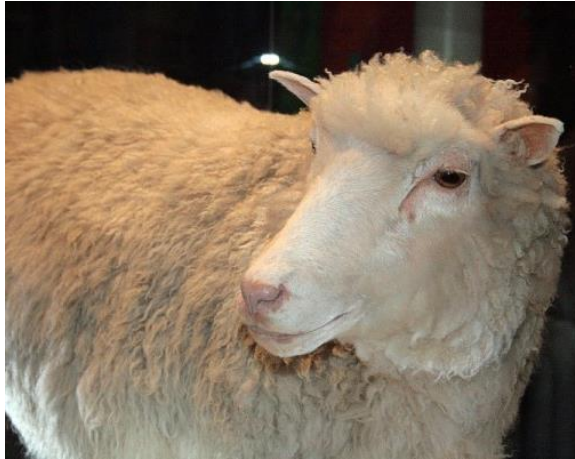
Historic Achievement: Dolly the Sheep (1996)
Dolly made history as the first mammal successfully cloned using an adult cell. Scientists used a mammary gland cell from an adult sheep to create this groundbreaking clone. Her success proved that cloning from adult cells was possible, revolutionising biotechnology.
Example
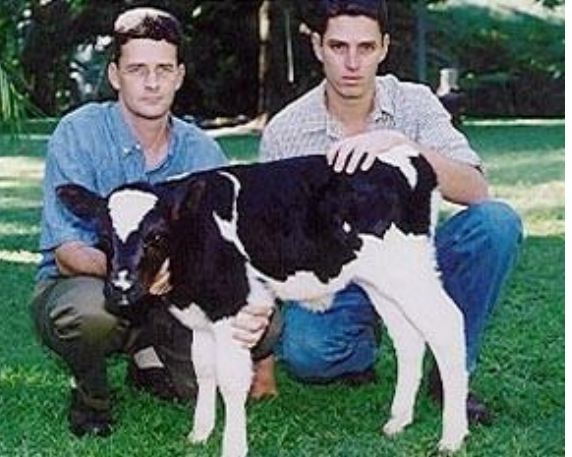
South African Milestone: Futhi the Cow (2003)
South Africa achieved its own cloning milestone when scientists successfully cloned Futhi. They used a cell from the ear of a prize-winning dairy cow, demonstrating that cloning technology could work in different countries and with different animals.
Important distinction: cloning vs IVF
Important
Critical Difference: Cloning vs IVF
It's crucial to understand that cloning is completely different from IVF (in vitro fertilisation). During IVF, scientists combine a sperm cell and an egg cell to create an embryo. This embryo contains genetic material from both parents, making it genetically unique.
In cloning, however, no sperm is involved. The clone contains DNA from only one parent, making it genetically identical to that parent.
Why clone animals?
Cloning offers several potential benefits that could impact medicine, agriculture, and scientific research:
Medical applications Therapeutic cloning could help replace damaged tissues in humans. Scientists hope to eventually grow new skin for burn victims, replace damaged heart cells after heart attacks, or develop treatments for conditions like Parkinson's disease.
Preventing genetic diseases By selecting animals without genetic defects for cloning, scientists could potentially reduce the occurrence of inherited diseases.
Improving food production Farmers could clone superior animals that produce more milk, better quality meat, or show greater resistance to diseases. This could help improve food security and quality.
Advancing scientific knowledge Research into cloning techniques continues to develop new technologies that may benefit humanity in unexpected ways.
The cloning process
The scientific method used for cloning is called somatic cell nuclear transfer (SCNT). This complex process involves multiple precise steps to create a genetically identical organism.
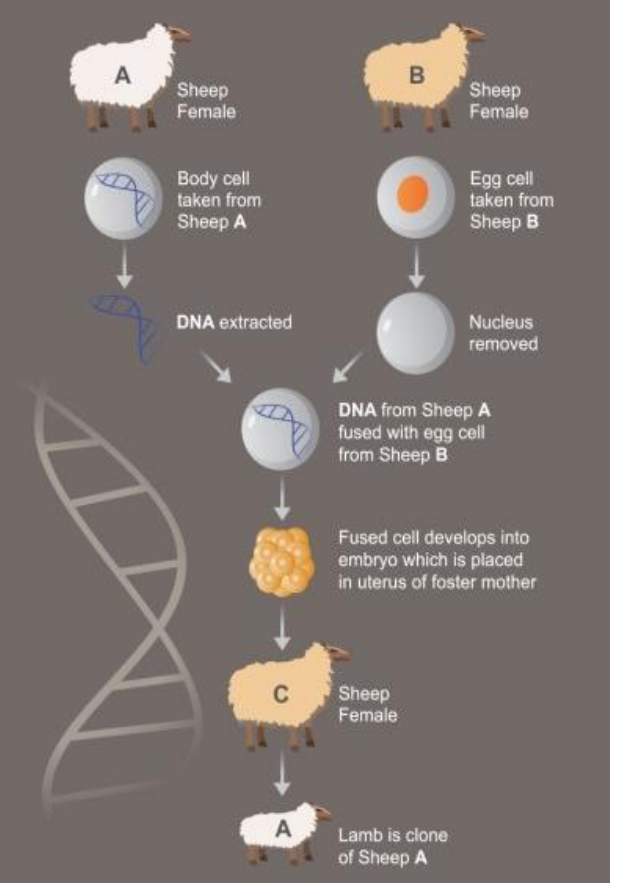
Step 1: Select the animals Scientists choose a superior animal (Animal A) to be cloned. They also select a hardy animal (Animal B) that can provide egg cells, and a third animal (Animal C) to serve as the surrogate mother.
Step 2: Collect the genetic material Researchers take a body cell (somatic cell) from the superior animal. This cell contains the complete genetic information they want to copy.
Step 3: Prepare the egg cell Scientists remove an egg cell from Animal B and carefully extract its nucleus. This creates an "empty" egg cell that has lost its original genetic material.
Step 4: Transfer the DNA The nucleus containing DNA from the superior animal is inserted into the empty egg cell. This gives the egg cell the genetic blueprint from the animal they want to clone.
Step 5: Stimulate development The egg cell receives an electrical shock that tricks it into beginning cell division, just as if it had been naturally fertilised.
Step 6: Create the embryo The egg cell develops into an embryo that contains DNA identical to the superior animal.
Step 7: Implant and develop Scientists place the embryo into the uterus of the surrogate mother, where it develops normally until birth.
Step 8: Birth of the clone The baby animal born will be genetically identical to the superior animal that provided the original body cell.
Summary
Key Points to Remember:
- Cloning creates genetically identical copies of organisms using scientific techniques
- Dolly the sheep (1996) was the first successfully cloned mammal, followed by South Africa's Futhi the cow (2003)
- Cloning differs from IVF because it uses only one parent's DNA instead of combining genetic material from two parents
- The process involves transferring DNA from a body cell into an egg cell that has had its nucleus removed
- Cloning has potential benefits including medical treatments, disease prevention, and improved food production