Dihybrid Crosses (Grade 12 NSC Matric Life Sciences): Revision Notes
📚Revision Notes
Dihybrid Crosses
What are dihybrid crosses?
A dihybrid cross is a genetic cross that examines the inheritance of two different characteristics at the same time. Unlike monohybrid crosses which look at only one trait, dihybrid crosses involve two pairs of alleles that control two separate features.
For example, when studying pea plants, we might examine both the height of the plant (tall or short) and the colour of its flowers (purple or white) in the same cross. This allows us to understand how these two traits are inherited together.
Note
The beauty of dihybrid crosses lies in their ability to reveal how multiple traits are passed from parents to offspring simultaneously, giving us a more complete picture of inheritance patterns in living organisms.
The law of independent assortment
The key principle behind dihybrid crosses is Mendel's Law of Independent Assortment. This law states that alleles for different genes separate independently from each other when gametes are formed during meiosis.
What this means is that the inheritance of one characteristic (like plant height) does not influence the inheritance of another characteristic (like flower colour). The alleles for these different traits move into gametes in various combinations, creating genetic diversity in the offspring.
Important
This independence of traits is fundamental to understanding genetic variation. Without independent assortment, we would see much less diversity in offspring, and evolution would proceed very differently.
Step-by-step approach to solving dihybrid crosses
Let's work through a complete example using pea plants to understand how dihybrid crosses work:
Example
Worked Example: Solving a Dihybrid Cross
Step 1: Identify the type of cross
When you see a genetics problem mentioning two different characteristics, you know it's a dihybrid cross. In our example, we're looking at both plant height and flower colour.
Step 2: Assign letters to represent alleles
Choose letters to represent the alleles for each characteristic:
- T = allele for tall plants (dominant)
- t = allele for short plants (recessive)
- P = allele for purple flowers (dominant)
- p = allele for white flowers (recessive)
Step 3: Determine parent phenotypes and genotypes
For this example, we're crossing two plants that are both tall with purple flowers, and both are heterozygous for both traits:
- Parent phenotypes: Tall, purple × Tall, purple
- Parent genotypes: TtPp × TtPp
Step 4: Determine the gametes each parent can produce
Each parent with genotype TtPp can produce four different types of gametes through meiosis. Remember, each gamete must contain one allele from each characteristic:

The possible gametes are: TP, Tp, tP, and tp
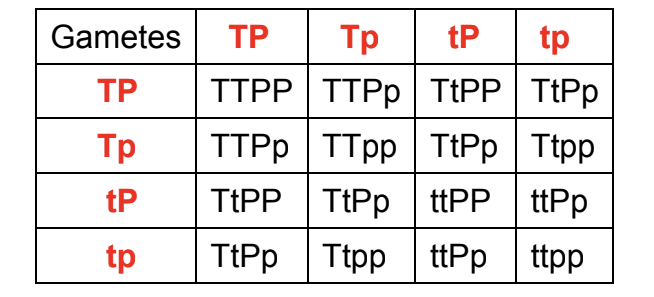
Step 5: Set up and complete the Punnett square
Create a 4×4 Punnett square with the four types of gametes from each parent:
Step 6: Analyse the results
From the completed Punnett square, count the different phenotypes:
- 9 tall, purple-flowered plants
- 3 short, purple-flowered plants
- 3 tall, white-flowered plants
- 1 short, white-flowered plant
This gives us the characteristic dihybrid phenotypic ratio of 9:3:3:1.
Understanding phenotypic expression
When determining phenotypes from genotypes, remember this fundamental rule about dominance and recessiveness:
Important
Key Rule for Phenotypic Expression:
If there is at least one capital letter (dominant allele) for a trait, that dominant characteristic will be expressed in the phenotype. Only when both alleles are lowercase (recessive) will the recessive trait be visible.
For example:
- TtPp = tall, purple (both dominant traits expressed)
- ttPp = tall, purple → short, purple (recessive height, dominant colour)
- Ttpp = tall, white (dominant height, recessive colour)
- ttpp = short, white (both recessive traits expressed)
Common exam tips
Here are some essential strategies to help you succeed with dihybrid cross problems:
Note
Essential Exam Strategies:
- Always check your gametes: Make sure each gamete has exactly one allele from each characteristic
- Use the checkerboard method: Systematically fill in your Punnett square to avoid missing combinations
- Count carefully: Double-check your phenotype counts to ensure they add up to 16 (total offspring in a 4×4 square)
- Remember the ratio: The 9:3:3:1 ratio is characteristic of dihybrid crosses between two heterozygotes
Summary
Key Points to Remember:
- Dihybrid crosses examine the inheritance of two characteristics simultaneously
- The Law of Independent Assortment explains how alleles for different traits segregate independently during gamete formation
- Each parent in a dihybrid cross can produce four different types of gametes
- The characteristic phenotypic ratio for a dihybrid cross between two heterozygotes is 9:3:3:1
- Always ensure each gamete contains one allele from each characteristic being studied