Cultural Evidence (Grade 12 NSC Matric Life Sciences): Revision Notes
📚Revision Notes
Cultural Evidence
What is cultural evidence?
Cultural evidence refers to the archaeological remains of human behaviour and technology that show how our ancestors developed unique abilities that separated them from other primates. The most significant aspect of cultural evidence is the development and manufacturing of tools, which became a defining characteristic of human evolution.
Note
Cultural evidence complements fossil evidence by providing insights into how early humans behaved, thought, and interacted with their environment. While fossils tell us about physical evolution, cultural artefacts reveal cognitive and social development.
Tool use vs tool manufacturing
While several animal species can use simple tools, the ability to manufacture sophisticated tools is uniquely human and belongs specifically to the genus Homo. This distinction is crucial for understanding human evolution.

Other primates, such as chimpanzees, demonstrate basic tool use in their natural environments. They have been observed using grass stems to fish for termites and employing stones to crack open nuts. However, these animals do not systematically create tools or develop increasingly complex tool technologies over time.
Important
Key Distinction: What makes humans different is our ability to deliberately craft tools with specific purposes in mind and to pass these manufacturing techniques down through generations, leading to progressive improvements in tool design and function.
Timeline of stone tool development
The archaeological record shows a clear progression in stone tool technology over millions of years, demonstrating increasing cognitive abilities and cultural sophistication in human ancestors.
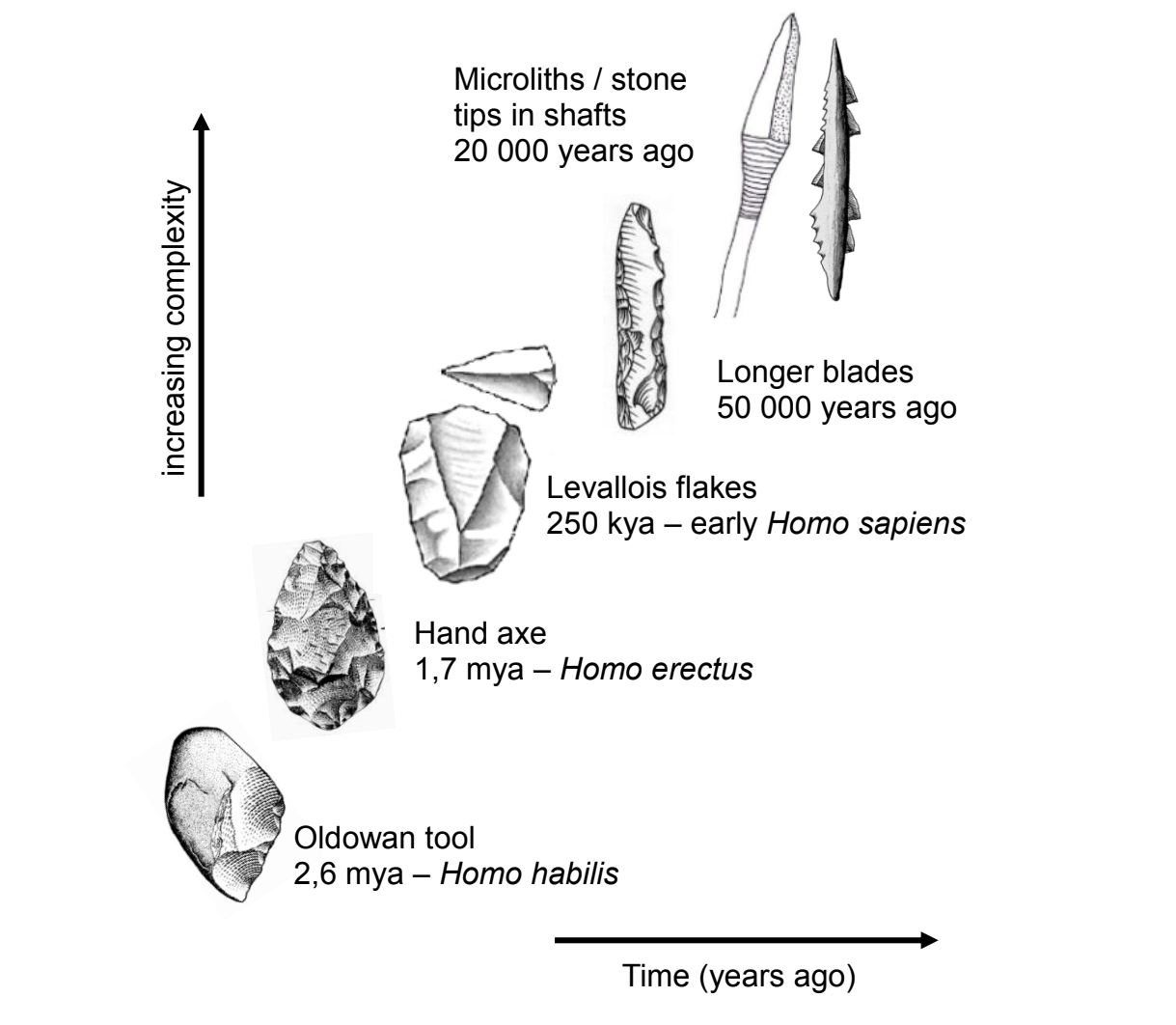
Oldowan tools (2.6 million years ago)
The earliest stone tools discovered are called Oldowan tools, named after Olduvai Gorge in Tanzania where they were first found. These primitive implements date back approximately 2.6 million years ago and are associated with Homo habilis.
Oldowan tools consisted of sharp stone flakes that were chipped off from larger cores. While simple in design, they represented a revolutionary development in human behaviour. These tools were probably not yet sharp enough to cut raw meat effectively, but they marked the beginning of systematic tool manufacturing.
Note
The discovery of Oldowan tools at Olduvai Gorge by Louis and Mary Leakey provided the first concrete evidence that early hominins were capable of deliberate tool manufacturing, not just opportunistic tool use.
Hand axes (1.7 million years ago)
Around 1.7 million years ago, more sophisticated tools called hand axes appeared in the archaeological record. These bifacially worked stone implements have been discovered at sites across Kenya and South Africa and are primarily associated with Homo erectus.
Hand axes showed significant improvements in design and manufacturing technique compared to Oldowan tools. They were more symmetrical, had better-defined cutting edges, and demonstrated greater skill in their production.
Levallois flakes (250,000 years ago)
Approximately 250,000 years ago, early modern humans (Homo sapiens) began producing smaller, sharper, knife-like tools called flakes. This technology, known as the Levallois technique, involved preparing stone cores in advance to produce flakes of predetermined shapes and sizes.
These tools represented a major advance in both planning ability and technical skill, showing that early humans could visualise the end product before beginning the manufacturing process.
Advanced blade tools (40,000-50,000 years ago)
Between 40,000 and 50,000 years ago, humans developed even more sophisticated blade-like tools. These implements were longer, thinner, and more efficient than earlier technologies.
Composite tools with microliths (20,000 years ago)
Around 20,000 years ago, human tool technology reached new levels of complexity with the development of composite tools. These involved attaching small stone chips called microliths to wooden or bone shafts using animal sinew. This created spears and arrows that were far more effective hunting weapons than previous tools.
Note
Composite tools represented a significant cognitive leap as they required planning multiple components and understanding how different materials could work together to create more effective implements.
End of the stone age (5,000 years ago)
Approximately 5,000 years ago, stone tool technology was gradually replaced by metal working. Humans began using copper, bronze, tin, and eventually iron to create tools and weapons, marking the end of the stone age and the beginning of the metal ages.
Other important cultural developments
Fire control
The ability to control fire was another crucial cultural development that significantly impacted human evolution. Learning to create and maintain fires provided several advantages:
- Warmth and protection from cold climates and predators
- Food preparation through cooking, which made nutrients more accessible and digestible
- Social cohesion as gathering around fires encouraged communication and group bonding
- Extended activity periods by providing light after dark
Important
Critical Impact: Fire control was so significant that it fundamentally changed human social behaviour, diet, and even brain development. Cooking food made more energy available to support larger brains.
Art and symbolic expression
Artistic expression represents another uniquely human cultural development that appeared relatively late in human evolution. The earliest known art dates from approximately 100,000 years ago, while the earliest cave paintings were created around 40,000 years ago.
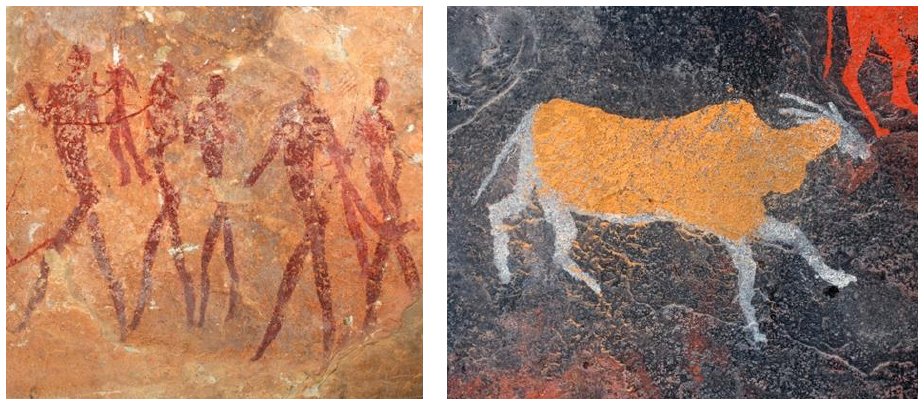
South Africa has provided abundant evidence of early rock art, including the famous San/!Kung cave paintings. These artworks often featured human figures and animals such as eland, which held great spiritual significance for these communities.
The development of art likely served several important functions:
- Social bonding between individuals and groups
- Strengthening relationships within communities
- Spiritual and religious expression
- Communication of important cultural knowledge
- Enhancement of reproductive success through group cooperation
Note
The appearance of symbolic art marks a crucial milestone in human cognitive evolution, demonstrating the capacity for abstract thinking, symbolic representation, and cultural transmission of non-practical knowledge.
Significance for understanding human evolution
Cultural evidence provides crucial insights into human cognitive development and social behaviour that cannot be obtained from fossil evidence alone. The progressive increase in tool complexity over time demonstrates:
- Growing brain capacity and problem-solving abilities
- Improved hand-eye coordination and fine motor skills
- Enhanced planning abilities and forwards thinking
- Social learning and knowledge transmission between generations
- Symbolic thinking and abstract reasoning capabilities
This cultural evidence helps scientists understand not just how human bodies evolved, but how human minds and societies developed the sophisticated capabilities that distinguish us from all other species.
Summary
Key Points to Remember:
- Tool manufacturing (not just tool use) is uniquely human and distinguishes genus Homo from other primates
- Stone tool technology showed progressive complexity over 2.6 million years, from simple Oldowan flakes to sophisticated composite tools
- Key timeline: Oldowan tools (H. habilis, 2.6 mya) → Hand axes (H. erectus, 1.7 mya) → Flakes (H. sapiens, 250,000 ya) → Microliths (20,000 ya)
- Fire control and art were other crucial cultural developments that enhanced survival, social bonding, and spiritual expression
- Cultural evidence provides insights into cognitive evolution that fossil evidence alone cannot reveal