DNA: The Code of Life (Grade 12 NSC Matric Life Sciences): Revision Notes
📚Revision Notes
DNA Profiling
What is DNA profiling?
DNA profiling is a scientific technique that creates a distinctive banding pattern using specialised X-ray technology. This pattern reveals the unique genetic fingerprint of an individual through lines that vary in length, thickness, and position on the X-ray film. The fascinating aspect of DNA profiling is that every person on Earth has their own unique DNA profile, with the only exception being identical twins who share the same genetic code.
Important
Critical Principle: All individuals, except identical twins, have a unique DNA profile. This fundamental principle underlies all applications of DNA profiling technology.
The uniqueness of DNA profiles makes them incredibly valuable for identification purposes. Just as no two people have identical fingerprints, no two individuals (except identical twins) share the same DNA profile pattern. This biological uniqueness forms the foundation for all applications of DNA profiling in modern society.
Note
The X-ray film technology used in DNA profiling creates patterns similar to a barcode - each person's "biological barcode" is completely unique and can be used for identification throughout their lifetime.
Applications of DNA profiling
DNA profiling serves numerous important purposes across different fields, making it one of the most versatile tools in biological science:
Forensic investigations represent the most well-known application, where DNA profiling helps law enforcement identify suspects and solve criminal cases. Crime scene samples can be compared against suspect profiles to establish connections or eliminate individuals from investigations.
Paternity and maternity testing allows families to establish biological relationships between parents and children. This application is crucial for legal proceedings, inheritance cases, and personal family matters where biological parentage needs to be confirmed.
Medical applications include determining the likelihood of genetic disorders and assessing compatibility for organ transplants. This helps doctors make informed decisions about patient care and treatment options, ensuring better outcomes for patients requiring transplant procedures.
Family identification enables people to locate and identify biological relatives, which can be particularly important in cases of adoption, missing persons, or family reunification after natural disasters or conflicts.
Note
DNA profiling has applications spanning from individual family matters to large-scale disaster victim identification, making it one of the most versatile scientific techniques available today.
Limitations and challenges of DNA profiling
While DNA profiling is considered highly reliable, there are several important limitations that must be understood and considered:
Human interpretation errors pose a significant challenge because trained technicians must analyse and interpret the results. Since humans are involved in the process, mistakes can occur during analysis or when comparing profiles, potentially leading to incorrect conclusions.
Laboratory inconsistencies can arise when different laboratories use varying methods for DNA profiling. These differences in technique and equipment can lead to inconsistent results and make it difficult to compare profiles processed at different facilities.
Sample limitations occur because only small pieces of DNA are used in the profiling process. This means the resulting profile might not be completely unique to a particular individual, though the probability of two people having identical profiles remains extremely low.
Cost barriers make DNA profiling expensive and not easily accessible to everyone who might need it. This is particularly problematic in criminal cases where financial constraints could affect the pursuit of justice, especially in resource-limited settings.
Privacy concerns arise because DNA profiles can reveal sensitive personal information about an individual's health status or genetic predispositions. For example, genetic information could indicate susceptibility to certain diseases, and this information might be used discriminatorily by insurance companies or create unfair prejudice in legal proceedings.
Important
Remember: While DNA profiling is highly reliable, it is not infallible. Understanding these limitations is crucial for proper interpretation and application of results in any context.
Forensic applications in crime solving
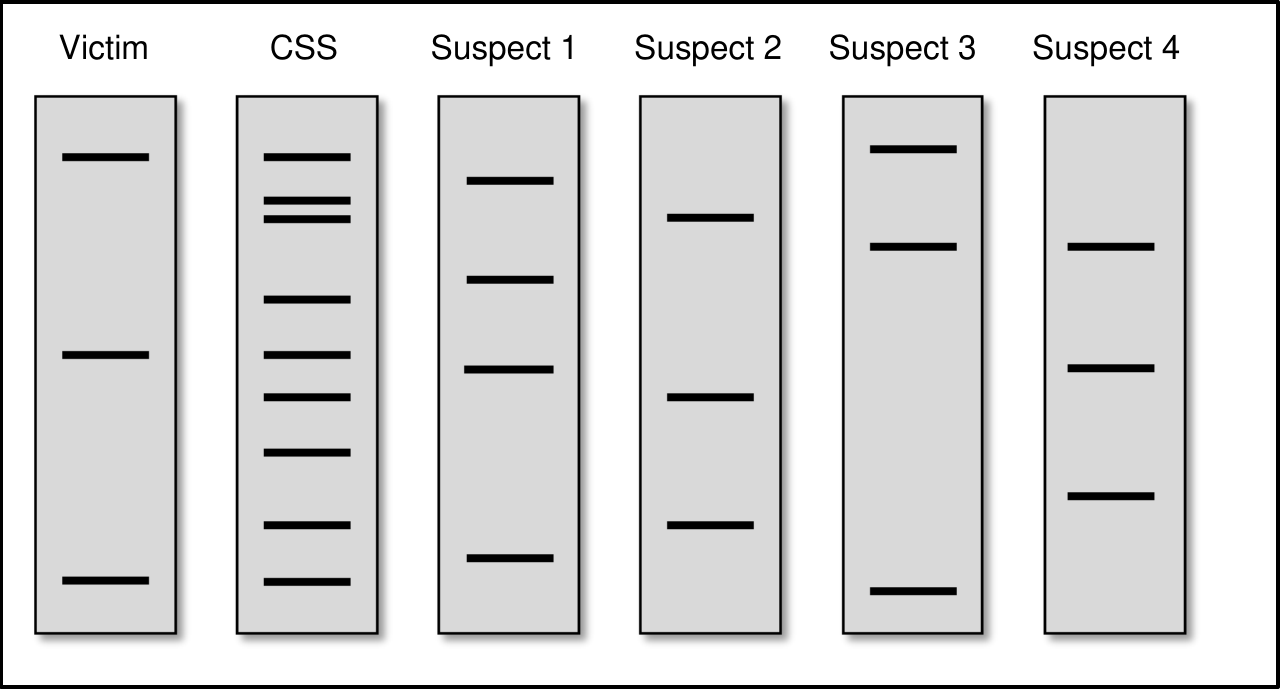
DNA profiling plays a crucial role in modern criminal investigations and has revolutionised forensic science. When a crime occurs, investigators collect biological evidence from the scene, such as blood, saliva, hair samples, or other bodily fluids. This evidence is then processed in specialised laboratories to create a DNA profile known as the Crime Scene Sample (CSS).
Example
Forensic DNA Comparison Process
Step 1: Collect biological evidence from the crime scene
- Blood, saliva, hair, skin cells, or other bodily fluids
Step 2: Process the sample in laboratory
- Extract DNA and create the Crime Scene Sample (CSS) profile
Step 3: Compare profiles systematically
- CSS vs Victim profile
- CSS vs Suspect profile(s)
Step 4: Analyse banding patterns
- Examine position, thickness, and pattern of bands
- Determine matches or exclusions
The CSS profile is systematically compared against profiles from the victim and any suspects in the case. Forensic experts examine the banding patterns carefully, looking at the position, thickness, and overall pattern of bands in each profile to identify matches or eliminate suspects from the investigation.
This scientific approach to criminal investigation has transformed law enforcement capabilities, helping to convict guilty parties based on solid biological evidence and exonerate innocent people who might otherwise have been wrongfully accused. The accuracy and reliability of DNA profiling have made it a cornerstone of modern forensic science.
Note
DNA profiling in forensics has not only helped solve current cases but has also been instrumental in reviewing cold cases, sometimes leading to convictions or exonerations decades after crimes were committed.
Important considerations for students
When studying DNA profiling, it's essential to understand that while this technology is highly reliable, it must be used responsibly. The interpretation of results requires careful consideration of the limitations discussed above, and results should always be approached with appropriate caution.
DNA profiling represents one of the most significant advances in biological science and has practical applications that extend far beyond solving crimes. Understanding both its capabilities and limitations is crucial for anyone studying molecular biology or considering careers in forensic science, medicine, or biotechnology.
Summary
Key Points to Remember:
- DNA profiling creates unique genetic fingerprints for every individual except identical twins
- The technique has wide applications including forensics, paternity testing, medical diagnosis, and organ transplant compatibility
- While highly reliable, DNA profiling has limitations including human error, cost barriers, and privacy concerns
- In criminal investigations, Crime Scene Samples (CSS) are compared against suspect profiles to identify perpetrators
- The method involves comparing patterns of lines that vary in length, thickness, and position on X-ray films