Comparison Between DNA and RNA (Grade 12 NSC Matric Life Sciences): Revision Notes
📚Revision Notes
Comparison Between DNA and RNA
Understanding nucleic acids
DNA (Deoxyribonucleic Acid) and RNA (Ribonucleic Acid) are both nucleic acids that play crucial roles in storing and expressing genetic information in living organisms. While they share some important similarities, they also have significant structural and functional differences that make each one suited for specific tasks in the cell.

Note
Both DNA and RNA are polymers made up of nucleotide monomers. Each nucleotide consists of three components: a phosphate group, a five-carbon sugar, and a nitrogenous base. Understanding this basic structure is essential for grasping how these molecules function in living systems.
Similarities between DNA and RNA
Before exploring their differences, it's important to understand what DNA and RNA have in common. Both of these nucleic acids share several fundamental characteristics that reflect their interconnected roles in gene expression.
Structural similarities:
- Both contain a backbone made of sugar molecules alternating with phosphate groups
- Both contain three of the same nitrogenous bases: adenine (A), guanine (G), and cytosine (C)
- Both are made up of nucleotide building blocks
Functional similarities:
- Both play essential roles in protein synthesis
- Both carry genetic information, though in different ways
- Both are found in the nucleus of cells
Note
These shared features reflect their common evolutionary origin. Scientists believe that RNA likely evolved first, with DNA evolving later as a more stable way to store genetic information long-term.
Key differences between DNA and RNA
Despite their similarities, DNA and RNA differ in several important ways that determine their specific functions in the cell.
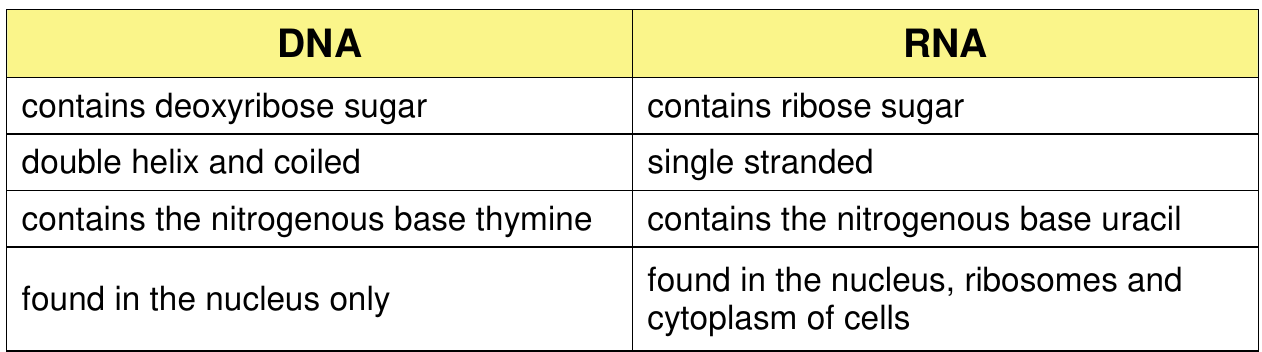
The table above highlights the four major differences between these nucleic acids. Let's examine each difference in detail:
Sugar composition
DNA contains deoxyribose sugar, which lacks one hydroxyl (OH) group compared to regular ribose sugar. This makes DNA more chemically stable and less reactive.
RNA contains ribose sugar, which has an extra hydroxyl group. This makes RNA less stable but more chemically reactive, allowing it to participate in various cellular processes.
Note
The presence of the extra OH group in RNA's ribose sugar is what makes RNA more susceptible to hydrolysis (breaking down in water) compared to DNA. This is why DNA can serve as long-term storage while RNA is better suited for temporary, active processes.
Structural form
DNA exists as a double helix - two complementary strands wound around each other in a spiral pattern. This double-stranded structure provides stability and allows for accurate replication.
RNA is typically single-stranded, though it can fold back on itself to form complex three-dimensional shapes. This flexibility allows RNA to perform various functions beyond just storing information.
Nitrogenous bases
DNA contains the base thymine (T), which pairs with adenine during base pairing.
RNA contains uracil (U) instead of thymine. Uracil pairs with adenine, just like thymine does, but this difference is important for distinguishing RNA from DNA during cellular processes.
Example
Base Pairing Rules:
In DNA:
- A (adenine) pairs with T (thymine)
- G (guanine) pairs with C (cytosine)
In RNA:
- A (adenine) pairs with U (uracil)
- G (guanine) pairs with C (cytosine)
Note that when RNA is transcribed from DNA, every T in the DNA template becomes a U in the RNA transcript.
Cellular location
DNA is found only in the nucleus of eukaryotic cells (and in the nucleoid region of prokaryotic cells). This restricted location helps protect the genetic material.
RNA is found in multiple locations: the nucleus (where it's made), ribosomes (where protein synthesis occurs), and throughout the cytoplasm (where it carries out various functions).
Why these differences matter
These structural differences between DNA and RNA reflect their different roles in the cell:
- DNA's stability makes it perfect for long-term storage of genetic information
- RNA's flexibility and reactivity make it ideal for active processes like protein synthesis and gene regulation
- The single-stranded nature of RNA allows it to fold into functional shapes, enabling it to act as both an information carrier and a biological catalyst
Note
Some RNA molecules, called ribozymes, can actually function as enzymes, catalysing chemical reactions. This dual role as both information storage and catalyst is unique to RNA and supports the "RNA World" hypothesis about early life on Earth.
Common exam misconceptions
Important
Watch out for these common mistakes:
Misconception: "DNA and RNA are completely different molecules"
Reality: They share many structural similarities and work together in gene expression
Misconception: "RNA is just a copy of DNA"
Reality: While RNA can be transcribed from DNA, it has unique functions and can exist independently
Exam tip: Remember that the key difference in bases is T (DNA) vs U (RNA) - this often appears in multiple-choice questions!
Summary
Key Points to Remember:
- DNA uses deoxyribose sugar, RNA uses ribose sugar - the extra OH group in RNA makes it less stable
- DNA is double-stranded and helical, RNA is single-stranded - this affects their stability and function
- DNA contains thymine, RNA contains uracil - both pair with adenine, but this difference is crucial for cellular recognition
- DNA stays in the nucleus, RNA travels throughout the cell - reflecting their different roles in gene expression
- Both are essential for protein synthesis - they work together to convert genetic information into functional proteins