Ratio, Proportion, and Rate (Grade 12 NSC Matric Mathematical Literacy): Revision Notes
📚Revision Notes
Ratio, Proportion, and Rate
What is a ratio?
A ratio compares two or more quantities and shows how much of one thing there is compared to another. Ratios help us understand the relationship between different amounts and are essential for making comparisons in mathematics and everyday life.
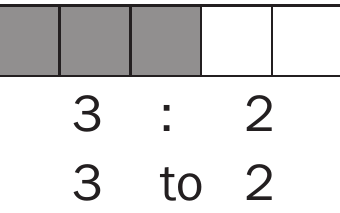
Different ways to write ratios
Ratios can be expressed in three different ways:
- Using a colon: 3 : 2
- Using words: 3 to 2
- As a fraction: 3/2
Important
All three methods represent the same relationship between the quantities. Choose the format that works best for your specific problem or context.
Equivalent ratios
Ratios can be scaled up or down while maintaining the same relationship. This creates equivalent ratios.
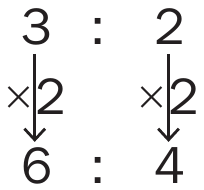
The key rule for creating equivalent ratios is to multiply or divide both numbers by the same value. For example:
- 3 : 2 can become 6 : 4 (multiply both by 2)
- 3 : 2 can become 9 : 6 (multiply both by 3)
Note
Always maintain the same order when writing ratios. The ratio 3:2 is different from 2:3 because the order matters for the comparison being made.
Writing ratios in simplest form
To write a ratio in its simplest form, find the largest number that divides into both terms and divide both by this number. This works the same way as simplifying fractions.
For example, to simplify 80 : 120:
- Both numbers can be divided by 10: 80 ÷ 10 = 8, 120 ÷ 10 = 12
- Both 8 and 12 can be divided by 4: 8 ÷ 4 = 2, 12 ÷ 4 = 3
- The simplest form is 2 : 3
Example
Worked Example: Pancake Recipe
A pancake recipe uses 3 cups of flour and 2 cups of milk, giving a ratio of 3:2.
To make pancakes for more people, multiply both amounts by 4:
- 3 × 4 = 12 cups of flour
- 2 × 4 = 8 cups of milk
- The ratio remains the same: 12:8 = 3:2
Ratios comparing 3 numbers
Sometimes you need to work with ratios that compare three quantities. The same principles apply - you can scale all three numbers up or down by the same factor.
Example
Worked Example: Sharing Money
A grandmother wants to share R800 between her three grandchildren in the ratio of their ages: 20:15:5 years.
Solution:
- Simplify the ratio: 20:15:5 = 4:3:1 (divide all by 5)
- Find total parts: 4 + 3 + 1 = 8 parts
- Calculate each share:
- First child: 4/8 × R800 = R400
- Second child: 3/8 × R800 = R300
- Third child: 1/8 × R800 = R100
- Check: R400 + R300 + R100 = R800 ✓
Types of ratio problems
Note
There are several types of ratio problems you might encounter. Understanding these different categories helps you choose the right approach for each situation.
Common types include:
- Working out ratios from given quantities
- Finding equivalent ratios
- Finding unit ratios
- Finding total number of parts
- Finding total quantities
- Finding quantities in specific parts
- Finding missing numbers
Unit ratios
A unit ratio has one of the terms equal to 1. This makes comparisons easier by showing the amount per single unit.
To create a unit ratio, divide both terms by the smaller number. For example:
- 5 : 9 becomes 1 : 1.8 (divide both by 5)
Example
Worked Example: Hospital Staffing
There are 23 nurses and 7,567 patients in a hospital. How many patients does each nurse care for?
Solution:
- Write the ratio: 23 : 7,567
- Convert to unit ratio: 1 : 329 (divide both by 23)
- Each nurse cares for approximately 329 patients
Proportions
A proportion is an equation stating that two ratios are equal. It has the form:
Cross-multiplication method
Important
When one number in a proportion is unknown, use cross-multiplication to find it:
If , then
This is the most reliable method for solving proportion problems.
Using tables for proportion problems
Tables can help organise proportion problems and make them easier to solve by clearly showing the relationships between quantities.

Example
Worked Example: Flower Bunches
Sipho makes flower bunches with a rose-to-daisy ratio of 1:3. If he has 15 daisies, how many roses does he need?
Solution:
- Set up the proportion:
- Cross-multiply:
- Solve: , so
- Sipho needs 5 roses
Example
Worked Example: Summer Camp
A summer camp has a boy-to-girl ratio of 8:11. If there are 88 boys, what is the total number of children?
Solution:
- Set up proportion: (where g = girls)
- Cross-multiply:
- Solve: girls
- Total children: 88 boys + 121 girls = 209 children
Rate
A rate compares two quantities with different units. This is particularly useful in real-world applications where you need to compare different types of measurements.
Common examples include:
- Cost rates (R16.95 per kg)
- Speed rates (60 km/h)
- Exchange rates
Unit rates
A unit rate shows the amount per one unit. To find a unit rate, divide one quantity by the other.
Example: If 2 kg of flour costs R20, the unit rate is: R20 ÷ 2 kg = R10 per kg
Distance, speed and time relationships
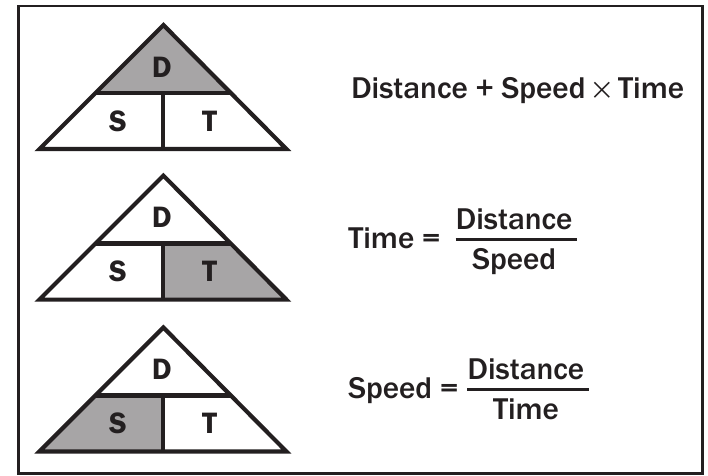
The relationship between distance, speed, and time can be remembered using triangles:
Important
Key Formulas:
- Distance = Speed × Time
- Speed = Distance ÷ Time
- Time = Distance ÷ Speed
These formulas help solve problems involving motion and travel.
Summary
Key Points to Remember:
- Ratios compare quantities and can be written as a, a to b, or a/b
- Always maintain the same order when writing ratios - 3:2 is not the same as 2:3
- Equivalent ratios are created by multiplying or dividing both terms by the same number
- Use cross-multiplication to solve proportion problems when one value is unknown
- Unit ratios and unit rates make comparisons easier by showing amounts per single unit
- The Distance-Speed-Time triangle helps remember motion formulas